An-14 Clod
Soviet twin-engined light STOL utility transport, first flown in 1958 and introduced in 1966, used by the Soviet Air Force and several allied air arms for liaison duties. Key figures: top speed 210 km/h, range 650 km, service ceiling 5,000 m, max takeoff weight 3,600 kg, built 332.
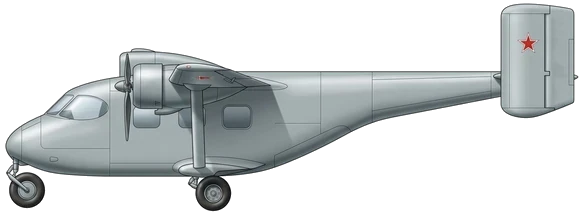
| Crew | 2 |
| Length | 11.4 m (37.3 ft) |
| Wingspan | 22.0 m (72.1 ft) |
| Height | 4.6 m (15.2 ft) |
| Wing area | 39.7 m² (427.5 sqft) |
| Empty weight | 2,600 kg (5,732 lbs) |
| Max. takeoff weight | 3,600 kg (7,937 lbs) |
| Powerplant | 2 × piston engines Ivchenko AI-14RF 224 kW each |
| Maximum speed | 210 km/h (130 mph) |
| Operational range | 650 km (404 mi) |
| Service ceiling | 5,000 m (16,404 ft) |
Description
The Antonov An-14 Pchelka ("Little Bee"; Ukrainian: Bdzhilka; NATO reporting name: Clod) is a Soviet twin-engined light STOL utility transport designed by Antonov. It first flew on 15 March 1958, and the production An-14A entered service with Aeroflot and the Soviet Air Force from the mid-1960s. The aircraft is known for its stable flight characteristics, which allowed most pilots to fly it after a few hours of basic training. It was intended to replace the An-2 biplane but did not do so.
Development
The design requirement called for an easily flown aircraft for light passenger and cargo transport, agricultural work, and air ambulance duties. Aeroflot planned to introduce the type in 1959. Development was delayed by problems with the An-14 prototype and by work on the Antonov An-10, which occupied the whole Antonov OKB. The An-14A entered production at state aircraft factory No. 166 in Arsenyev in 1965. Some accounts give 1966 as the start of serial production. Compared with the prototype, the production aircraft had revised wings, a distinctly V-shaped tailplane, and modified vertical stabilizers. The type was shown at the 1967 Domodedovo air show. Sources differ on total output: one gives about 300 aircraft built by 1972, and another gives 332 by 1976. Production ended because the type could not replace the An-2, which remained in production until 2001.
Design
The An-14 is a strut-braced high-wing monoplane with an all-metal semi-monocoque fuselage. The wing has automatic leading-edge slats and split flaps, a span of 21.99 m, and an aspect ratio of 12.15:1. Twin vertical stabilizers sit on the tailplane tips in the propeller slipstream. The original variant has fixed tricycle landing gear, with the main units mounted on short sponsons, and skis can be fitted for winter use. All variants except the An-14M are powered by two 220 kW (300 hp) Ivchenko AI-14RF nine-cylinder air-cooled radial engines driving three-bladed variable-pitch propellers.
The cabin measures 3.1 × 1.53 × 1.6 m and has a rear cargo door with an opening of 0.85 × 1.90 m. It holds seven passengers or 600 kg of freight, and the specification data give 6–8 passengers or a 720 kg payload. The agricultural fit adds a 1,000-litre tank and spraying booms. The ambulance version carries six stretchers and one nurse, and a VIP version seats five. Maximum take-off weight is 3,600 kg, maximum speed is 210 km/h, cruise speed is 180 km/h, and range is 650 km. The take-off run is 100–110 m and the landing run is 110 m.
Operational History
Fifteen An-14s were exported. East Germany received four in 1966. They flew with Verbindungsfliegerstaffel 25, a liaison squadron at Strausberg, which was renamed VS-14 in 1971, until 1980 or 1981. Two of these aircraft, 995 and 996, are preserved at the German Air Force Museum and the Airport Museum Cottbus. Other operators were:
- Afghan Air Force: 12 aircraft from 1985 to 1991.
- Mongolian People's Air Force: two aircraft from the early 1970s through the 1980s.
- Military of Guinea.
- Balkan Bulgarian Airlines.
- Letalski center Maribor in Yugoslavia, whose YU-BCD crashed in 1967.
A small number of An-14s remain airworthy.
Variants
- An-14A: Production version with revised wings, a V-shaped tailplane, and modified vertical stabilizers.
- An-14B: Variant fitted with retractable landing gear.
- An-14M: Turboprop-powered development, first flown in 1969 with a stretched fuselage and high-lift wing, which led to the Antonov An-28.
- An-14Sh: Testbed for an air-cushion landing gear, which worked but degraded aerodynamics and left little payload capacity.
- An-714: Precursor of the An-14Sh, fitted with inflatable floats.
Frequently Asked Questions
What type of aircraft is the An-14 Clod?
What is the maximum speed of the An-14 Clod?
What is the range of the An-14 Clod?
When did the An-14 Clod first fly?
How many An-14 Clod have been built?
Which countries operate the An-14 Clod?
What is the service ceiling of the An-14 Clod?
- OCT 12026 Created Page created: An-14 Clod