Mongolia Military Forces
Open-source order of battle for 2026: 9,700 active troops, 22 aircraft, 1,866 ground vehicles.
Armed Forces in 2026
| Domain | Strength | Composition |
|---|---|---|
| Air Force | 22 aircraft | 10 combat 6 helicopters |
| Ground Forces | 1,866 vehicles | 420 main battle tanks |
| Personnel | 9,700 active | 137,000 reserve 7,500 paramilitary |
ARMS Index (Aggregate Rating of Military Strength)
Full ranking →| Pillar | Weight | Score | Basis |
|---|---|---|---|
| Manpower | 15% | 63.9 | Active, reserve & paramilitary personnel |
| Ground forces | 20% | 57.8 | Tanks, armor & artillery weighted by type |
| Naval power | 20% | 0.0 | Weighted by hull type: carrier tiers, nuclear vs conventional submarines |
| Air power | 25% | 26.8 | Weighted by aircraft type and fleet age |
| Nuclear deterrent | 10% | 0.0 | No declared nuclear capability |
| Defense budget | 10% | 20.6 | Annual spending, purchasing-power adjusted |
| Readiness | modifier | ×0.95 | Budget per soldier: proxy for training, maintenance & technology |
Country File
| Population | 3.5M (2024) |
| GDP | $23.8 billion (2024) |
| GDP per capita | $6,751 |
| Military budget | $167M (2024) |
| Share of GDP | 0.7% (2024) |
| Military spending per capita | $47 (2024) |
| Inflation rate | 6.2% (2024) |
| Capital | Ulaanbaatar |
| Region | Asia |
| Land area | 1,553,556 km² |
| Land borders | 8,220 km |
| Bordering countries | 2 |
| Currency | MNT |
Strategic Overview in 2026
Strategic Position
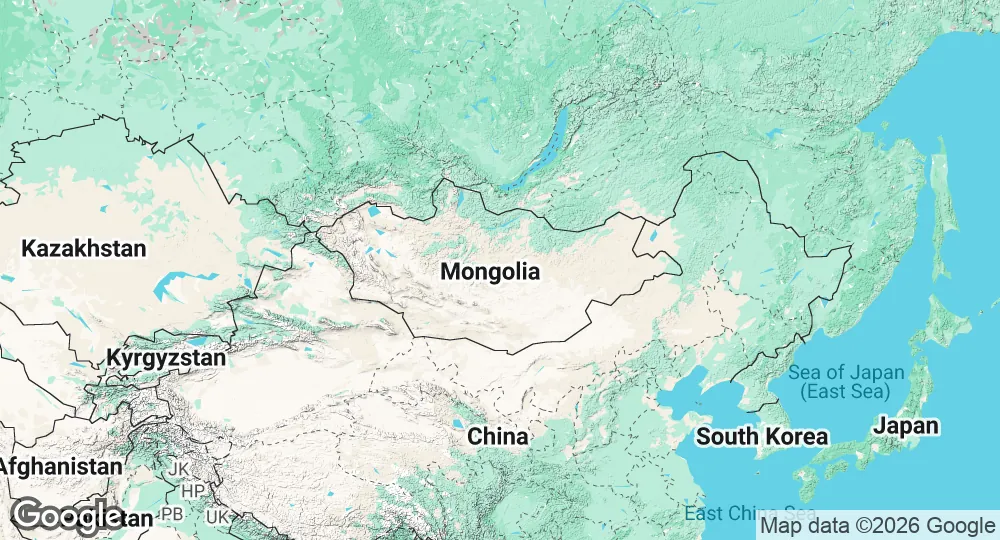
Mongolia’s defense posture is defined by its landlocked geography between the Russian Federation and the People's Republic of China. National security policy operates through a "Third Neighbor" strategy, which seeks to balance the influence of its immediate neighbors by cultivating security and diplomatic partnerships with distant powers, including the United States, Japan, South Korea, India, and the European Union.
Mongolia maintains a status as a NATO Global Partner. In 2024, the relationship transitioned to an Individually Tailored Partnership Programme (ITPP), focusing on interoperability, cybersecurity, and maritime-free logistics. While Mongolia remains an observer to the Shanghai Cooperation Organisation (SCO), it has resisted full membership to preserve its neutral diplomatic flexibility.
Despite its pro-Western outreach, Mongolia maintains pragmatic military cooperation with its neighbors. In September 2025, Mongolia participated in "Border Defense 2025," the first tripartite military exercise with Russia and China conducted along the Manzhouli frontier. This exercise focused on joint reconnaissance and drone surveillance, reflecting a policy of maintaining stable borders through direct engagement with Moscow and Beijing.
Military Forces
The Mongolian Armed Forces (MAF) are organized under the General Staff and divided into four primary components: the Ground Force, the Air Force, the Construction and Engineering Forces, and the Cyber Security Forces. Paramilitary support is provided by the State Border Guard and the Internal Troops, both under the Ministry of Justice and Internal Affairs. Personnel levels consist of approximately 10,000 active-duty troops supported by 130,000 reservists.
- Ground Force: The largest branch utilizes a mechanized fleet largely comprised of Soviet-legacy equipment. Primary maneuver assets include T-72 and T-54/55 main battle tanks. Armored transport is provided by BMP-1 infantry fighting vehicles and various BTR-series wheeled carriers, including BTR-60, BTR-70, and BTR-80 models. Artillery capabilities center on BM-21 Grad multiple launch rocket systems and towed D-30 howitzers.
- Air Force: Aerial assets are geared toward transport and border surveillance rather than offensive operations. The inventory includes Su-30SM and MiG-29UB multirole aircraft. The rotary-wing fleet consists of Mi-8/17 transport helicopters and Mi-24 attack helicopters. Ground-based air defense is maintained through modernized S-125 Pechora-2M surface-to-air missile systems. In February 2025, the force integrated a new air traffic control radar system provided by Japan to enhance airspace management.
- Specialized Capabilities: Specialized units include the 150th and 311th Peacekeeping Battalions, which are the primary contributors to international missions. The Cyber Security Forces, bolstered by a NATO-supported center, manage incident response and defense of critical military infrastructure.
Defense Industry
Mongolia lacks a comprehensive domestic arms industry and remains heavily reliant on Russia and China for major platforms. However, the state has initiated programs to improve self-sufficiency in small-scale manufacturing. In September 2025, Mongolia launched a domestic ammunition cartridge production line in collaboration with the Turkish firm MKE. Domestic efforts also include the small-scale assembly of light armored vehicles and the production of tactical unmanned aerial vehicles (UAVs) for border reconnaissance. Maintenance and refurbishment of Soviet-era hardware are conducted at the 311th Military Repair Plant.
Strategic Trends
The primary doctrinal focus of the MAF is international peacekeeping, which serves as a vehicle for professionalization and foreign policy engagement. Mongolia hosted the 22nd iteration of the Khaan Quest multinational exercise in June 2025, involving participants from over 20 countries. This exercise emphasizes United Nations (UN) peacekeeping standards and civil-military coordination.
Modernization priorities are currently focused on surveillance and niche technologies rather than heavy platform replacement. Procurement trends emphasize the acquisition of tactical drones, mobile radar units, and secure communication systems. Defense spending is estimated at approximately 0.6% to 1.0% of GDP in 2025. Constraints facing the military include a limited procurement budget, a high dependence on foreign fuel and spare parts, and the logistical challenges of monitoring over 8,000 kilometers of border with a small active-duty force. Future force structure shifts likely involve the continued expansion of the Construction and Engineering Forces to support national infrastructure projects.
Frequently Asked Questions
How large is Mongolia's military?
What is Mongolia's defense budget?
How does Mongolia rank militarily in the world?
Does Mongolia have nuclear weapons?
How many aircraft does Mongolia's air force have?
How many tanks does Mongolia have?
What percentage of GDP does Mongolia spend on defense?
What is Mongolia's military personnel per capita?
Does Mongolia have paramilitary forces?
Military Expenditure: CIA World Factbook. Last updated on 4 August 2026. Suggest a change
- AUG 42026 Updated Global Military Index updated in a site-wide editorial pass
- AUG 32026 Updated Global Military Index updated
- JUL 162026 Updated Global Military Index updated in a site-wide editorial pass
- JUN 162026 Updated Yearly statistics, military spending and 2 more fields updated
- JAN 172026 Updated Main battle tank count and Global Military Index updated
- JAN 132026 Updated Description added