B-21 Raider
Summary
| Category | Bombers |
| Origin country | 🇺🇸 United States |
| Manufacturer | Northrop Grumman |
| First flight | 10 November 2023 |
| Year introduced | 2027 |
| Number produced | 3 units |
| Average unit price | $700 million |
Technical specifications
| Version: B-21 | |
|---|---|
| Crew | 2 |
| Operational range | 9,600 km (5,965 mi) |
| Maximum speed | 1050 km/h (652 mph) |
| Wingspan | 40 m (131.2 ft) |
| Length | 16 m (52.5 ft) |
| Service ceiling | 15,000 m (49,213 ft) |
| Empty weight | 31,751 kg (69,999 lbs) |
| Max. takeoff weight | 81,647 kg (180,001 lbs) |
| Powerplant | 2 x Pratt & Whitney PW9000 non-afterburning turbofans delivering 12240 kgf each |
Current operating countries
| Country | Units | ||
|---|---|---|---|

|
United States | 3 (+97) | |
All operators
1 recent event involving the B-21 Raider
| Date | Air Force | Aircraft | Active Δ | Ordered Δ |
|---|---|---|---|---|
| 12 Sep 2025 | 🇺🇸 United States Air Force | B-21 | +1 | — |
| Second B-21 Raider test aircraft flown from Palmdale to Edwards AFB for test campaign. Details → | ||||
Description
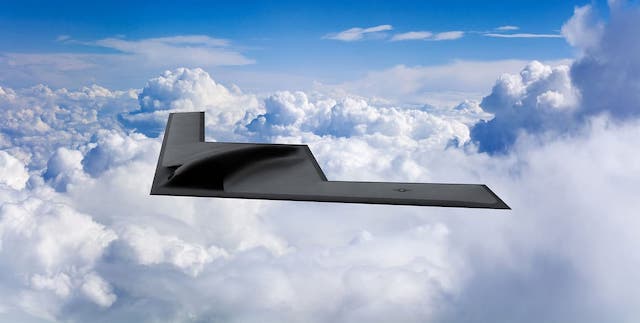
The Northrop Grumman B-21 Raider is an American strategic bomber conceived within the Long Range Strike Bomber (LRS-B) program, initiated in 2011, to develop a stealthy, intercontinental platform capable of delivering both conventional and thermonuclear weapons. Developed by Northrop Grumman, with key contributions from tier-one suppliers including Pratt & Whitney for engines, BAE Systems, Spirit AeroSystems, Orbital ATK, Rockwell Collins, GKN Aerospace, and Janicki Industries, the aircraft is intended to replace the Rockwell B-1 Lancer and Northrop B-2 Spirit by 2040, and potentially the Boeing B-52 Stratofortress thereafter. The Air Force commenced planning in 2011, issuing a request for proposal in July 2014 and awarding the development contract to Northrop Grumman in October 2015, a decision upheld by the Government Accountability Office in October 2016 following bid protests from a Boeing-Lockheed Martin team, with cost being the deciding factor. The B-21, so designated as the 21st century's first bomber and named "Raider" in September 2016 to honor the Doolittle Raiders, achieved its critical design review in December 2018. The first aircraft was publicly unveiled on December 2, 2022, followed by its maiden flight on November 10, 2023. A low-rate initial production contract was awarded in January 2024. By September 2024, three airworthy B-21s were engaged in program testing, with assembly occurring at United States Air Force Plant 42. Initial plans suggest an order of 100 aircraft, potentially expanding to a fleet of 175 to 200.
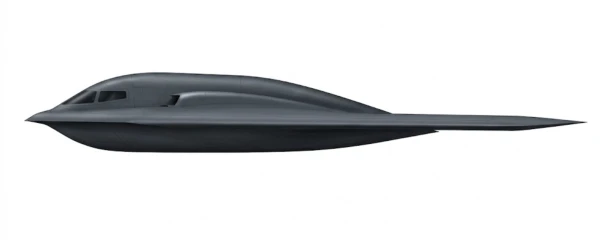
The B-21 Raider incorporates advanced stealth characteristics, central to its design as an intercontinental strategic bomber. Aerodynamically, initial renderings and observations suggest an aircraft smaller and lighter than its predecessor, the B-2 Spirit, featuring distinctive flush and blended air inlets and a two-wheel main landing gear configuration. The cockpit windows are uniquely designed to eliminate joints and seams, thereby minimizing its radar cross-section. While specific construction materials remain largely classified, a specialized coatings facility indicates the use of advanced stealth coatings. The Raider is described by Northrop Grumman as the world's first sixth-generation aircraft and by Air Force officials as a fifth-generation global precision attack platform with networked sensor-shoot capability. Its internal operations are reported to be significantly more advanced than those of the B-2, featuring a modular, open systems architecture to facilitate upgrades and potentially enable the export of components. Support for the B-21 will leverage a cloud-based digital twin for operations and sustainment. Early reports also indicated the bomber might function as an intelligence collection platform and a battle manager.
The B-21 Raider is designed to deliver a versatile array of armaments, including both conventional and thermonuclear weapons. Its payload is accommodated within a main internal weapons bay, which has a reported capacity of 20,000 pounds (9,100 kilograms). Among the specific munitions the B-21 is slated to carry are the AGM-181 Long Range Stand Off cruise missile and various bombs from the Joint Direct Attack Munition family.
Currently in low-rate initial production and undergoing extensive testing, the B-21 Raider has not yet been operationally deployed. The United States Air Force is the primary user, with plans to acquire at least 100 aircraft to replace its B-1 Lancer and B-2 Spirit bomber fleets by 2040, and potentially the B-52 Stratofortress fleet in the more distant future. Maintenance and sustainment will be coordinated by Tinker Air Force Base, Oklahoma, while Edwards Air Force Base, California, leads testing and evaluation. Ellsworth Air Force Base, South Dakota, has been selected to host the first operational B-21 unit and the initial training unit, with other potential operating locations including current heavy bomber bases such as Dyess Air Force Base, Texas, and Whiteman Air Force Base, Missouri. The program is focusing on Indo-Pacific operations, viewing the B-21 as a critical platform. There has been some international interest, notably from Australia, whose Royal Australian Air Force expressed interest under the AUKUS collaboration, although a 2023 Australian Defence Strategic Review did not recommend its acquisition at that time.