B-2 Spirit
American stealth bomber, operational since the late 20th century, notably deployed in Kosovo, Afghanistan, and Iraq conflicts. Key figures: top speed 972 km/h, range 11,000 km, service ceiling 15,240 m, max takeoff weight 170,200 kg, unit price $750M, built 21. In service with 1 air force as of 2026 — United States (20).

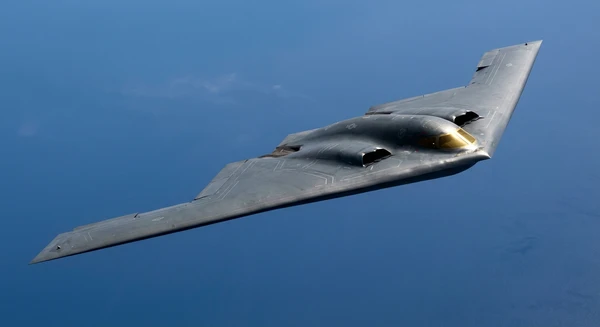
| Crew | 2 |
| Length | 21 m (68.9 ft) |
| Wingspan | 52 m (170.6 ft) |
| Height | 5 m (16.4 ft) |
| Wing area | 478 m² (5145.1 sqft) |
| Empty weight | 71,668 kg (158,001 lbs) |
| Max. takeoff weight | 170,200 kg (375,226 lbs) |
| Powerplant | 4 × turbofans General Electric F118-GE-100 7,847 kgf each |
| Ejection seat | McDonnell Douglas ACES II |
| Maximum speed | 972 km/h (604 mph) |
| Operational range | 11,000 km (6,835 mi) |
| Endurance | 12 hours |
| Service ceiling | 15,240 m (50,000 ft) |

- Thermonuclear B61
- Guided Boeing GBU-57A/B
- Thermonuclear Livermore B83
- Low-Drag Mk 82
- Low-Drag Mk 84


Description
The Northrop Grumman B-2 Spirit is an American subsonic stealth strategic bomber operated solely by the United States Air Force. A four-engined flying wing with a crew of two, it was built to penetrate dense air defenses with conventional or thermonuclear weapons. It entered service in 1997 and remains the only acknowledged in-service aircraft able to carry large air-to-surface standoff weapons in a stealth configuration.
Development
Development began in 1979 under the Advanced Technology Bomber (ATB) black project, following DARPA stealth work that produced Lockheed's Have Blue and Northrop's Tacit Blue demonstrator. Northrop's "Senior Ice" design was selected over the Lockheed/Rockwell "Senior Peg" proposal on 20 October 1981. Boeing, Hughes Aircraft, General Electric Aviation and Vought were principal subcontractors. A mid-1980s change from high-altitude to low-altitude terrain-following profiles delayed first flight by two years and added about US$1 billion. The aircraft was publicly displayed at Palmdale on 22 November 1988 and first flew on 17 July 1989. Planned procurement fell from 132 aircraft to 75, then to 20 under a 1992 decision by President Bush; a 21st test airframe was converted to Block 30 standard in 1996 for nearly $500 million. Total program cost reached US$44.7 billion, averaging US$2.13 billion per aircraft. Production ran from 1988 to 2000.
Design
The B-2 has no fuselage or vertical tail, using split brake-rudders and differential thrust for directional control via a quadruplex fly-by-wire system; pitot-static sensing plates replace conventional pitot tubes. Four non-afterburning General Electric F118-GE-100 turbofans of 17,300 lbf each are buried in the wing, with boundary-layer air mixed into the exhaust to reduce infrared signature. Wingspan is 172 ft (52.4 m), service ceiling 50,000 ft, and unrefueled range about 6,900 mi (11,000 km). The airframe is mostly carbon-graphite composite with radar-absorbent materials; radar cross-section is reported at about 0.1 m². Avionics include the AN/APQ-181 low-probability-of-intercept radar, later converted to an AESA, the NAS-26 astro-inertial navigation system, GPS, and a Defensive Management System. Each aircraft is housed in a climate-controlled hangar costing about US$5 million.
Armament
Two internal bays carry ordnance on rotary launcher assemblies or bomb rack assemblies, with an official limit of 40,000 lb (18,000 kg); 60,000 lb has been carried operationally. Loadouts include 80 Mk 82 or GBU-38 500 lb bombs, 16 Mk 84 or GBU-31 2,000 lb bombs, 16 B61 or B83 nuclear bombs, 36 CBU-class bombs, and 16 AGM-154 JSOW, AGM-158 JASSM/JASSM-ER or AGM-158C LRASM. Two 30,000 lb GBU-57 Massive Ordnance Penetrators can be carried, one per bay. The GPS-Aided Targeting System uses the APQ-181 to map targets for JDAM release.
Operational History
The first aircraft, Spirit of Missouri, was delivered to Whiteman AFB on 17 December 1993, with initial operational capability on 1 January 1997. Combat debut came in the 1999 Kosovo War, where six B-2s flew 30-hour round trips from Missouri and dropped 11 percent of NATO's bombs; one struck the Chinese Embassy on 7 May 1999. Subsequent operations covered Afghanistan, Iraq, Libya in 2011 and 2017, and Yemen in October 2024. On 22 June 2025, seven B-2s dropped 14 GBU-57s on the Fordow and Natanz nuclear sites. Forward operating locations include Diego Garcia, Andersen AFB and RAF Fairford. One aircraft was lost at Andersen AFB on 23 February 2008; another was damaged in December 2022 and divested. Nineteen remain in service, with retirement planned by 2032 as the B-21 Raider enters service.
Frequently Asked Questions
What type of aircraft is the B-2 Spirit?
What is the maximum speed of the B-2 Spirit?
What is the range of the B-2 Spirit?
When did the B-2 Spirit first fly?
How many B-2 Spirit have been built?
Which countries operate the B-2 Spirit?
How much does a B-2 Spirit cost?
What is the service ceiling of the B-2 Spirit?
- AUG 302026 Updated Description updated
- AUG 52026 Updated Powerplant updated in a site-wide editorial pass
- JUL 232026 Updated Sources and cross-references refreshed
- APR 72026 Updated Sources and cross-references refreshed
- FEB 72026 Updated Endurance added
- JAN 122026 Updated Range updated in a site-wide editorial pass