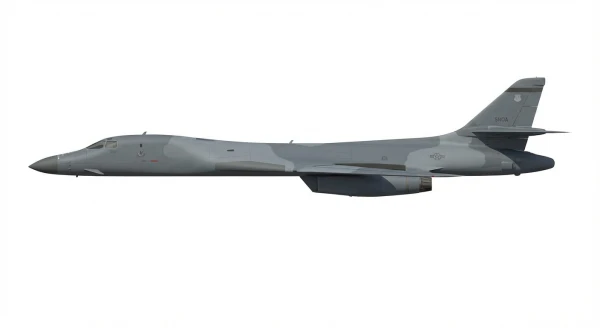
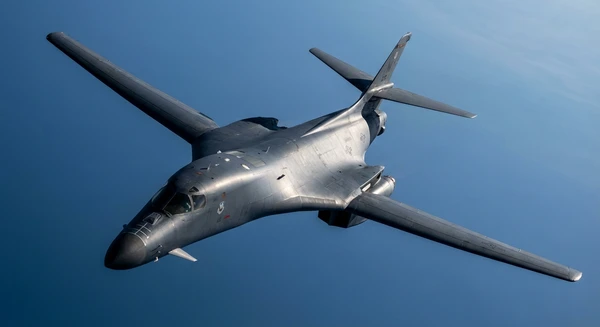
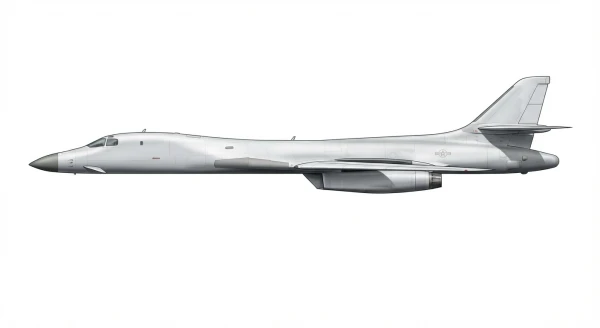
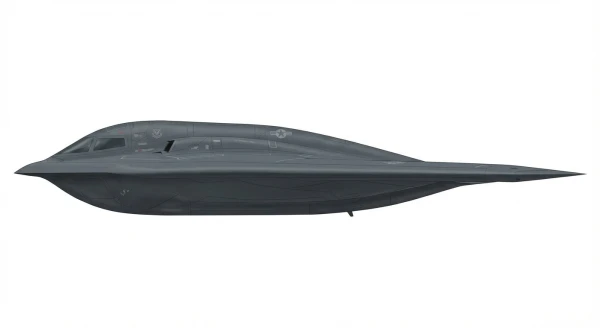
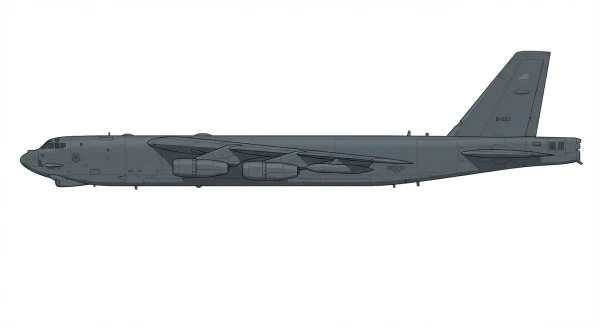
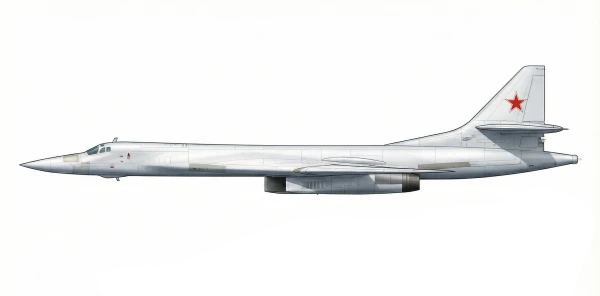
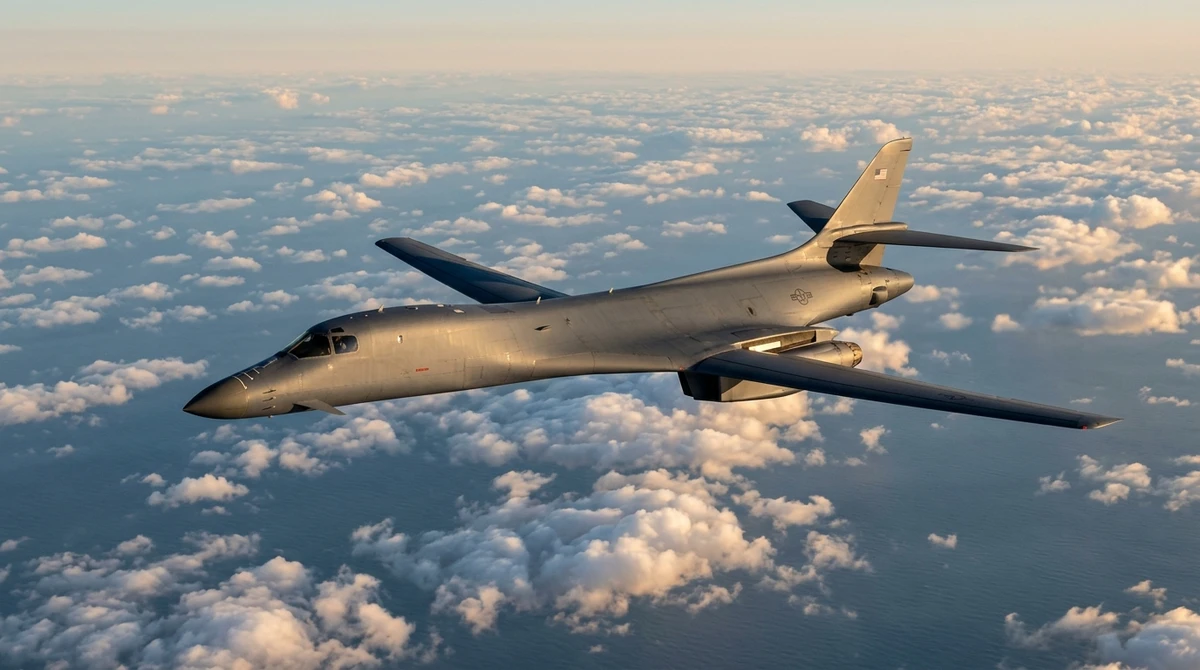
The Rockwell B-1B Lancer is a supersonic variable-sweep wing heavy bomber operated by the United States Air Force. Developed from the cancelled B-1A, it entered service with Strategic Air Command in 1986 as a nuclear bomber, was converted to conventional roles in the 1990s, and remains one of three USAF strategic bomber types alongside the B-2 Spirit and B-52 Stratofortress. It is known by the nickname "Bone" and carries up to 75,000 lb (34,000 kg) of internal ordnance.
Development
The programme originated in 1960s studies for a bomber combining the Mach 2 speed of the B-58 Hustler with the range and payload of the B-52, passing through the SLAB, ERSA, AMPSS and AMSA studies. North American Rockwell won the development contract in June 1970; the B-1A prototype (74-0158) first flew on 23 December 1974. President Carter cancelled the programme on 30 June 1977 in favour of the AGM-86 ALCM and the Advanced Technology Bomber, though flight testing continued to April 1981 across 70 flights and 378 hours, with a top speed of Mach 2.22 recorded. Reagan restarted the programme on 2 October 1981 with an order for 100 aircraft, and Rockwell received two contracts worth $2.2 billion in January 1982. The first production B-1B flew on 18 October 1984; the 100th and last was delivered on 2 May 1988. Boeing acquired Rockwell's defence operations in 1996 and remains prime contractor.
Design
The B-1B has a blended wing body with wings sweeping from 15 to 67.5 degrees, four General Electric F101-GE-102 afterburning turbofans of 30,780 lbf each, and a cruciform tail. Maximum speed is Mach 1.25 at altitude and Mach 0.92 at low level; maximum takeoff weight is 477,000 lb (216,364 kg). Fixed intake ramps, serpentine S-ducts and radar-absorbent material reduce radar cross-section to roughly 2.4 m², about one-fiftieth that of the B-52. The Structural Mode Control System uses triangular nose vanes and the lower rudder to damp low-altitude turbulence. Avionics centre on the IBM AP-101 computer, AN/APQ-164 passive electronically scanned array radar with SAR, GMTI and terrain-following modes, AN/ALQ-161A defensive suite, AN/ALQ-153 missile warning and AN/ALE-49 flare dispensers. The Sniper XR targeting pod was fielded in 2008, and the Integrated Battle Station upgrade was completed in 2020.
Armament
Three internal bomb bays hold 75,000 lb of ordnance and six external hardpoints carry a further 50,000 lb. Munitions include Mk-82, Mk-84, GBU-31 and GBU-38 JDAM, GBU-54 Laser JDAM, CBU-87/89/97 and WCMD cluster munitions, Mk-62 and Mk-65 mines, AGM-154 JSOW, AGM-158 JASSM and AGM-158C LRASM. B61 and B83 nuclear weapons were carried until nuclear capability was removed by 1995; New START conversions were completed in 2011.
Operational History
First combat use came during Operation Desert Fox in December 1998, followed by Operation Allied Force in 1999. Eight B-1s dropped nearly 40 percent of aerial ordnance in the first six months of Operation Enduring Freedom, including some 3,900 JDAMs. B-1s struck Libyan targets in Operation Odyssey Dawn in March 2011 and flew against Islamic State from 2014, dropping 660 bombs over five months during the Battle of Kobane. On 14 April 2018 B-1s launched 19 JASSM against targets in Syria. All aircraft transferred to Air Force Global Strike Command in October 2015; 45 remain in service.
Variants
- B-1A: Original design with variable intakes and Mach 2.2 top speed; four prototypes built, no production.
- B-1B: Production version with reduced radar signature, Mach 1.25 top speed and low-level penetration optimisation; 100 built.
- B-1R: Proposed 2004 upgrade with AESA radar, air-to-air missiles and F119 engines for Mach 2.2 but 20 percent less range.