B-21 Raider vs Tu-160 Blackjack
B-21 Raider vs Tu-160 Blackjack at a glance — top speed 1,050 vs 2,220 km/h, range 9,600 vs 12,300 km, max takeoff weight 81,647 vs 274,877 kg, built 3 vs 37 units.

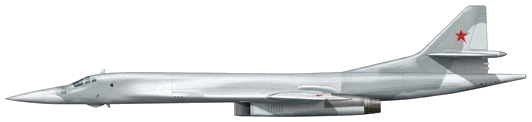
| B-21 Raider | Tu-160 Blackjack | |
|---|---|---|
| Origin country | 🇺🇸 United States | 🇷🇺 Ex-USSR |
| Category | Bombers | Bombers |
| Manufacturer | Northrop Grumman | Tupolev |
| First flight | 10 November 2023 | 19 December 1981 |
| Year introduced | 2027 | 1987 |
| Number produced | 3 units | 37 units |
| Average unit price | $700 million | $250 million |
| Wing area | -- m² | 232.0 m² |
| Wingspan | 40.0 m | 55.7 m |
| Height | -- m | 13.1 m |
| Length | 16.0 m | 54.1 m |
| Maximum speed | 1050 km/h | 2220 km/h |
| Operational range | 9,600 km | 12,300 km |
| Service ceiling | 15,000 m | 16,000 m |
| Max. takeoff weight | 81,647 kg | 274,877 kg |
| Empty weight | 31,751 kg | 109,769 kg |
| Total thrust | 2 x 12,240 kgf | 4 x 24,983 kgf |
Detailed Comparison
The Northrop Grumman B-21 Raider and the Tupolev Tu-160 Blackjack execute fundamentally opposed strategic doctrines: broadband stealth and sensor networking versus kinematic performance and standoff mass.
Development and Design
The Tu-160 utilizes a variable-sweep wing design that optimizes low-speed loitering and high-altitude supersonic dash. Originating in the late 1970s as a response to the American B-1 program, production was severely disrupted by the Soviet collapse, yielding only 37 airframes. Russia recently restarted production of an upgraded Tu-160M standard, relying on traditional titanium structures and physical mass.
Conversely, the B-21 emerged from the 2011 Long Range Strike Bomber (LRS-B) program. Northrop Grumman built the airframe around a modular open systems architecture and a cloud-based digital twin to facilitate rapid software integration. The B-21's design centers on a flying wing planform, flush inlets, and radar-absorbent coatings to defeat VHF and UHF early warning radars, eliminating the physical seams that compromise traditional airframes.
Specifications and Performances
The Tu-160 dwarfs the B-21 in physical scale. At 274,877 kg maximum takeoff weight, the Blackjack is more than three times heavier than the Raider (81,647 kg) and carries a payload of 40,000 kg internally compared to the B-21's 9,100 kg limit. The Blackjack’s four Kuznetsov NK-32 engines generate sufficient thrust to reach 2,220 km/h, dictating a strike profile based on rapid transit to standoff launch coordinates.
The B-21 trades kinetic performance for survivability. Its two non-afterburning Pratt & Whitney PW9000 turbofans restrict it to subsonic speeds (1,050 km/h). This limitation manages the aircraft's thermal signature and improves loiter efficiency inside hostile airspace. The Blackjack outranges the Raider unrefueled (12,300 km versus 9,600 km), aligning with Russian doctrine that relies on deep sanctuary basing.
Deployment and usage
The Tu-160 saw its combat debut in 2015 during Russian operations in Syria, launching Kh-555 and Kh-101 cruise missiles. Russian Aerospace Forces currently utilize the Tu-160 in the Ukraine conflict to execute standoff strikes against infrastructure from deep within Russian airspace, remaining entirely outside the engagement envelopes of Ukrainian surface-to-air missiles.
The B-21 is in low-rate initial production, with three airframes undergoing testing at Edwards Air Force Base. US Air Force doctrine assigns the B-21 a role beyond munitions delivery. Positioned for Indo-Pacific operations, the platform will function as a forward-deployed intelligence node and battle manager, networking with autonomous drones to penetrate Chinese anti-access/area denial (A2/AD) networks directly.
Conclusion
The Tu-160 holds the edge strictly as a standoff missile carrier. Its 40,000 kg payload and Mach 2 sprint capability allow it to rapidly position and launch high-volume cruise missile volleys from secure airspace. However, against a peer adversary utilizing modern integrated air defense systems, the B-21 Raider is the definitive asset. The Blackjack's massive radar and infrared signatures make it structurally incapable of penetrating contested airspace. The B-21’s synthesis of broadband stealth, sensor fusion, and the ability to drop direct-attack munitions inside denied envelopes provides a survivable first-strike capability that legacy supersonic bombers cannot replicate.

