Scottish Aviation Bulldog
Summary
| Category | Military Training Aircraft |
| Origin country | 🇬🇧 United Kingdom |
| Manufacturer | Scottish Aviation |
| First flight | 19 May 1969 |
| Year introduced | 1971 |
| Number produced | 328 units |
| Average unit price | $0.1 million |
Technical specifications
| Version: Bulldog 120 | |
|---|---|
| Operational range | 1,000 km (621 mi) |
| Maximum speed | 241 km/h (150 mph) |
| Wing area | 12 m² (129.2 sqft) |
| Wingspan | 10.1 m (33.2 ft) |
| Height | 2.7 m (9.0 ft) |
| Length | 7.1 m (23.2 ft) |
| Service ceiling | 4,877 m (16,001 ft) |
| Empty weight | 649 kg (1,431 lbs) |
| Max. takeoff weight | 1,066 kg (2,350 lbs) |
| Climb rate | 5.3 m/s (17.4 ft/s) |
| Powerplant | 1 x pistons engine Lycoming IO-360-A1B6 delivering 149 kW each |
Current operating countries
| Country | Units | ||
|---|---|---|---|

|
Lebanon | 3 | |
All operators
Description
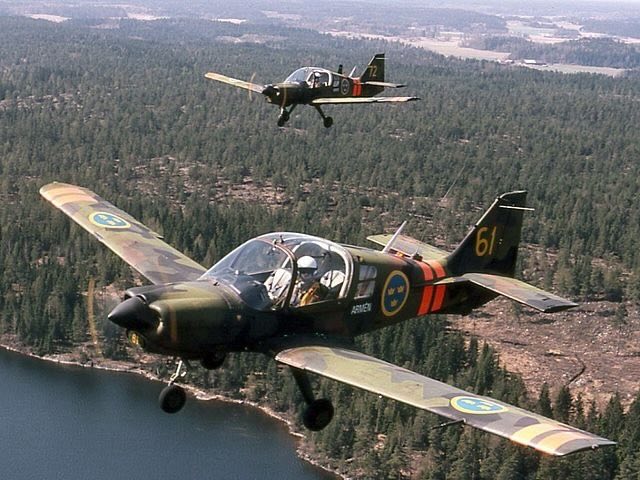
Originally designed by Beagle Aircraft as the B.125 Bulldog, the aircraft's development was spurred by the need for a robust and versatile two-seat trainer. The prototype Bulldog first took flight on 19 May 1969 at Shoreham Airport. Beagle Aircraft faced financial difficulties and ceased trading before production could commence. Scottish Aviation (Bulldog) Limited then acquired the production rights, along with an initial order for 78 aircraft from the Swedish Air Board. All subsequent Bulldogs were manufactured at Prestwick Airport, initially by Scottish Aviation and later by British Aerospace.
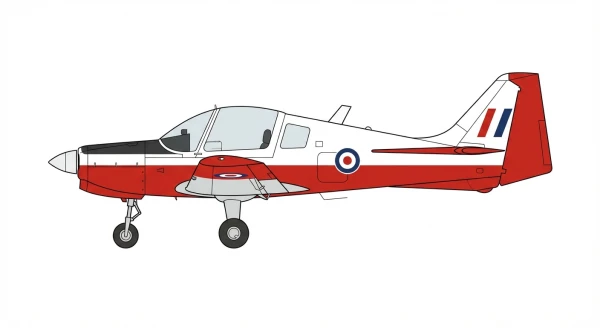
The Scottish Aviation Bulldog is a two-seat, side-by-side training aircraft, with an option for a third seat, designed for military training and general aviation roles. Constructed with conventional materials, it features a robust airframe designed to withstand the stresses of aerobatic maneuvers, with g limits of +6g and -3g. Its NACA 632615 airfoil contributes to stable flight characteristics and effective stall behavior. Equipped with a Lycoming IO-360-A1B6 engine, the Bulldog provides adequate power for training exercises and general flying. Some models, particularly the Bulldog 1210, were designed as light attack variants and could be fitted with four underwing hardpoints for optional armament. Armaments tested on company demonstrator aircraft included bombs up to 290 kg (640 lb), Matra pods with SNEB 68mm rockets, .30 in (7.62mm) machine guns, and other rocket types. While hardpoints were available, there was no provision for production weapons launch control systems. Weapons training was conducted on Bulldog trainers in Sweden, although the underwing hardpoints were never utilized in RAF service.
The Scottish Aviation Bulldog served in various roles across different nations. The first deliveries were to the Swedish Air Force in 1971, with these aircraft designated SK 61A and SK 61B, followed by additional aircraft for the Swedish Army as FPL 61C in 1972, later transferred to the Air Force and redesignated as SK 61C; all Swedish Bulldogs were withdrawn from military service by 2001. The Royal Air Force, the largest customer, began operating 130 Bulldogs as the Bulldog T.1 in 1975, using them for basic training, particularly within University Air Squadrons and Air Experience Flights. The Royal Navy also utilized the aircraft for Elementary Flying Training at RAF Topcliffe. The RAF sold its remaining Bulldog trainers in 2001, replacing them with the Grob Tutor. Some nations, such as Botswana, operated a light attack variant of the aircraft, equipped with underwing hard points, though the Bulldog was primarily used in a training capacity.
Main Variants:
-
Bulldog Series 1: The initial prototype built by Beagle Aircraft, followed by a second built by Scottish Aviation, serving as the foundation for subsequent models.
-
Bulldog Series 100: An export model for Sweden, designated SK 61 in the Swedish Air Force and FPL 61 in the Swedish Army.
-
Bulldog Model 121: This primary trainer variant was specifically designed for the Royal Air Force and designated the Bulldog T.1.
-
Bulldog Series 1210: An export model for Botswana and a light attack variant equipped with underwing hard points for potential armament.
-
Bulldog Series 200: A four-seat variant featuring a retractable undercarriage, also known as the Bullfinch in its civilian version.