Malaysia Military Forces
Open-source order of battle for 2026: 113,000 active troops, 149 aircraft, 97 warships, 1,055 ground vehicles.
Armed Forces in 2026
| Domain | Strength | Composition |
|---|---|---|
| Royal Malaysian Air Force | 149 aircraft | 25 combat 54 helicopters +32 on order |
| Royal Malaysian Navy | 97 warships | 4 major combatants 2 submarines |
| Ground Forces | 1,055 vehicles | 48 main battle tanks |
| Personnel | 113,000 active | 51,600 reserve 267,200 paramilitary |
Global Military Index
Full ranking →Log-scaled composite · sources: CIA World Factbook, World Bank, SIPRI, IISS and GMNET inventories · the world's strongest military scores 100 · full methodology.
| Pillar | Weight | Score | Basis |
|---|---|---|---|
| Manpower | 15% | 73.2 | Active, reserve & paramilitary personnel |
| Ground forces | 20% | 49.1 | Tanks, armor & artillery weighted by type |
| Naval power | 20% | 37.6 | Weighted by hull type: carrier tiers, nuclear vs conventional submarines |
| Air power | 25% | 40.7 | Weighted by aircraft type and fleet age |
| Nuclear deterrent | 10% | 0.0 | No declared nuclear capability |
| Defense budget | 10% | 45.1 | Annual spending, purchasing-power adjusted |
| Readiness | modifier | ×1.00 | Budget per soldier: proxy for training, maintenance & technology |
Country File
| Population | 35.6M (2024) |
| GDP | $422.2 billion (2024) |
| GDP per capita | $11,874 |
| Military budget | $4.2 billion (2024) |
| Share of GDP | 1.0% (2024) |
| Military spending per capita | $119 (2024) |
| Inflation rate | 1.83% (2024) |
| Capital | Kuala Lumpur |
| Region | Asia |
| Land area | 329,613 km² |
| Coastline | 4,675 km |
| Land borders | 3,147 km |
| Bordering countries | 3 |
| Currency | MYR |
Strategic Overview in 2026
Strategic Position
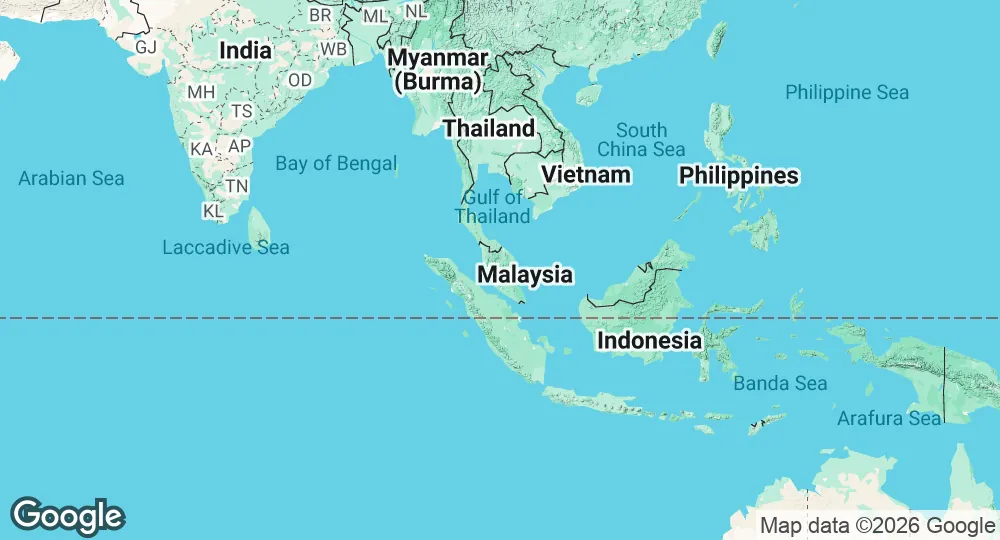
Malaysia’s defense posture is defined by its bifurcated geography, consisting of Peninsular Malaysia and the states of Sabah and Sarawak on the island of Borneo. This geography necessitates a maritime-centric security strategy focused on the Malacca Strait and the South China Sea. Primary security concerns include territorial disputes in the South China Sea, where Malaysia maintains claims over features in the Spratly Islands, and maritime security in the Sulu-Celebes Seas, characterized by threats of piracy, kidnapping, and cross-border militancy in Eastern Sabah.
Malaysia is a member of the Five Power Defence Arrangements (FPDA) alongside Singapore, Australia, New Zealand, and the United Kingdom, which provides a framework for multilateral defense cooperation and joint exercises. Regionally, Malaysia adheres to the ASEAN principle of non-alignment and maintains the General Border Committee with Indonesia and Thailand to manage land and maritime boundaries. Defense doctrine is guided by the National Defence Policy and the Defence White Paper, which emphasize "Comprehensive Defence" (HANRUH) and "Credible Deterrence," prioritizing the ability to operate simultaneously in two theaters—East and West Malaysia.
Military Forces
The Malaysian Armed Forces (Angkatan Tentera Malaysia - ATM) are organized into three primary branches under the Joint Force Headquarters. Active personnel number approximately 115,000, supported by a reserve force and paramilitary units such as the Malaysian Maritime Enforcement Agency (MMEA) and the Police Field Force.
The Malaysian Army (Tentera Darat Malaysia) is structured around four regional commands. Its armored capability consists of PT-91M Twardy main battle tanks and a variety of wheeled armored fighting vehicles, including the AV8 Gempita and AV4 Lipanbara. Artillery assets include 155mm self-propelled howitzers and the ASTROS II Multiple Launch Rocket System. The 10th Paratrooper Brigade serves as the primary rapid deployment force for domestic and regional contingencies.
The Royal Malaysian Navy (Tentera Laut Diraja Malaysia) operates under the "15-to-5" Transformation Program, which aims to consolidate the fleet into five classes: Littoral Mission Ships (LMS), Littoral Combat Ships (LCS), New Generation Patrol Vessels (NGPV), Scorpène-class submarines, and Multi-Role Support Ships (MRSS). The submarine force consists of Scorpène-class vessels based in Sepanggar, Sabah. Surface combatants include Lekiu-class and Kasturi-class frigates, as well as Kedah-class NGPVs and Keris-class LMS.
The Royal Malaysian Air Force (Tentera Udara Diraja Malaysia) maintains a mixed inventory of Western and Russian platforms. The combat fleet includes Su-30MKM and F/A-18D Hornet multirole fighters. In 2025, the force began integrating FA-50 Block 20 light combat aircraft to replace aging Hawk 108/208 airframes. Strategic airlift is provided by A400M Atlas and C-130 Hercules aircraft.
Specialized units include the Gerak Khas (Army), PASKAL (Navy), and PASKAU (Air Force). Cyber defense is managed by the Defence Cyber and Electromagnetic Division.
Defense Industry
The Malaysian defense industry focuses on land systems assembly, naval shipbuilding, and Maintenance, Repair, and Overhaul (MRO) services. DRB-HICOM Defence Technologies (DefTech) is the primary manufacturer of land vehicles, responsible for the production of the AV8 Gempita 8x8 armored vehicle. Boustead Heavy Industries Corporation (BHIC) manages major naval construction, including the Maharaja Lela-class Littoral Combat Ship program.
Aviation support is centered on AIROD, which provides MRO services for military transport and rotary-wing aircraft. While Malaysia remains reliant on foreign original equipment manufacturers (OEMs) for high-technology components and power plants, there is a domestic emphasis on co-production and technology transfer. Examples include the LMS Batch 2 program, which involves collaboration with Turkish shipbuilders for the delivery of Ada-class corvettes.
Strategic Trends
The 13th Malaysia Plan, commencing in 2026, guides current procurement and modernization priorities. The defense budget for 2025 and 2026 remains approximately 1% to 1.1% of GDP, with a focus on addressing the technological gap in maritime domain awareness and air defense. Modernization efforts prioritize the acquisition of Medium-Altitude Long-Endurance (MALE) Unmanned Aerial Systems (UAS) and long-range air defense radars to monitor the Exclusive Economic Zone (EEZ).
Force structure is shifting toward a more integrated joint-service model to better respond to "gray zone" activities in the South China Sea. Challenges include the fiscal constraints of maintaining a diversified inventory of Russian, American, and European platforms, which complicates logistics and lifecycle costs. Furthermore, the protracted timeline of the LCS program has led to a strategic emphasis on the LMS Batch 2 corvettes to provide immediate maritime patrol capability. Internal security focus remains high in Eastern Sabah via the Eastern Sabah Security Command (ESSCOM) to mitigate unconventional threats.
Malaysian Defense Manufacturing
Designed in MalaysiaFrequently Asked Questions
How large is Malaysia's military?
What is Malaysia's defense budget?
How does Malaysia rank militarily in the world?
Does Malaysia have nuclear weapons?
How many aircraft does Malaysia's air force have?
How large is Malaysia's navy?
How many tanks does Malaysia have?
What percentage of GDP does Malaysia spend on defense?
What is Malaysia's military personnel per capita?
Does Malaysia have submarines?
Does Malaysia have paramilitary forces?
Military Expenditure: CIA World Factbook. Suggest a change