Jordan Military Forces
Open-source order of battle for 2026: 100,500 active troops, 258 aircraft, 27 warships, 2,492 ground vehicles.
Armed Forces in 2026
| Domain | Strength | Composition |
|---|---|---|
| Royal Jordanian Air Force | 258 aircraft | 73 combat 120 helicopters 5 air bases +38 on order |
| Royal Jordanian Navy | 27 warships | |
| Ground Forces | 2,492 vehicles | 1,458 main battle tanks |
| Personnel | 100,500 active | 65,000 reserve 15,000 paramilitary |
ARMS Index (Aggregate Rating of Military Strength)
Full ranking →| Pillar | Weight | Score | Basis |
|---|---|---|---|
| Manpower | 15% | 68.8 | Active, reserve & paramilitary personnel |
| Ground forces | 20% | 62.3 | Tanks, armor & artillery weighted by type |
| Naval power | 20% | 14.0 | Weighted by hull type: carrier tiers, nuclear vs conventional submarines |
| Air power | 25% | 47.7 | Weighted by aircraft type and fleet age |
| Nuclear deterrent | 10% | 0.0 | No declared nuclear capability |
| Defense budget | 10% | 40.3 | Annual spending, purchasing-power adjusted |
| Readiness | modifier | ×0.97 | Budget per soldier: proxy for training, maintenance & technology |
Country File
| Population | 11.6M (2024) |
| GDP | $53.4 billion (2024) |
| GDP per capita | $4,618 |
| Military budget | $2.4B (2024) |
| Share of GDP | 4.5% (2024) |
| Military spending per capita | $208 (2024) |
| Inflation rate | 1.56% (2024) |
| Capital | Amman |
| Region | Asia |
| Land area | 88,802 km² |
| Coastline | 26 km |
| Land borders | 1,635 km |
| Bordering countries | 5 |
| Currency | JOD |
Strategic Overview in 2026
Strategic Position
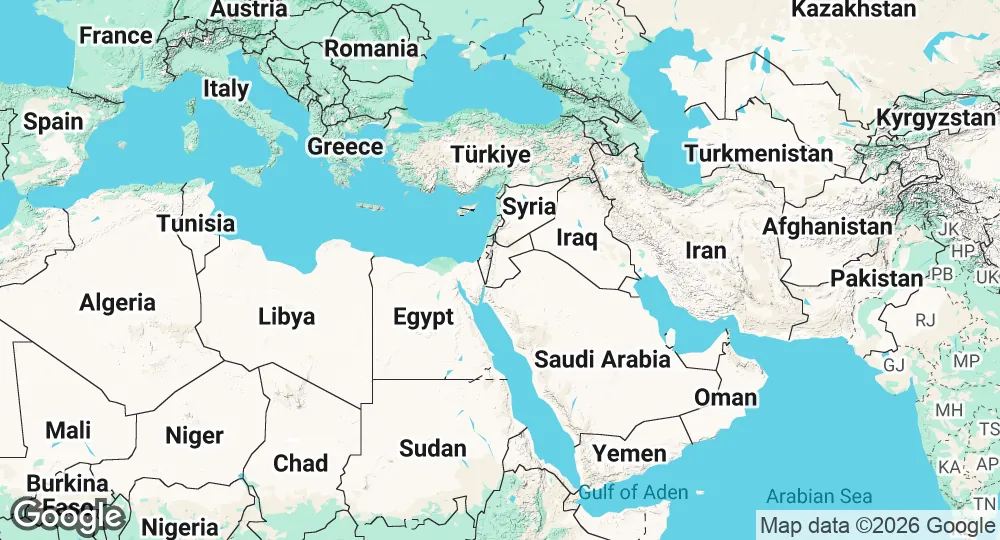
Jordan occupies a central position in the Levant, sharing borders with Israel, Syria, Iraq, and Saudi Arabia. Since 1996, the country has held Major Non-NATO Ally (MNNA) status with the United States. Its defense posture is defined by its role as a regional buffer and its reliance on bilateral security agreements, most notably the 2021 Defense Cooperation Agreement with the U.S., which facilitates the presence of American personnel and equipment on Jordanian territory.
Primary security concerns center on border integrity and regional spillover. In late 2025 and early 2026, the Jordanian Armed Forces (JAF) intensified operations along the northern frontier to counter drug and weapons smuggling syndicates originating in Syria. Jordan maintains a 1994 peace treaty with Israel and coordinates closely with Gulf Cooperation Council (GCC) members on regional security and counter-terrorism initiatives. Following the political shifts in Syria in late 2024 and 2025, Jordan reaffirmed its support for Syrian territorial integrity while conducting precision airstrikes against extremist elements in January 2026.
Military Forces
The Jordanian Armed Forces, officially known as the Arab Army, are under the supreme command of the King. The force is managed by the Chairman of the Joint Chiefs of Staff. Personnel levels are approximately 100,000 active duty members, supported by 60,000 reserves and 15,000 paramilitary forces within the Gendarmerie.
Royal Jordanian Army: The army is organized into four regional commands: Northern, Eastern, Central, and Southern. It operates a mix of Western-origin armor and mobile platforms. The inventory includes M60A3 main battle tanks and Centauro tank destroyers. Infantry units utilize M113 armored personnel carriers and a variety of Mine-Resistant Ambush Protected (MRAP) vehicles. Artillery support is provided by M109 self-propelled howitzers and HIMARS rocket systems.
Royal Jordanian Air Force (RJAF): The RJAF is the primary instrument for border surveillance and regional strike missions. It operates F-16 Fighting Falcons as its primary combat aircraft. Transport and utility requirements are met by C-130 Hercules and UH-60 Black Hawk fleets. The attack helicopter component includes AH-1 Cobra and MD530 platforms. In 2025, the RJAF increased its integration of unmanned aerial vehicles (UAVs) for long-endurance border monitoring.
Royal Jordanian Navy: A coastal force based in Aqaba, the navy operates patrol craft and rigid-hull inflatable boats to secure Jordan’s access to the Red Sea and maintain presence in the Dead Sea.
Specialized Units: The King Abdullah II Special Operations Group (KASOG) is a specialized unit focused on counter-terrorism and unconventional warfare. Jordan also hosts the King Abdullah II Special Operations Training Center (KASOTC), a facility used for international training and the annual Warrior Competition.
Defense Industry
The Jordan Design and Development Bureau (JODDB), formerly known as KADDB, serves as the primary domestic arms manufacturer. JODDB operates several clusters specializing in land systems, armament, and electronics.
Domestic production includes the Al-Wahsh 4x4 and Al-Mared 8x8 armored vehicles, which are utilized by the JAF and exported to regional partners. In 2025, JODDB introduced the JSP 9 striker-fired pistol and the Al-Wahsh Al-Kaser, an upgraded variant designed for convoy protection. The bureau also manufactures 155mm artillery shells, mortar rounds, and various small arms ammunition. Through the CyberShield Academy, the industry has expanded into cyber defense training and electronic warfare systems, including the Sky Storm counter-drone jammer. Jordan maintains co-production agreements with various international defense firms to localize the assembly of tactical electronics and protective gear.
Strategic Trends
The Jordanian defense budget for 2025 is approximately $2.5 billion, representing roughly 4% of GDP. Modernization is focused on "proactive deterrence," specifically targeting the threat of Unmanned Aerial Systems (UAS) and cross-border smuggling.
A priority procurement program involves the acquisition of F-16 Block 70/72 aircraft, with deliveries intended to replace aging airframes and enhance air defense capabilities. The U.S. remains the primary provider of Foreign Military Financing (FMF), which supports the upkeep of the Black Hawk and F-16 fleets.
Recent operational shifts include the integration of ground-based radar and electro-optical sensors into a unified border security system. In 2025, the JAF reported the interception of dozens of smuggling drones and hundreds of infiltration attempts. Jordan is also scheduled to host the Eager Lion 2026 exercise, a multilateral drill involving over 30 partner nations designed to improve interoperability in counter-terrorism and maritime security. Constraints facing the military include the economic pressure of hosting a large refugee population and the necessity of maintaining high readiness levels amid volatile borders.
Military Expenditure: CIA World Factbook. Last updated on 11 August 2026. Suggest a change
Frequently Asked Questions
How large is Jordan's military?
What is Jordan's defense budget?
How does Jordan rank militarily in the world?
Does Jordan have nuclear weapons?
How many aircraft does Jordan's air force have?
How large is Jordan's navy?
How many tanks does Jordan have?
What percentage of GDP does Jordan spend on defense?
What is Jordan's military personnel per capita?
Does Jordan have paramilitary forces?
- AUG 112026 Updated Global Military Index updated
- AUG 42026 Updated Global Military Index updated in a site-wide editorial pass
- JUL 222026 Updated Rank insignia and ranks overview added
- JUL 162026 Updated Global Military Index updated in a site-wide editorial pass
- JUN 162026 Updated Yearly statistics, military spending and 2 more fields updated
- JAN 172026 Updated Main battle tank count and Global Military Index updated
- JAN 132026 Updated Description updated