CL-215 Scooper
Summary
| Category | Military Transport Aircraft |
| Origin country | 🇨🇦 Canada |
| Manufacturer | Canadair |
| First flight | 23 October 1967 |
| Year introduced | 1969 |
| Number produced | 125 units |
Technical specifications
| Version: CL-215 | |
|---|---|
| Operational range | 2,094 km (1,301 mi) |
| Maximum speed | 291 km/h (181 mph) |
| Wing area | 100.3 m² (1079.9 sqft) |
| Wingspan | 28.6 m (93.8 ft) |
| Height | 8.9 m (29.3 ft) |
| Length | 19.8 m (65.0 ft) |
| Empty weight | 12,160 kg (26,808 lbs) |
| Max. takeoff weight | 19,731 kg (43,499 lbs) |
| Climb rate | 5.0 m/s (16.4 ft/s) |
| Powerplant | 2 x 2× Pratt & Whitney R-2800-83AM radial piston delivering 783 kW each |


Description
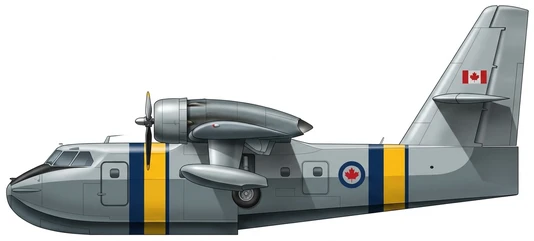
The Canadair CL-215 is a twin-engine, high-wing amphibious flying boat and the first large aircraft designed specifically for aerial firefighting. Development originated from the CL-43 and CL-204 studies in the early 1960s, with the latter serving as a preliminary 1962 design for a purpose-built water bomber. The program received authorization on February 1, 1966, and the first prototype conducted its maiden flight on October 23, 1967. Manufactured by Canadair and later Bombardier, 125 aircraft were produced between 1969 and 1990. In 2018, Viking Air acquired the intellectual property rights for the CL-215 and its successors.
The airframe is a fail-safe structure constructed to withstand aerodynamic and hydrodynamic loads associated with low-altitude firefighting. To mitigate corrosion in maritime environments, aluminum components are sulfurically anodized and sealed with sodium dichromate, while steel parts are plated with a cadmium-titanium alloy. The CL-215 is powered by two 2,100 hp (later 2,200 hp) Pratt & Whitney R-2800-83AM 18-cylinder radial piston engines. The flight control system utilizes manual mechanical linkages. For water bombing, the aircraft is equipped with two 1,400-liter belly tanks capable of being filled via rotatable aluminum scoops while the aircraft skins across a water surface. Discharge is managed through hydraulically actuated, electrically controlled doors at the bottom of the tanks.
Beyond its primary firefighting role, the aircraft is utilized for search and rescue, freight transport, and passenger services. The cabin can be configured to accommodate up to 36 passengers in utility roles. Operational users include the governments of Quebec, Ontario, and Saskatchewan, the Hellenic Air Force, the Spanish Air and Space Force, and the Royal Thai Navy. French Sécurité Civile operated 15 aircraft between 1969 and 1996. Export deliveries reached 11 countries, and as of 2018, approximately 165 aircraft from the CL-215 and CL-415 family remained in service globally.
Main Variants:
- CL-215A: Initial water bomber production version featuring radial piston engines and internal water tanks.
- CL-215B: Variant adapted with minor modifications for search and rescue and commercial freight operations.
- CL-215C: Dedicated utility and passenger transport version lacking water bombing apparatus and featuring larger side doors.
- CL-215T: Turboprop conversion utilizing Pratt & Whitney Canada PW123AF engines and structural aerodynamic improvements.
- CL-415EAF: Conversion program by Viking Air incorporating turboprop engines and an EFIS avionics suite.