CL-415 Super Scooper
Canadian amphibious aircraft, significant in firefighting operations globally, developed in the late 20th century. Key figures: top speed 359 km/h, range 2,427 km, service ceiling 4,481 m, max takeoff weight 19,890 kg, unit price $37M, built 95. In service with 4 air forces as of 2026 — Greece (8), Morocco (8), Croatia (6) and 1 other.
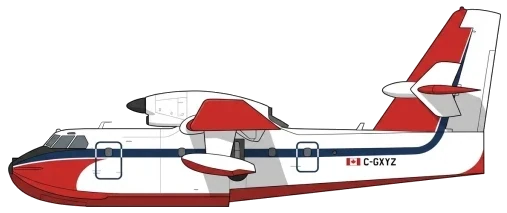
| Length | 20 m (65.6 ft) |
| Wingspan | 28.4 m (93.1 ft) |
| Height | 8.9 m (29.3 ft) |
| Wing area | 100 m² (1076.4 sqft) |
| Empty weight | 12,882 kg (28,400 lbs) |
| Max. takeoff weight | 19,890 kg (43,850 lbs) |
| Powerplant | 2 × turboprops Pratt & Whitney Canada PW123AF 1,775 kW each |
| Maximum speed | 359 km/h (223 mph) |
| Operational range | 2,427 km (1,508 mi) |
| Service ceiling | 4,481 m (14,701 ft) |
| Climb rate | 8.1 m/s (26.6 ft/s) |
| Takeoff distance | 838 m (2,749 ft) |


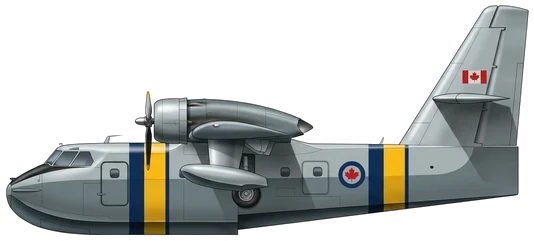
Description
The Canadair CL-415, marketed as the Super Scooper and later designated Bombardier 415, is a twin-turboprop amphibious aircraft built in Canada by Canadair, Bombardier and, in its current form, De Havilland Canada. Derived from the piston-engined CL-215, it was designed for aerial firefighting, with secondary search and rescue and utility transport roles. It first flew on 6 December 1993, with deliveries beginning in November 1994. Ninety-five were built before the line closed in October 2015.
Development
The CL-215, introduced in 1966, was the first aircraft designed from the outset as a water bomber; 125 were built, the last delivered in May 1990. In 1987 Canadair retrofitted 17 CL-215 airframes with Pratt & Whitney Canada PW123AF turboprops, a 15 percent power increase over the piston engines, producing the CL-215T. The retrofit added powered flight controls, cockpit air conditioning, upgraded electrical and avionics systems, and aerodynamic additions to the wings and empennage. Company officials judged CL-215T demand insufficient to justify an all-new design at the time, but the programme led to the new-production CL-415. A 180-day sales tour covering 21 countries was flown in 1995 using a Quebec Government aircraft. By July 1996, 37 were in service in Canada, France, Italy and Spain, and 51 orders had been placed by 1999. Assembly moved to North Bay/Jack Garland Airport, Ontario, in 1998, with testing on Lake Nipissing. Unit cost in 2014 was US$36.9 million. Viking Air acquired the CL-215, CL-215T and CL-415 type certificates on 3 October 2016 and began work on the CL-515. Bridger Aerospace of Bozeman, Montana became launch customer for the CL-415EAF in May 2018 with a $204 million contract for up to six aircraft. Indonesia ordered six CL-515s and one CL-415EAF in June 2019. The CL-515 was renamed DHC-515 on 31 March 2022, with 22 European letters of intent; Greece signed a $530 million order in March 2024. Assembly of the first DHC-515 began in Calgary in March 2026, with first delivery planned for 2028.
Design
Power comes from two PW123AF turboprops of 1,775 kW each driving four-bladed Hamilton Sundstrand 14SF-19 propellers. The engines sit closer to the fuselage than on the CL-215; an inverted fixed leading-edge slat forward of the right horizontal stabiliser and winglets compensate for the resulting stability changes. The airframe uses corrosion-resistant treated aluminium for salt-water operation. Tanks located mainly beneath the cabin floor hold 6,137 litres, filled during a twelve-second, 410-metre run on the water at 70 knots; the full scooping cycle from and back to 15 m altitude requires 1,340 m. Drop patterns and sequences are selected from a water status panel, with a manual emergency dump lever bypassing the system. Avionics are Honeywell EDZ-605 on the CL-415, Rockwell Collins Pro Line Fusion on the EAF, and Universal InSight on later upgrades and the DHC-515. Capacity includes 18 paratroops or 2,903 kg of cargo.
Operational History
Operators have used the type mainly for firefighting and maritime search and rescue. Customers include Sécurité Civile France, SOREM Italy, the Hellenic Air Force, Spain and Canadian provincial agencies. In 2016–2019, 164 CL-215s and CL-415s were in service across 11 countries. Fourteen aircraft have been lost in accidents, including two Hellenic Air Force and SOREM aircraft on the same day, 23 July 2007. The type received the Batefuegos de Oro award in Spain in 2006.
Variants
- CL-415: Original production model, 86 built.
- CL-415MP: Maritime patrol version, three built.
- CL-415GR: Higher operating weight version for the Hellenic Air Force, six built.
- CL-415EAF: Enhanced Aerial Firefighter conversion with Pro Line Fusion avionics, launched by Bridger Aerospace.
- DHC-515: Updated De Havilland Canada version with 7,000-litre capacity and 14-second refill, assembled in Calgary.
Frequently Asked Questions
What type of aircraft is the CL-415 Super Scooper?
What is the maximum speed of the CL-415 Super Scooper?
What is the range of the CL-415 Super Scooper?
When did the CL-415 Super Scooper first fly?
How many CL-415 Super Scooper have been built?
Which countries operate the CL-415 Super Scooper?
How much does a CL-415 Super Scooper cost?
What is the service ceiling of the CL-415 Super Scooper?
- AUG 302026 Updated Description updated
- APR 72026 Updated Picture credits updated in a site-wide editorial pass
- JAN 202026 Updated Range added