CL-215 Scooper vs CL-415 Super Scooper
CL-215 Scooper vs CL-415 Super Scooper at a glance — top speed 291 vs 359 km/h, range 2,094 vs 2,427 km, max takeoff weight 19,731 vs 19,890 kg, built 125 vs 95 units.
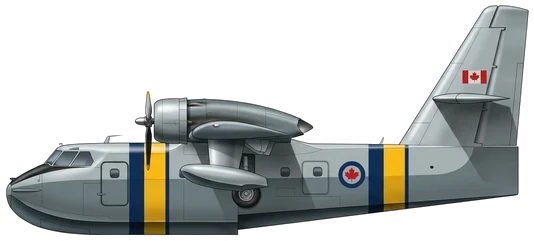
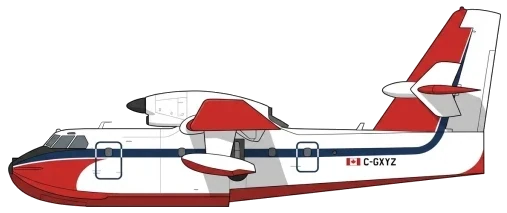
| CL-215 Scooper | CL-415 Super Scooper | |
|---|---|---|
| Origin country | 🇨🇦 Canada | 🇨🇦 Canada |
| Category | Military Transport Aircraft | Military Transport Aircraft |
| Manufacturer | Canadair | Viking Air |
| First flight | 23 October 1967 | 6 December 1993 |
| Year introduced | 1969 | 1994 |
| Number produced | 125 units | 95 units |
| Average unit price | -- | $37 million |
| Wing area | 100.3 m² | 100.0 m² |
| Wingspan | 28.6 m | 28.4 m |
| Height | 8.9 m | 8.9 m |
| Length | 19.8 m | 20.0 m |
| Maximum speed | 291 km/h | 359 km/h |
| Operational range | 2,094 km | 2,427 km |
| Service ceiling | -- m | 4,481 m |
| Max. takeoff weight | 19,731 kg | 19,890 kg |
| Empty weight | 12,160 kg | 12,882 kg |
| Total thrust | 2 x 1,566 kW | 2 x 1,775 kW |
Detailed Comparison
The Canadair CL-215 pioneered the purpose-built amphibious water bomber concept in 1969, replacing converted World War II maritime patrol aircraft. Its successor, the turboprop-powered CL-415, emerged in 1994 to address the logistical and performance limitations of the original piston-engine airframe. While both share the same fundamental hydrodynamic hull and high-wing architecture, the shift from radial engines to turboprops altered the aircraft's operational tempo and sustainment footprint.
Development and Design
Canadair designed the CL-215 around a fail-safe hull built for low-altitude, high-stress maritime environments. Early iterations relied on manual mechanical flight controls and twin Pratt & Whitney R-2800 18-cylinder radial engines. The reliance on aviation gasoline (avgas) and the maintenance burden of large radial engines forced a design evolution. The CL-415 integrated Pratt & Whitney Canada PW123AF turboprops, providing 1,775 kW per engine. This swap required aerodynamic corrections—specifically inverted fixed leading-edge slats on the right horizontal stabilizer and winglets—to counteract torque and restore lateral stability. The CL-415 also introduced powered flight controls and an updated cockpit, reducing pilot fatigue during multi-hour, low-level scooping profiles.
Specifications and Performances
The propulsion upgrade translates directly into cycle time reductions. The CL-415 cruises at 359 km/h compared to the CL-215's 291 km/h, narrowing transit times between water sources and fire lines. Climb rate improves to 8.1 m/s, a 62% increase over the CL-215’s 5.0 m/s, allowing pilots to clear terrain faster after dropping their payload. The CL-415 expanded water capacity to 6,140 liters, capable of scooping a full load in 12 seconds over a 410-meter run. Maximum takeoff weight increased from 19,731 kg to 19,890 kg, while turboprop efficiency pushes the range to 2,427 km, a 333 km extension over the legacy airframe.
Deployment and usage
Both platforms operate globally under civil defense, military, and paramilitary commands. The CL-215 established the baseline doctrine for amphibious scooping, dominating Mediterranean and North American fire seasons throughout the 1970s and 1980s. Present-day operational distribution reflects modernization budgets and logistics:
- The Hellenic Air Force utilizes the CL-415GR, a variant with higher operating weights tailored for the high-density altitude environment of the Aegean.
- France's Sécurité Civile retired its CL-215 fleet by 1996, transitioning to the CL-415 due to avgas scarcity and higher sortie generation rates.
- Spain operates mixed fleets, but relies on the CL-415's chemical foam mixing systems for primary initial attack tactics.
Structural fatigue from cyclic water impacts and low-altitude turbulence has resulted in multiple hull losses and high maintenance hours across both fleets.
Conclusion
The CL-415 renders the CL-215 obsolete in every metric that dictates firefighting effectiveness: turnaround time, climb performance, and supply chain viability. The transition to Jet-A fuel alone determines the CL-415’s superiority, as global avgas scarcity makes the CL-215's R-2800 radial engines a logistical liability. For operators requiring high-frequency, sustained drop cycles in steep, mountainous terrain, the CL-415’s higher power-to-weight ratio and powered flight controls make it the strictly necessary airframe.


