Canadair CL-289
Canadian unmanned surveillance drone, developed in the late 20th century, deployed for military reconnaissance and intelligence gathering. Key figures: top speed 740 km/h, range 60 km, service ceiling 3,000 m, max takeoff weight 156 kg.
| Length | 3.7 m (12.2 ft) |
| Wingspan | 0.9 m (3.1 ft) |
| Empty weight | 78 kg (172 lbs) |
| Max. takeoff weight | 156 kg (344 lbs) |
| Powerplant | 1 × Williams International WR2-6 57 kgf each |
| Maximum speed | 740 km/h (460 mph) |
| Operational range | 60 km (37 mi) |
| Service ceiling | 3,000 m (9,843 ft) |
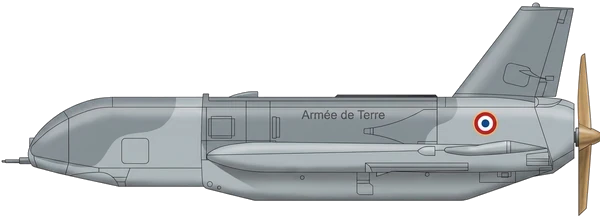
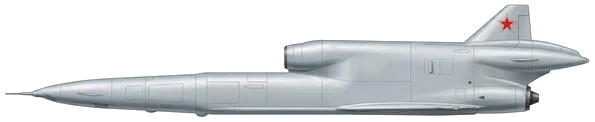
Description
The Canadair CL-289 is an unmanned surveillance drone designed to provide corps-level intelligence for NATO armies. Development of the CL-289 began in 1974 as an enlarged successor to the CL-89 drone. In November 1987, Canada, West Germany, and France signed a production agreement for the system, which officially entered service in November 1990 under the military designation AN/USD-502.
Design
The drone features a cylindrical body with four rear-mounted stub-wings and smaller canard foreplanes for aerodynamic trim. It is launched from truck-mounted rails using a BAJ Vickers Wagtail rocket booster that produces 5,000 lbf (22 kN) of thrust. Once flight speed is attained, the booster is jettisoned, and a Williams International WR2-6 turbojet producing 125 lbf (0.56 kN) of thrust powers the drone for the rest of its programmed flight path. The system operates entirely without external control, relying on pre-programmed instructions.
For recovery, the engine cuts at a calculated position and a drogue parachute deploys. This slows the drone and allows a main parachute to release from its underside, causing the aircraft to invert. Prior to landing, a pair of pneumatic landing bags deploy from the top of the drone (which faces the ground during inversion) to cushion the impact. While the predecessor CL-89 could only carry a single camera or sensor, the CL-289 is designed to carry multiple sensor units.
Operational History
During the NATO bombing of Yugoslavia in 1999, the Yugoslav Army shot down at least nine CL-289 drones. Operators of the system have included Canada, France, and Germany, with the German Army eventually replacing its inventory with the Rheinmetall KZO.
Variants
- CL-89 (AN/USD-501): A divisional-level surveillance drone developed in the 1960s by Canada, Britain, and West Germany.
- CL-289 (AN/USD-502): An enlarged corps-level surveillance drone with increased range, payload capacity, and support for multiple sensors.
Frequently Asked Questions
What type of aircraft is the Canadair CL-289?
What is the maximum speed of the Canadair CL-289?
What is the range of the Canadair CL-289?
When did the Canadair CL-289 first fly?
Which countries operate the Canadair CL-289?
What is the service ceiling of the Canadair CL-289?
- JUL 272026 Updated Name updated
- JUL 62026 Created Page created: CL-289