Soko G-4 Super Galeb
Summary
| Category | Military Training Aircraft |
| Origin country | 🇳🇱 Ex-Yugoslavia |
| Manufacturer | SOKO |
| First flight | 17 July 1978 |
| Year introduced | 1983 |
| Number produced | 85 units |
Technical specifications
| Version: None | |
|---|---|
| Crew | 2 (student and instructor) |
| Operational range | 1,900 km (1,181 mi) |
| Maximum speed | 910 km/h (565 mph) |
| Wing area | 19.5 m² (209.9 sqft) |
| Wingspan | 9.9 m (32.4 ft) |
| Height | 4.3 m (14.1 ft) |
| Length | 12.3 m (40.2 ft) |
| Service ceiling | 12,850 m (42,159 ft) |
| Empty weight | 3,250 kg (7,165 lbs) |
| Max. takeoff weight | 6,330 kg (13,955 lbs) |
| Climb rate | 31.0 m/s (101.7 ft/s) |
| Powerplant | 1 x Rolls-Royce Viper 632-46 turbojet delivering 1815 kgf each |
| Ejection seat | Martin-Baker |
Current operating countries
| Country | Units | ||
|---|---|---|---|

|
Serbia | 20 | |
All operators
Armament
Missiles payload:
GSh-23L 23mm gun pod; wingtip missile rails (G-4M variant)
Bombs payload:
4 underwing hardpoints (350 kg inner, 250 kg outer) + 1 centerline (400 kg); BL755 cluster bombs, rockets, drop tanks
Description
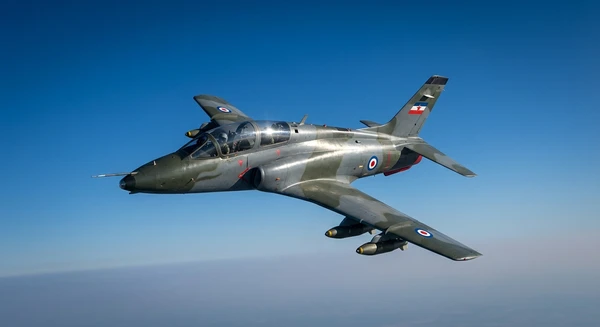
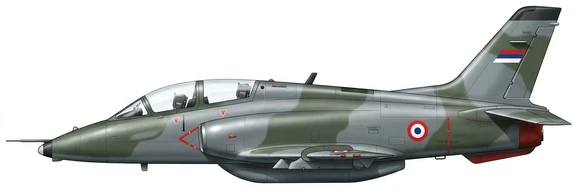
The Soko G-4 Super Galeb, designated N-62, is a Yugoslav single-engine advanced jet trainer and light ground-attack aircraft. Developed during the 1970s by the Aeronautical Technical Institute at Žarkovo and manufactured by SOKO in Mostar, the aircraft was designed as a successor to the G-2 Galeb. The initial development aircraft, designated G-4 PPP, performed its maiden flight on July 17, 1978. The first production-standard G-4 flew in 1983, with quantity production commencing in 1984. Assembly continued until the breakup of Yugoslavia in 1991, with a total of 85 aircraft completed.
The G-4 is a low-wing monoplane featuring swept wing and tail surfaces. It is powered by a single Rolls-Royce Viper turbojet; while early models used the basic Viper, production aircraft transitioned to the uprated Viper 632-46 engine. Design features include an all-moving anhedral tailplane, semi-circular air intakes, and JATO (jet-assisted take-off) attachment points. The crew of two sits in a tandem configuration on Martin-Baker ejection seats; the rear seat is elevated to improve instructor visibility. Avionics support flight in adverse weather and at night, including a radio altimeter and gyro-gunsight. To shorten landing distances, the aircraft utilizes a drogue parachute.
For combat operations, the G-4 is equipped with a removable centerline pod containing a twin-barrel 23mm GSh-23L cannon with 200 rounds. Four underwing hardpoints are provided, with the inboard pair rated for 350 kg and the outboard pair for 250 kg. The inboard pylons are plumbed for 70-gallon external fuel tanks. The aircraft can deploy Eastern and Western European munitions, including BL755 cluster bombs and air-to-air missiles.
During the Yugoslav Wars, G-4s were utilized for ground-attack sorties, resulting in four recorded losses to air defenses. In February 1994, NATO aircraft shot down three G-4s for violating a UN no-fly zone. During the 1999 NATO bombing of Yugoslavia, 23 G-4s were destroyed on the ground. Outside of Yugoslavia, Myanmar was the sole export customer, receiving six aircraft in 1991 for counter-insurgency operations. The Serbian Air Force remains the primary operator and intends to operate an upgraded fleet through the 2030s.
Main Variants
- G-4: Standard production advanced jet trainer and light ground-attack aircraft.
- G-4Š: Unarmed jet trainer variant with five units produced.
- G-4T: Dedicated target tug model.
- G-4M: Upgraded variant featuring improved avionics, wingtip missile rails, and increased payload capacity.
- G-4MD: Planned modernization program including LCD screens, HOTAS, HUD, and GPS-based navigation.