G-2 Galeb
Yugoslavian jet trainer and light-attack aircraft, historically deployed during the Yugoslav Wars and Libyan Civil War. Key figures: top speed 812 km/h, range 669 km, service ceiling 12,000 m, max takeoff weight 4,300 kg, unit price $0.18M, built 248. In service with 1 air force as of 2026 — Libya (3).
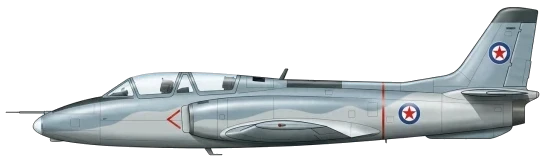
| Length | 10.3 m (33.9 ft) |
| Wingspan | 11.6 m (38.1 ft) |
| Height | 3.3 m (10.8 ft) |
| Wing area | 19.4 m² (209.1 sqft) |
| Empty weight | 2,620 kg (5,776 lbs) |
| Max. takeoff weight | 4,300 kg (9,480 lbs) |
| Powerplant | 1 × turbojet Armstrong Siddeley Viper ASV.11 Mk 22-6 1,134 kgf each |
| Ejection seat | Folland Type 1-B |
| Maximum speed | 812 km/h (505 mph) |
| Operational range | 669 km (416 mi) |
| Service ceiling | 12,000 m (39,370 ft) |
| Climb rate | 22.8 m/s (74.8 ft/s) |

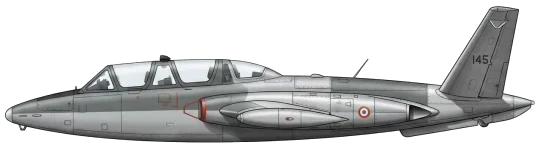
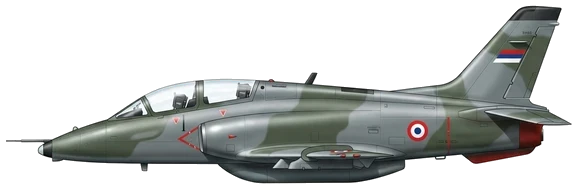
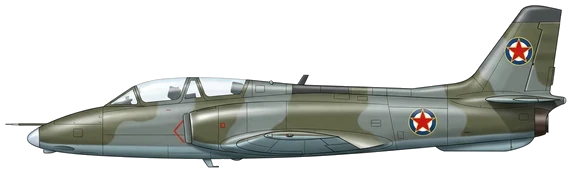
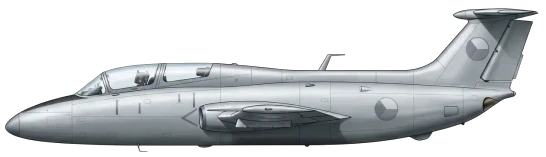
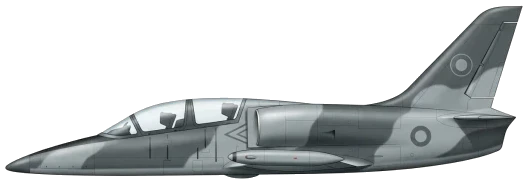
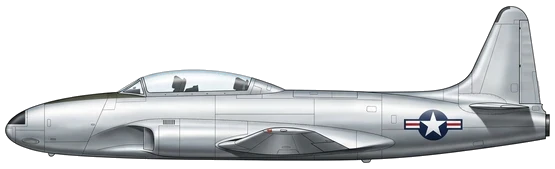
Description
In 1957, the Aeronautical Technical Institute (VTI) of Yugoslavia initiated the Galeb's design, aiming to replace the Lockheed T-33 Shooting Star jet trainer then in service. The aircraft was intended for ab initio, intermediate, and advanced training missions. SOKO, an aircraft manufacturer in Mostar, Bosnia and Herzegovina, established in 1951, handled primary manufacturing. The Galeb's development was a collaborative effort between Yugoslavia and the United Kingdom; a significant number of components, including the Armstrong Siddeley Viper turbojet engine, ejector seats, and navigational fittings, were sourced from British aerospace manufacturers. Rolls-Royce Limited sponsored the engine development. Two prototypes were constructed; the first, Galeb 1, made its maiden flight on 3 July 1961, piloted by Ljubomir Zekavica. Following a full-size wooden mock-up, the second prototype, Galeb 2, was constructed. In 1964, mass production commenced, making it the first indigenously developed jet aircraft in Yugoslavia. A total of 248 Galeb aircraft were produced, with 132 used by the Yugoslav Air Force. Production of updated aircraft for export to Libya was extended until mid-1983.
Design
The G-2 Galeb is a versatile trainer aircraft designed to fulfill a wide array of training missions. Operated by a crew of two, a candidate pilot and an instructor, the aircraft features a tandem cockpit layout and Folland Type 1-B lightweight ejector seats for both crew members. Power is provided by a single Armstrong Siddeley Viper II Mark 22/6 turbojet engine, delivering up to 2,500lb of thrust, facilitating rapid and stall-free acceleration. Constructed with a conventional stressed-skin design using frames and bulkheads, the Galeb incorporates an all-metal straight wing complete with tip tanks. The aircraft is equipped with a hydraulic system featuring an engine-driven hydraulic pump and a 24-volt battery powers its electrical systems. The G-2 Galeb is equipped with two 12.7 mm machine guns in the nose, each with 80 rounds. Furthermore, the aircraft features four underwing hardpoints with a total capacity of 300 kg for external stores, enabling the Galeb to carry a variety of munitions, including bombs and rockets, for light attack or weapons training missions.
Operational History
The G-2-A Galeb served as the standard trainer with the Yugoslav Air Force, extensively used for school-combat training of Military Air Force Academy cadets. Its ease of handling and maintenance made it popular among both students and technicians, with aircraft regularly achieving 5,000 flight hours. An export variant, the G-2-AE, was introduced in late 1974 for Libya and Zambia. During the Bosnian War, Galeb aircraft saw combat use with the 105th Fighter-Bomber Regiment over Bosnia-Herzegovina, while reports indicate the deployment of a few aircraft to Zaire during the First Congo War, flown by Serbian mercenaries. The Libyan Air Force also operated the Galeb, employing it in ground attack missions during the 2011 Libyan civil war; some were destroyed by NATO forces enforcing a no-fly zone. The aircraft continued in service with the Libyan Dawn forces during the Second Libyan Civil War, though the operational status remains uncertain.
Variants
Main Variants:
-
G-2-A: The standard two-seat advanced jet trainer and light attack aircraft operated by the Yugoslav Air Force.
-
G-2A-E: A two-seat export version of the G-2-A, specifically designed for use by Libya and Zambia.
-
G-2Š: An unarmed trainer variant of the G-2 Galeb, likely used for basic flight instruction.
-
G3 Galeb-3: A prototype export version featuring a BMB (Rolls-Royce/Bristol Siddeley) Viper Mk 532 Turbojet engine, a modern cockpit, cameras in tip-tanks, doubled weapon load, JATO, and other modifications.
Frequently Asked Questions
What type of aircraft is the G-2 Galeb?
What is the maximum speed of the G-2 Galeb?
What is the range of the G-2 Galeb?
When did the G-2 Galeb first fly?
How many G-2 Galeb have been built?
Which countries operate the G-2 Galeb?
How much does a G-2 Galeb cost?
What is the service ceiling of the G-2 Galeb?
- AUG 12026 Updated Manufacturer updated
- JUL 232026 Updated Sources and cross-references refreshed
- APR 72026 Updated Sources and cross-references refreshed
- APR 52026 Updated Ejection seat added
- JAN 122026 Updated Range updated in a site-wide editorial pass