Montenegro Military Forces
Open-source order of battle for 2026: 2,350 active troops, 11 aircraft.
Armed Forces in 2026
| Domain | Strength | Composition |
|---|---|---|
| Air Force | 11 aircraft | 11 helicopters 1 air bases |
| Personnel | 2,350 active | 1,000 reserve 4,100 paramilitary |
Global Military Index
Full ranking →| Pillar | Weight | Score | Basis |
|---|---|---|---|
| Manpower | 15% | 39.1 | Active, reserve & paramilitary personnel |
| Ground forces | 20% | 0.0 | Tanks, armor & artillery weighted by type |
| Naval power | 20% | 0.0 | Weighted by hull type: carrier tiers, nuclear vs conventional submarines |
| Air power | 25% | 14.5 | Weighted by aircraft type and fleet age |
| Nuclear deterrent | 10% | 0.0 | No declared nuclear capability |
| Defense budget | 10% | 20.6 | Annual spending, purchasing-power adjusted |
| Readiness | modifier | ×1.04 | Budget per soldier: proxy for training, maintenance & technology |
Country File
| Population | 623K (2024) |
| GDP | $8.3 billion (2024) |
| GDP per capita | $13,263 |
| Military budget | $165M (2025) |
| Share of GDP | 2.0% (2025) |
| Military spending per capita | $265 (2025) |
| Inflation rate | 3.34% (2024) |
| Capital | Podgorica |
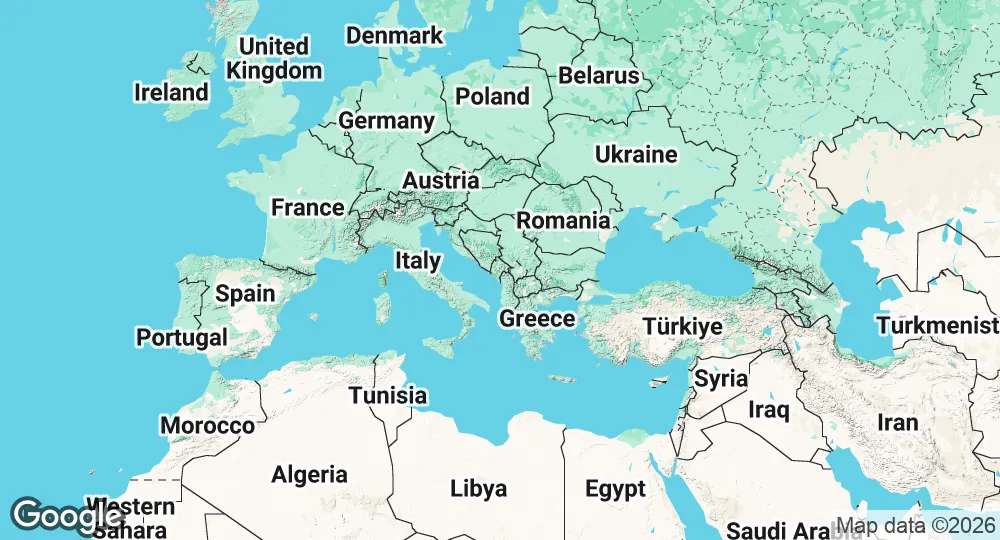
| Region | Europe |
| Land area | 13,452 km² |
| Coastline | 293 km |
| Land borders | 625 km |
| Bordering countries | 5 |
| Currency | EUR |
Strategic Overview in 2026
Strategic Position
Montenegro’s defense posture is defined by its membership in NATO, which it joined in 2017. As a small Adriatic state, its security doctrine emphasizes collective defense and regional stability within the Western Balkans. Primary security concerns include hybrid threats, maritime security in the Adriatic Sea, and the maintenance of stability in neighboring territories.
The country is fully integrated into the NATO integrated air and missile defense system. Because it maintains no fixed-wing combat aviation, its airspace is secured through the NATO Air Policing mission, conducted by the Italian and Greek air forces. Bilateral defense cooperation is most active with the United States, Slovenia, and Croatia, focusing on training, modernization, and interoperability. Strategic priorities include the fulfillment of NATO capability goals, particularly in the areas of mountain warfare, chemical, biological, radiological, and nuclear (CBRN) defense, and maritime surveillance.
Military Forces
The Armed Forces of Montenegro (Vojska Crne Gore) are a professionalized, unified force under the command of the Ministry of Defense and the General Staff in Podgorica. Total active personnel are approximately 2,400, supported by a reserve force of roughly 1,000.
Army The Army is the largest branch and is organized into an infantry battalion, a combat support company, and specialized units for signals and electronic warfare. It operates no main battle tanks, having transitioned to a light, mobile force. The primary maneuver assets are Joint Light Tactical Vehicles (JLTV) and BOV armored personnel carriers. Specialized capabilities include a dedicated mountain infantry company and a CBRN defense unit.
Navy The Navy focuses on coastal defense, maritime patrol, and search and rescue operations. It operates patrol boats and coastal surveillance assets. Naval operations are centered at the bases in Bar and Tivat. The force is tasked with protecting territorial waters and participating in multinational maritime exercises and counter-piracy missions.
Air Force The Air Force is a helicopter-centric component based at Golubovci Air Base. It operates Bell 412 and Bell 505 multi-purpose helicopters. These assets are utilized for troop transport, medical evacuation, and search and rescue. In 2026, the government initiated plans to procure additional multi-role helicopters to enhance tactical mobility and disaster response capabilities.
Defense Industry
Montenegro maintains a niche defense industrial base focused on small arms and explosives. Tara Aerospace and Defense Products is the primary domestic manufacturer, producing the TM9 pistol and TM4 assault rifle, which are used by national forces and exported to regional markets. Poliex, based in Berane, specializes in the production of civilian and military explosives and the demilitarization of surplus ordnance.
In 2025, the government established a partnership with U.S.-based firms to launch domestic production of unmanned aircraft systems (UAS). This initiative, supported by Foreign Military Financing, aims to manufacture vertical take-off and first-person view (FPV) drones for the national military and export to allies, including Ukraine.
Strategic Trends
Defense spending in Montenegro reached the NATO-mandated 2% of GDP in recent cycles, with projections to increase toward 3% by 2026. A significant portion of this budget is allocated to modernization and the replacement of legacy equipment inherited from the former Yugoslav and Union states.
Procurement priorities for 2025 and 2026 include:
- Air Defense: The acquisition of short- and medium-range air defense systems to establish a baseline national capability.
- Aviation: A planned expansion of the helicopter fleet to include four new multi-purpose platforms.
- Anti-Armor: Integration of the Spike anti-tank guided missile system into infantry units.
- Logistics: The replacement of 40-year-old support vehicles with modern tactical trucks and engineering equipment.
The primary constraint facing the military is the limited scale of its personnel and budget, which necessitates a high degree of specialization and total reliance on the NATO alliance for high-end combat capabilities, such as air superiority and heavy armor. Strategic shifts involve a transition from territorial defense toward a force optimized for expeditionary peacekeeping and rapid reaction within multinational frameworks.
Frequently Asked Questions
How large is Montenegro's military?
What is Montenegro's defense budget?
How does Montenegro rank militarily in the world?
Does Montenegro have nuclear weapons?
How many aircraft does Montenegro's air force have?
What percentage of GDP does Montenegro spend on defense?
What is Montenegro's military personnel per capita?
Does Montenegro have paramilitary forces?
Military Expenditure: CIA World Factbook. Last updated on 4 August 2026. Suggest a change
- AUG 42026 Updated Global Military Index updated in a site-wide editorial pass
- JUL 162026 Updated Global Military Index updated in a site-wide editorial pass
- JUN 162026 Updated Yearly statistics, military spending and 2 more fields updated
- MAR 172026 Updated Paramilitary personnel updated
- MAR 162026 Updated Reserve personnel added
- JAN 212026 Updated Rank insignia updated (57 entries)
- JAN 202026 Updated Coastline length updated