G-2 Galeb vs Soko G-4 Super Galeb
G-2 Galeb vs Soko G-4 Super Galeb at a glance — top speed 812 vs 910 km/h, range 669 vs 1,900 km, max takeoff weight 4,300 vs 6,330 kg, built 248 vs 85 units.
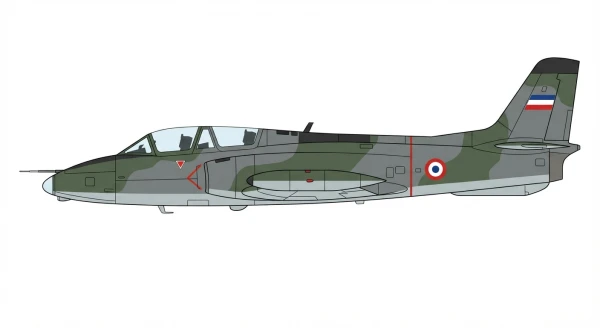
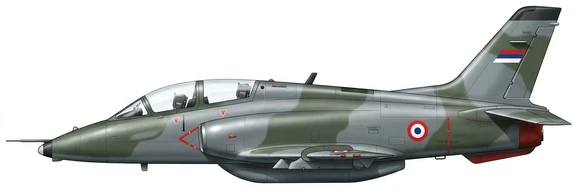
| G-2 Galeb | Soko G-4 Super Galeb | |
|---|---|---|
| Origin country | 🇷🇸 Ex-Yugoslavia | 🇷🇸 Ex-Yugoslavia |
| Category | Military Training Aircraft | Military Training Aircraft |
| Manufacturer | Soko | Soko |
| First flight | 31 July 1961 | 17 July 1978 |
| Year introduced | 1965 | 1983 |
| Number produced | 248 units | 85 units |
| Average unit price | $180K | -- |
| Wing area | 19.4 m² | 19.5 m² |
| Wingspan | 11.6 m | 9.9 m |
| Height | 3.3 m | 4.3 m |
| Length | 10.3 m | 12.3 m |
| Maximum speed | 812 km/h | 910 km/h |
| Operational range | 669 km | 1,900 km |
| Service ceiling | 12,000 m | 12,850 m |
| Max. takeoff weight | 4,300 kg | 6,330 kg |
| Empty weight | 2,620 kg | 3,250 kg |
| Total thrust | 1 x 1,134 kgf | 1 x 1,815 kgf |
Detailed Comparison
The Soko G-2 Galeb established Yugoslavia’s domestic aerospace capability in the 1960s, functioning as a reliable basic trainer analogous to the Jet Provost. Its successor, the G-4 Super Galeb, abandoned this utilitarian lineage for a high-performance design mirroring the British Aerospace Hawk. While the G-2 was a volume product for the Non-Aligned Movement, the G-4 represented a genuine attempt to compete with Western advanced jet trainers, though its potential was strangled by geopolitical dissolution.
Development and Design
The G-2 Galeb, initiated in 1957, relied heavily on British technology—specifically the Armstrong Siddeley Viper engine—to replace the Lockheed T-33. Its straight-wing architecture and unpressurized cockpit prioritized stability for ab initio cadets. Conversely, the G-4 Super Galeb (N-62) adopted the swept-wing configuration essential for advanced combat lead-in. Visually and structurally echoing the BAe Hawk, the G-4 integrated Martin-Baker seats and a stepped cockpit, addressing the G-2’s poor instructor visibility. The G-4 was not merely an upgrade but a clean-sheet redesign meant to bridge the gap to high-performance interceptors like the MiG-29, incorporating avionics for adverse weather operations that the G-2 lacked.
Specifications and Performances
Performance metrics illustrate the doctrinal shift from basic handling to tactical energy management. The G-4 utilizes the uprated Rolls-Royce Viper 632-46, generating 1,815 kgf of thrust compared to the G-2’s 1,134 kgf. This yields a 36% increase in climb rate (31.0 m/s vs 22.8 m/s). While the G-2 maxes out at 812 km/h, the G-4 reaches 910 km/h, edging closer to transonic regimes required for modern fighter training. The G-4 provides a significant leap in combat radius, nearly tripling the range (1,900 km vs 669 km) and upgrading armament from fixed .50 caliber nose guns to a centerline 23mm GSh-23L cannon pod and heavier ordnance capacity, including cluster munitions.
Deployment and Usage
The G-2 saw extensive service as the primary trainer for the Yugoslav Air Force and achieved export success in Libya and Zambia. Its combat record is defined by low-intensity conflicts and attrition; Libyan G-2s were heavily targeted by NATO during the 2011 civil war. The G-4’s operational history is inextricably linked to the violent breakup of Yugoslavia. Unlike the G-2, the G-4 was employed aggressively in close air support (CAS) roles during the Balkan conflicts. This exposure proved costly: NATO F-16s downed three G-4s during Operation Deny Flight in 1994, and 23 were destroyed on the ground in 1999. The G-4 secured only one export client, Myanmar, before sanctions halted production.
Conclusion
The G-2 Galeb succeeded as an industrial milestone, proving SOKO could manufacture reliable jet aircraft in volume. However, the G-4 Super Galeb is objectively the superior platform, offering avionics, kinematics, and payload options comparable to the Alpha Jet or MB-339. The G-2 belongs to the obsolescent first generation of straight-wing jet trainers. The G-4 remains a viable, if orphan, platform for light attack and advanced training, limited only by the geopolitical collapse that severed its supply chain and export potential.