Myanmar Military Forces
Myanmar ranks #32 of 170 militaries worldwide in 2026, with 201,000 active troops. The Myanmar/ Burma Army fields 5,840 ground vehicles, including 445 main battle tanks; the Air Force flies 338 aircraft, including 132 combat aircraft; the Navy operates 239 warships, including 2 submarines. Myanmar has no nuclear weapons.
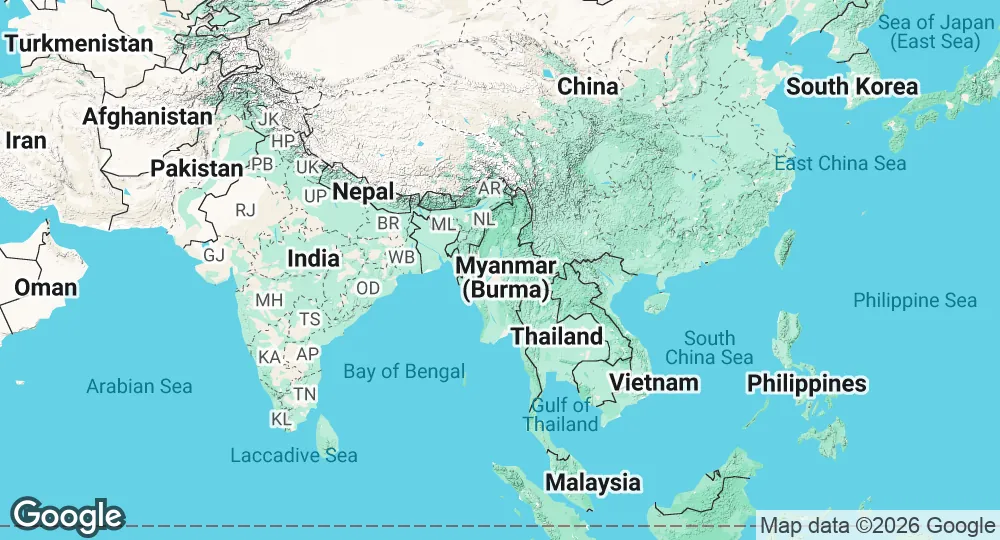

Armed Forces in 2026
| Domain | Strength | Composition |
|---|---|---|
| Air Force | 338 aircraft | 132 combat 89 helicopters +33 on order |
| Myanmar Navy | 239 warships | 8 major combatants 2 submarines |
| Ground Forces | 5,840 vehicles | 445 main battle tanks |
| Personnel | 201,000 active | 70,000 paramilitary |
ATLAS Index (Aggregate Total of Land, Air and Sea strength)
Full ranking →| Pillar | Weight | Score | Basis |
|---|---|---|---|
| Manpower | 10% | 50.4 | Active, reserve & paramilitary personnel |
| Ground forces | 20% | 51.7 | ARMS inventory power: armour & artillery by type and era, attack helicopters, armament |
| Naval power | 20% | 37.5 | SEAS inventory power: hulls by type, size and era, air wing, sustainment, armament |
| Air power | 25% | 31.0 | AIRS inventory power: aircraft by type and generation, enablers, armament |
| Nuclear deterrent | 10% | 0.0 | No declared nuclear capability |
| Defense budget | 15% | 31.2 | Annual spending, purchasing-power adjusted |
| Availability | modifier | ground ×0.91 · naval ×0.94 · air ×1.01 | Budget per point of each force, from the branch indexes |
Country File
| Population | 54.5M (2024) |
| GDP | $74.1 billion (2024) |
| GDP per capita | $1,359 |
| Military budget | $2.9B (2023) |
| Share of GDP | 3.9% (2023) |
| Military spending per capita | $53 (2023) |
| Inflation rate | 8.83% (2019) |
| Capital | Naypyidaw |
| Region | Asia |
| Land area | 653,508 km² |
| Coastline | 1,930 km |
| Land borders | 5,876 km |
| Bordering countries | 5 |
| Currency | MMK |
Strategic Overview in 2026
Strategic Position
Myanmar’s defense posture is defined by an ongoing internal conflict between the ruling State Administration Council (SAC) and a diverse coalition of Ethnic Armed Organizations (EAOs) and the People’s Defense Forces (PDFs). The military, known as the Tatmadaw, has shifted its strategic priority from external territorial defense to internal regime survival and the suppression of nationwide insurgencies. Geopolitically, Myanmar serves as a critical corridor for the People's Republic of China, which seeks to secure its China-Myanmar Economic Corridor (CMEC) to gain direct access to the Indian Ocean.
Myanmar maintains no formal alliance memberships with major international pacts such as NATO. Instead, it relies on bilateral defense cooperation with the Russian Federation and China. Russia serves as a primary supplier of advanced military hardware and technical expertise, with both nations signing 2025 roadmaps for cooperation in nuclear and space technology. Relationships within the Association of Southeast Asian Nations (ASEAN) remain strained due to the internal conflict, though the military maintains functional border security cooperation with Thailand and India.
Military Forces
The Tatmadaw is organized into three primary branches: the Army, Navy, and Air Force, all under the centralized control of the Office of the Commander-in-Chief. In 2024, the SAC activated the People's Military Service Law to address manpower shortages caused by desertions and battlefield casualties. This conscription program aims to draft approximately 60,000 personnel annually to supplement the active-duty force, which is estimated to number between 150,000 and 200,000.
The Army remains the dominant branch, organized into Regional Military Commands (RMCs). It fields a mix of Soviet and Chinese-designed armored vehicles, including VT-4, T-72S, and Type 59D main battle tanks, as well as BTR-3U and locally assembled armored personnel carriers. Specialized units, such as Light Infantry Divisions (LIDs), serve as mobile strike forces for counter-insurgency operations.
The Air Force has assumed a lead role in the current conflict to offset ground-force limitations. It operates a fleet of multirole fighters including the Su-30SME, MiG-29, and JF-17. Light attack capabilities are centered on the FTC-2000G and Yak-130 aircraft. In 2025, the Air Force significantly increased its use of unmanned aerial vehicles (UAVs) for reconnaissance and precision strikes.
The Navy maintains a coastal and riverine focus, though it has expanded its deep-sea capabilities. It operates Kilo-class diesel-electric submarines and a fleet of locally built frigates, such as the Kyan Sittha class. Its primary role in 2025 involves logistical support for ground operations in Rakhine State and the Ayeyarwady Delta.
Defense Industry
The Directorate of Defence Industries (DDI), commonly known as KaPaSa, manages a network of approximately 20 to 25 state-owned factories. These facilities produce a wide range of materiel, including the MA-series of small arms, mortars, artillery shells, landmines, and aerial bombs. In 2025, several critical production lines were relocated to the administrative capital, Naypyidaw, to secure them from advancing resistance forces.
While the military is largely self-sufficient in the production of light weapons and ammunition, it remains heavily dependent on foreign imports for advanced components. This includes computer numerical control (CNC) machinery, high-tech fuses, optical sights, and raw materials sourced from Russia, China, India, and Thailand.
Strategic Trends
The primary strategic trend in 2025 is the fragmentation of territorial control. The Tatmadaw has lost significant territory in border regions, including the loss of the Northeast and Western Regional Military Commands to EAOs. In response, the military has adopted a "rump state" strategy, focusing its remaining resources on defending major urban centers, critical infrastructure, and the administrative heartland of central Myanmar.
Defense spending is estimated to exceed 3% of GDP, though accurate figures are difficult to verify due to off-budget revenue from state-owned enterprises. Procurement priorities have shifted toward airpower and drone technology to counter the resistance's use of commercial-off-the-shelf (COTS) UAVs. The SAC's long-term strategy includes holding national elections in late 2025 or 2026 to legitimize its authority, a goal that dictates current offensive operations intended to clear and secure contested townships. However, the military faces severe constraints, including international sanctions targeting aviation fuel and the erosion of its professional officer corps through prolonged attrition.
Military Expenditure (latest): CIA World Factbook; historical series: information from the Stockholm International Peace Research Institute (SIPRI) Military Expenditure Database. Last updated on 29 August 2026. Suggest a change
Frequently Asked Questions
How large is Myanmar's military?
What is Myanmar's defense budget?
How does Myanmar rank militarily in the world?
Does Myanmar have nuclear weapons?
How many aircraft does Myanmar's air force have?
How large is Myanmar's navy?
How many tanks does Myanmar have?
What percentage of GDP does Myanmar spend on defense?
What is Myanmar's military personnel per capita?
Does Myanmar have submarines?
Does Myanmar have paramilitary forces?
- AUG 292026 Updated Military spending and share of GDP revised to the 2023 estimate
- AUG 42026 Updated Global Military Index updated in a site-wide editorial pass
- AUG 32026 Updated Global Military Index updated
- JUL 242026 Updated Global Military Index updated
- JUL 162026 Updated Global Military Index updated in a site-wide editorial pass
- JUL 12026 Updated Rank insignia and ranks overview added
- JUN 162026 Updated Yearly statistics, military spending and 2 more fields updated