Gulfstream G100
Summary
| Category | Military Transport Aircraft |
| Origin country | 🇺🇸 United States |
| Manufacturer | Gulfstream |
| First flight | 1 January 1984 |
| Year introduced | 1985 |
| Number produced | 265 units |
| Average unit price | $4.3 million |
Technical specifications
| Version: Gulfstream G100 | |
|---|---|
| Operational range | 5,462 km (3,394 mi) |
| Maximum speed | 874 km/h (543 mph) |
| Wing area | 29.4 m² (316.5 sqft) |
| Wingspan | 16.6 m (54.6 ft) |
| Height | 5.5 m (18.2 ft) |
| Length | 17.0 m (55.6 ft) |
| Service ceiling | 13,716 m (45,000 ft) |
| Empty weight | 6,531 kg (14,398 lbs) |
| Max. takeoff weight | 11,500 kg (25,353 lbs) |
| Climb rate | 19.0 m/s (62.3 ft/s) |
| Powerplant | 2 x turbojets Honeywell TFE731-40R-200G delivering 1928 kgf each |
Current operating countries
| Country | Units | ||
|---|---|---|---|

|
India | 2 | |

|
United States | 2 | |
All operators
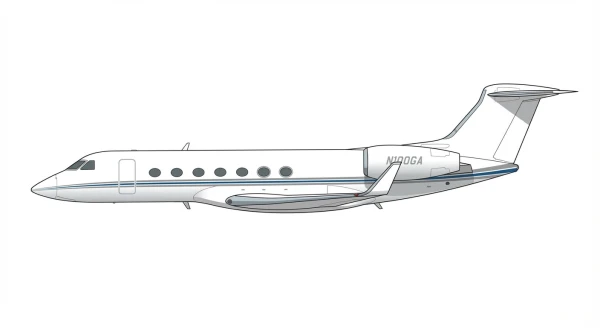
Description
In the early 1990s, the Gulfstream V (GV) was developed, rolling out in 1995. This aircraft represented Gulfstream's entry into the ultra-long-range business jet market, offering a capability of up to 6,500 nmi (12,000 km). It achieved certification on April 11, 1997. Total production of the Gulfstream V amounted to 193 aircraft.
Compared to the Gulfstream IV, the Gulfstream V incorporates several design enhancements. It is powered by Rolls-Royce BR700-710A1-10 engines, which provide increased thrust and feature a higher bypass ratio along with Full Authority Digital Engine Controls (FADEC). This engine upgrade contributed to an increase in the operating ceiling from 45,000 to 51,000 feet. The aircraft includes thrust reversers and utilizes composite materials for flight control surfaces. Aerodynamic and structural changes include a 30% increase in horizontal tail area and an extended wingspan, growing from 74.6 to 93.5 feet. The fuselage was lengthened by 5 feet forward of the main entry door and by 2 feet aft of the wing. These modifications resulted in a 15% increase in maximum takeoff and landing weights. Furthermore, the Gulfstream V introduced a new semi supercritical wing design, enabling a fuel capacity increase of 41,000 lb.
As a business jet and VIP transport platform, the Gulfstream V is not typically configured with offensive armament. However, specific modified variants exist for specialized missions. The Israeli Ministry of Defense operates a Special Electronic Mission Aircraft (SEMA) based on a highly modified Gulfstream G-V. The C-20C variant operated by the U.S. Air Force was equipped with enhanced, secure communications capabilities. The HIAPER Gulfstream V, operated by the National Center for Atmospheric Research (NCAR), is specifically modified to accept wing/pylon mounted instrumentation for environmental and atmospheric research purposes.
The Gulfstream V has been deployed in diverse operational roles globally across both civilian and military sectors. Its primary function remains executive transport for corporate entities and individual owners. Within governmental and military domains, the G-V platform, under the U.S. military designation C-37A, is utilized for command and executive transport across the Air Force, Army, Marine Corps, Navy, and Coast Guard. Internationally, the Japan Coast Guard operates a C-37A for maritime surveillance and search and rescue missions. Specialized G-V modifications serve unique functions, such as the NCAR's HIAPER aircraft for atmospheric science. Other platform adaptations within the family, like G550-based systems, are used for roles such as Airborne Early Warning and Control (AEW&C) by the Italian and Singapore Air Forces, while Saudi Arabia operates two GVs configured for medical evacuation missions. The aircraft's operational effectiveness is supported by its long range, high cruising altitude, and payload capacity.
Main Variants:
-
G-V: The initial production variant, powered by two BMW-Rolls-Royce 700-710A1-10 engines.
-
C-37A: The United States military designation for the G-V, employed for command and executive transport duties.
-
C-20C: A variant based on the C-20B (an earlier Gulfstream III/IV type) that was modified with enhanced, secure communications and used to support senior-level personnel.