Gulfstream V
American business jet, active during the late 20th and early 21st century, widely operated for long-range, high-speed corporate travel. Key figures: top speed 940 km/h, range 12,000 km, service ceiling 15,545 m, max takeoff weight 41,050 kg, unit price $18M, built 193. In service with 5 air forces as of 2026 — United States (12), Israel (3), Algeria (1) and 2 others.
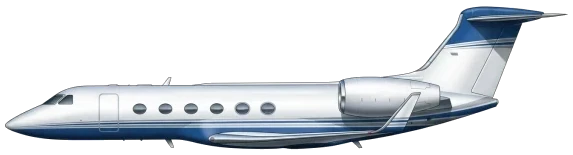
| Length | 29.4 m (96.5 ft) |
| Wingspan | 28.5 m (93.4 ft) |
| Height | 7.7 m (25.1 ft) |
| Wing area | 106 m² (1141.0 sqft) |
| Empty weight | 20,956 kg (46,200 lbs) |
| Max. takeoff weight | 41,050 kg (90,500 lbs) |
| Powerplant | 2 × turbofans Rolls-Royce BR710A1-10 6,690 kgf each |
| Maximum speed | 940 km/h (584 mph) |
| Operational range | 12,000 km (7,456 mi) |
| Service ceiling | 15,545 m (51,001 ft) |
| Takeoff distance | 1,570 m (5,151 ft) |





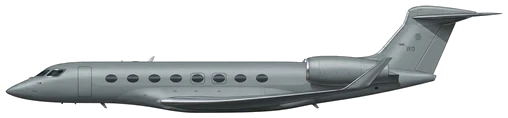
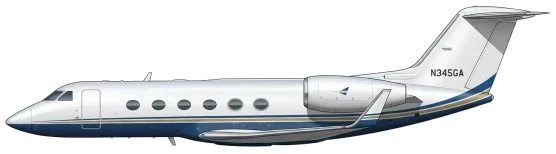
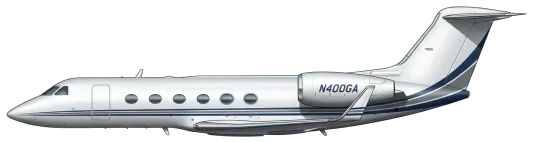
Description
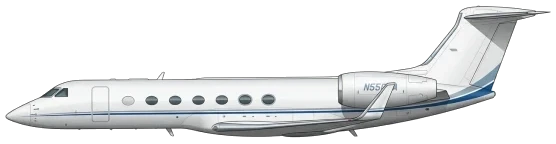
The Gulfstream V (GV) is a large, long-range business jet built by Gulfstream Aerospace at Savannah, Georgia, and derived from the Gulfstream IV. It was the company's first ultra-long-range business jet, developed in the early 1990s in response to the Bombardier Global Express. The type first flew on 28 November 1995 and entered service in June 1997; 193 were built before the improved Gulfstream G550 succeeded it in 2003. In military service it is best known as the C-37A executive transport of the US armed forces.
Development
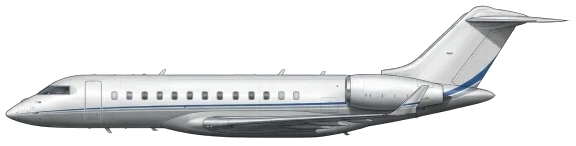
Gulfstream developed the GV by reworking the Gulfstream IV with new engines, a new wing and a longer fuselage. The first aircraft was rolled out in 1995 and flew on 28 November 1995; the FAA certified the type on 11 April 1997, and it entered service in June 1997. After 193 aircraft, the GV was replaced in 2003 by the improved Gulfstream G550 (Model GV-SP). Against the Global Express, the GV offered more range and better fuel efficiency, while the Bombardier aircraft had better runway performance and a larger cabin.
Design
The GV is powered by two Rolls-Royce BR710A1-10 turbofans, each rated at 65.6 kN (14,750 lbf), with a higher bypass ratio than the GIV's engines, FADEC and thrust reversers. The wing is a new semi-supercritical design, and span grew from 22.7 m to 28.5 m (74.6 to 93.5 ft); the horizontal tail area was increased by 30%, and the flight control surfaces are composite. The fuselage was lengthened by 1.5 m (5 ft) ahead of the main door and by 61 cm (2 ft) aft of the wing. Maximum take-off and landing weights rose by 15%, and fuel capacity is about 18.7 t (41,300 lb), roughly 5.4 t more than the GIV. The ceiling was raised from 13,700 m to 15,500 m (45,000 to 51,000 ft).
The aircraft is 29.4 m long with a wing area of 105.6 m². Empty weight is 20,956 kg against a maximum take-off weight of 41,050 kg (90,500 lb), with a maximum payload of 3,800 kg. The three-zone cabin, similar to the GIV's and smaller than the Global Express's, is 13.39 m long and 1.88 m high. A crew of two flies the aircraft; a typical configuration carries four crew and 14 passengers, with capacity for 15 to 19. Maximum speed is Mach 0.885 and long-range cruise Mach 0.80. Range is 12,000 km (6,500 nmi) with four crew and eight passengers, and endurance exceeds 14 hours. Take-off distance at maximum weight is about 1,900 m.
Military service
On 5 May 1997 the US Air Force selected the GV for its VC-X programme to expand the Special Air Mission fleet, and designated it C-37A. The first aircraft arrived at Andrews Air Force Base, Maryland, in July 1998, followed by a second in September. The C-37A carries cabinet secretaries, congressional delegations and senior military leaders, with a typical mission of 10,200 km (5,500 nmi) without refuelling. It is operated by the 99th Airlift Squadron (89th Airlift Wing) at Andrews, the 310th Airlift Squadron (6th Air Mobility Wing) at MacDill AFB, Florida, the 65th Airlift Squadron at Hickam, Hawaii, and the 76th Airlift Squadron (86th Airlift Wing) at Ramstein, Germany. The US Army flies it from its Priority Air Transport Detachment at Andrews, and the Navy, Marine Corps and Coast Guard use it as a command and executive transport. The Japan Coast Guard took delivery of a C-37A on 17 January 2005, named Umi Washi (Sea Eagle), for maritime surveillance and search and rescue.
Israel ordered the GV in November 2001. Three airframes, delivered in June 2005, February 2006 and August 2006, were fitted out by Israel Aerospace Industries as Special Electronic Mission Aircraft for signals intelligence, named Nachshon Shavit. First used operationally in the 2006 Lebanon War, shortly after initial operational capability, they serve with 122 "Nachshon" Squadron at Nevatim alongside the G550-based CAEW airborne early warning aircraft.
The Hellenic and Algerian air forces fly the GV as a VIP transport; Kuwait operates it as a state transport, and Saudi Arabia has two in medical evacuation configuration.
Research use
The National Center for Atmospheric Research received a GV on 11 March 2005 as HIAPER (High-performance Instrumented Airborne Platform for Environmental Research), modified to carry instruments on wing pylons. NASA flies one, including to bring astronauts home from Kazakhstan after International Space Station missions.
Variants
- G-V: production model with two Rolls-Royce BR710A1-10 turbofans; 193 built.
- C-37A: US military designation, also used by the Japan Coast Guard.
- G550 (GV-SP): improved development that replaced the GV in production in 2003.
Frequently Asked Questions
What type of aircraft is the Gulfstream V?
What is the maximum speed of the Gulfstream V?
What is the range of the Gulfstream V?
When did the Gulfstream V first fly?
How many Gulfstream V have been built?
Which countries operate the Gulfstream V?
How much does a Gulfstream V cost?
What is the service ceiling of the Gulfstream V?
- OCT 52026 Updated Description rewritten: GV design, C-37A transport units, Israeli Nachshon Shavit SIGINT aircraft, other operators
- JUL 232026 Updated Sources and cross-references refreshed
- APR 72026 Updated Sources and cross-references refreshed
- FEB 72026 Updated Top speed added
- JAN 122026 Updated Range updated in a site-wide editorial pass