Gulfstream III
American business jet, primarily used in the 1980s for private, business, and military transport purposes. Key figures: top speed 927 km/h, range 6,760 km, service ceiling 13,716 m, max takeoff weight 31,615 kg, unit price $0.69M, built 202. In service with 2 air forces as of 2026 — India (3), Morocco (1).
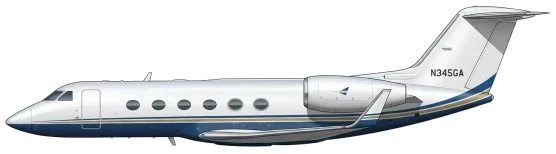
| Length | 25.3 m (83.1 ft) |
| Wingspan | 23.5 m (77.1 ft) |
| Height | 7.4 m (24.4 ft) |
| Wing area | 86.8 m² (934.6 sqft) |
| Empty weight | 17,236 kg (37,999 lbs) |
| Max. takeoff weight | 31,615 kg (69,699 lbs) |
| Powerplant | 2 × turbofans Rolls-Royce RB163 Spey Mk 511-8 5,171 kgf each |
| Maximum speed | 927 km/h (576 mph) |
| Operational range | 6,760 km (4,200 mi) |
| Service ceiling | 13,716 m (45,000 ft) |
| Climb rate | 19.3 m/s (63.3 ft/s) |


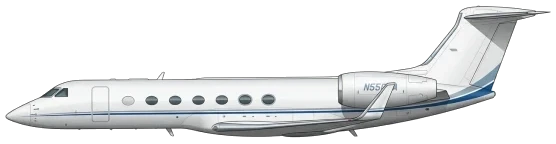
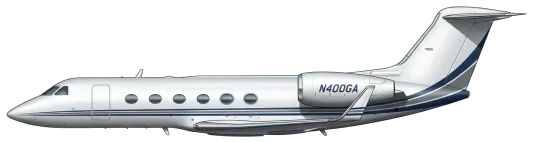
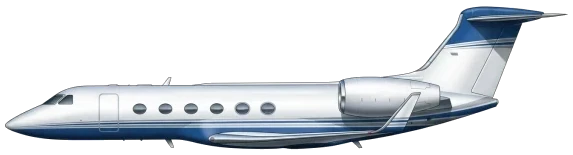
Description
The Gulfstream III (G-1159A) is a business jet built by Gulfstream at Savannah, Georgia, as an improved development of the Grumman Gulfstream II. It kept the Spey engines and basic airframe of its predecessor but introduced a modified wing with winglets and a slightly longer fuselage. First flown in 1979 and certified in 1980, it was built until 1986, with 202 aircraft completed, and was succeeded by the Gulfstream IV. In US service it is designated C-20A to C-20E, and the type has also flown with several air forces and governments.
Development
Design studies were carried out by Grumman Aerospace together with Gulfstream American. An all-new supercritical wing with winglets was studied, but optimisation work showed that most of the expected gain could be obtained by modifying the existing wing, so the Gulfstream II wing box and trailing-edge surfaces were retained.
Compared with the Gulfstream II, the span grew by 1.8 m (6 ft), plus 1.5 m (5 ft) winglets, and the leading edge was lengthened with a modified contour. The fuselage was stretched by 61 cm (2 ft) aft of the main door, the radome extended and a new curved windshield fitted. Maximum take-off weight rose to 31,615 kg (69,700 lb), and the autopilot and instruments were revised. The first flight took place on 2 December 1979 and the FAA type certificate followed on 22 September 1980. Production ended in 1986 after 202 aircraft.
Design
The Gulfstream III is flown by two pilots and seats 19 passengers in the standard configuration. It is 25.32 m long, with a span of 23.72 m, a height of 7.43 m and a wing area of 86.83 m². Empty weight is 17,237 kg and maximum take-off weight 31,615 kg. Power comes from two Rolls-Royce Spey 511-8 turbofans of 51 kN (11,400 lbf) each. Maximum cruising speed is 928 km/h and long-range cruise 819 km/h; range is 6,760 km (3,650 nmi) with eight passengers and IFR reserves. Service ceiling is 13,700 m (45,000 ft) and rate of climb 19 m/s. The type is named, with the Gulfstream II, in the FAA Stage 3 noise rule effective 31 December 2015.
Military and government service
In the US armed forces the Gulfstream III forms the C-20A to C-20E of the C-20 series (the C-20F, G, H and J are Gulfstream IVs). The C-20A served the US Air Force with 14 passengers and five crew; it was retired from the USAF in 2002, and one passed to NASA Armstrong at Edwards AFB as a test aircraft, fitted with a centreline pylon for the UAVSAR radar pod. The C-20B is a Special Air Mission transport with upgraded electronics flown by the USAF and the US Coast Guard, the Coast Guard aircraft carrying the Commandant and the Secretary of Homeland Security. The C-20C is a C-20B with hardened secure communications, often flown as a backup accompanying the VC-25A when it operates as Air Force One. The C-20D is a US Navy operational support airlift aircraft with modified communications, and the C-20E the US Army's operational support airlift version.
Denmark received three SMA-3s, built in 1983 for the Royal Danish Air Force with a Texas Instruments APS-127 search radar for maritime patrol, fisheries protection, search and rescue and VIP transport; they are now retired. On 3 August 1996 a Danish Gulfstream III flew into a mountain on approach to Vágar in the Faroe Islands, killing all nine aboard, including Denmark's Chief of Defence. The SRA-1 was a special reconnaissance and surveillance export version. India took two aircraft fitted with long-range oblique photography cameras (K2961 and K2962); the Indian Air Force lists three Gulfstream IIIs. The Italian Air Force flew two from 1985 to 2003. Other military and government operators have included Algeria, Cameroon, Gabon, Ghana, Ireland (on lease), Ivory Coast, Mexico, Morocco, Oman, Saudi Arabia, Togo, Uganda, Venezuela and Zimbabwe. A Venezuelan vice-presidential Gulfstream III crashed into the sea off Margarita Island on 4 July 2017 with nine aboard.
The ex-Danish SMA-3s, operated by Phoenix Air, provide maritime range surveillance for the Missile Defense Agency and, fitted with an Airborne Biomedical Containment System developed by the CDC, flew Ebola evacuation missions from Liberia in 2014. Lockheed Martin's "Dragon Star" multi-intelligence laboratory is a Gulfstream III leased by Italy since 2012.
Variants
- G-1159A Gulfstream III: basic production version.
- C-20A: US Air Force transport, 14 passengers and five crew; retired in 2002.
- C-20B: Special Air Mission transport with upgraded electronics, USAF and US Coast Guard.
- C-20C: C-20B with hardened secure communications.
- C-20D: US Navy operational support airlift version with modified communications.
- C-20E: US Army operational support airlift version.
- SMA-3: maritime patrol version for Denmark with APS-127 search radar; three built in 1983.
- SRA-1: special reconnaissance and surveillance export version.
Frequently Asked Questions
What type of aircraft is the Gulfstream III?
What is the maximum speed of the Gulfstream III?
What is the range of the Gulfstream III?
When did the Gulfstream III first fly?
How many Gulfstream III have been built?
Which countries operate the Gulfstream III?
How much does a Gulfstream III cost?
What is the service ceiling of the Gulfstream III?
- OCT 52026 Updated Description rewritten: GII-derived wing, C-20A to C-20E variants, Danish SMA-3 and military operators
- AUG 52026 Updated Powerplant updated in a site-wide editorial pass
- APR 72026 Updated Sources and cross-references refreshed
- JAN 122026 Updated Gulfstream III: range added; Gulfstream III: price added