Hawker 400
Light business jet adapted as a military aircrew trainer, flown by the USAF as the T-1A Jayhawk until 2026 and still in Japanese service as the T-400. Key figures: top speed 860 km/h, range 4,000 km, service ceiling 13,716 m, max takeoff weight 7,303 kg, unit price $7.4M, built 951. In service with 1 air force as of 2026 — Japan (13).
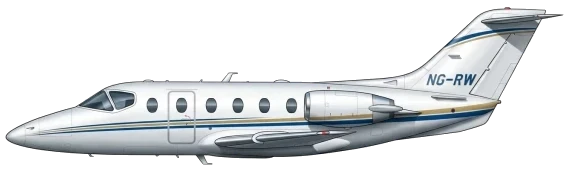
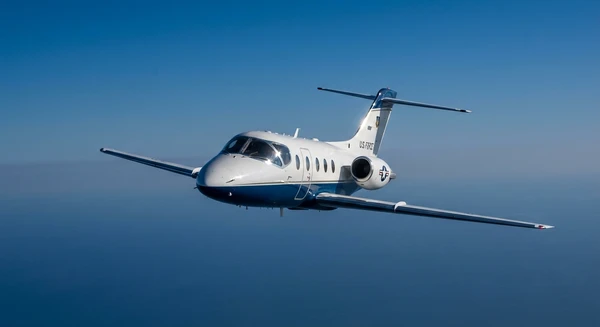
| Length | 14.8 m (48.4 ft) |
| Wingspan | 13.3 m (43.5 ft) |
| Height | 4.2 m (13.9 ft) |
| Wing area | 22.4 m² (241.4 sqft) |
| Empty weight | 4,559 kg (10,051 lbs) |
| Max. takeoff weight | 7,303 kg (16,100 lbs) |
| Powerplant | 2 × turbofans Pratt & Whitney Canada JT15D-5B 1,315 kgf each |
| Maximum speed | 860 km/h (534 mph) |
| Operational range | 4,000 km (2,485 mi) |
| Service ceiling | 13,716 m (45,000 ft) |
| Climb rate | 19.2 m/s (63.0 ft/s) |

Recent Events — Hawker 400
2 events →
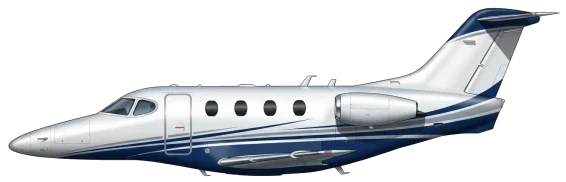
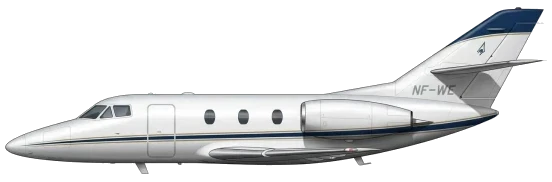
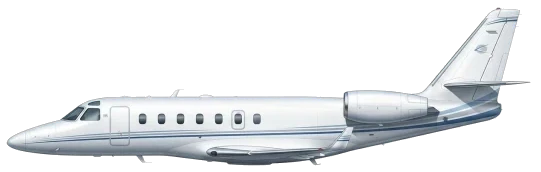
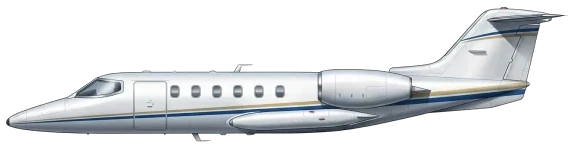
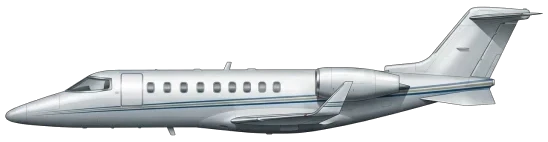
Description
The Hawker 400 is a light business jet and military aircrew trainer originally designed by Mitsubishi in Japan and later produced in the United States by Beechcraft, Raytheon, and Textron Aviation. First flying in 1978 and receiving type certification in 1981, the aircraft is utilized for corporate transport and military instruction. Over 900 aircraft of the family have been delivered.
Development
Designed originally as the Mitsubishi MU-300 Diamond, the aircraft made its first flight on August 29, 1978, but FAA certification was delayed until November 6, 1981, due to post-accident regulatory changes that added 600 lb (270 kg) to the airframe. Mitsubishi produced 97 MU-300s before selling manufacturing rights to Beechcraft in 1985, which obtained FAA certification for the Beechjet 400 in May 1986. Following Raytheon's acquisition of Hawker in 1993, the type was renamed the Hawker 400, leading to the 400XP variant in 2003 with increased gross weight and thrust reversers. Modernization efforts include the Nextant 400XT retrofit certified in 2011 and the factory-supported Hawker 400XPR, which first flew in 2012 and began deliveries in July 2017.
Design
The Hawker 400 is an all-metal, low-wing twin-turbofan aircraft configured for a two-pilot crew and seven to nine passengers in a pressurized cabin. The wing utilizes a computer-designed supercritical airfoil to minimize aerodynamic drag. Standard models are powered by two rear-fuselage-mounted Pratt & Whitney Canada JT15D turbofans, consuming 1,500 lb (680 kg) of fuel during the first hour of flight. The aircraft has a basic operating weight of 11,000 to 11,100 lb (4,990 to 5,030 kg) and a maximum range of 1,351 nmi (2,502 km) at a cruising speed of Mach 0.71 to 0.73.
Operational History
The majority of Hawker 400s are registered in the United States, with additional major civil operator concentrations in Mexico and Brazil. Corporate operators average 300 to 400 flight hours annually, whereas commercial charter and fractional operators fly between 800 and 900 hours per year. In military service, the United States Air Force operated 178 T-1A Jayhawk variants for training transport and tanker crews until the type was retired on 22 August 2026 after 34 years, Vance Air Force Base being the last to fly it and the survivors going to storage. The Japan Air Self-Defense Force continues to operate 13 T-400 aircraft.
Variants
-
Mitsubishi MU-300 Diamond I: Initial production variant of which 89 aircraft were built.
-
Beechcraft Model 400 Beechjet: Production model built by Beechcraft after acquiring the design rights from Mitsubishi in 1985.
-
Model 400A: Upgraded variant featuring increased range, higher takeoff weight, and an all-glass flight deck, later designated the Hawker 400XP.
-
Model 400T: Military trainer variant manufactured for the United States Air Force as the T-1 Jayhawk and the Japan Air Self-Defense Force as the T-400.
-
Hawker 400XPR: Factory-certified upgrade package featuring Williams FJ44-4A-32 engines, winglets, updated avionics, and reduced fuel consumption.
Frequently Asked Questions
What type of aircraft is the Hawker 400?
What is the maximum speed of the Hawker 400?
What is the range of the Hawker 400?
When did the Hawker 400 first fly?
How many Hawker 400 have been built?
Which countries operate the Hawker 400?
How much does a Hawker 400 cost?
What is the service ceiling of the Hawker 400?
- AUG 262026 Updated T-1A Jayhawk retirement recorded and the short description brought back to a military register
- AUG 62026 Updated Description updated
- AUG 52026 Updated Powerplant updated in a site-wide editorial pass
- APR 72026 Updated Sources and cross-references refreshed
- JAN 122026 Updated Range updated in a site-wide editorial pass