IAR-93 / J-22 Orao
Summary
| Category | Combat Aircraft |
| Origin country | 🇷🇴 Romania • 🇳🇱 Ex-Yugoslavia |
| Manufacturer | CNIAR/Soko |
| First flight | 31 August 1974 |
| Year introduced | 1977 |
| Number produced | 88 units |
| Average unit price | $10 million |
Technical specifications
| Version: IAR-SOKO IAR-93B | |
|---|---|
| Crew | 1 pilot |
| Operational range | 1,320 km (820 mi) |
| Maximum speed | 1094 km/h (680 mph) |
| Wing area | 26 m² (279.9 sqft) |
| Wingspan | 9.3 m (30.5 ft) |
| Height | 4.5 m (14.8 ft) |
| Length | 14.9 m (48.9 ft) |
| Service ceiling | 13,600 m (44,619 ft) |
| Empty weight | 5,750 kg (12,677 lbs) |
| Max. takeoff weight | 10,900 kg (24,030 lbs) |
| Climb rate | 65.0 m/s (213.3 ft/s) |
| Powerplant | 2 x turbojets Rolls-Royce Viper Mk 633-47 delivering 3628 kgf each |
| Ejection seat | Martin-Baker Mk 10 |
Current operating countries
| Country | Units | ||
|---|---|---|---|

|
Serbia | 17 | |
All operators
Armament
Missiles payload:
- Air-to-Air Short-Range Vympel R-3 (AA-2 Atoll)
Bombs payload:
- Low-Drag BM-100
- Low-Drag BM-250
- Low-Drag BM-500
Description
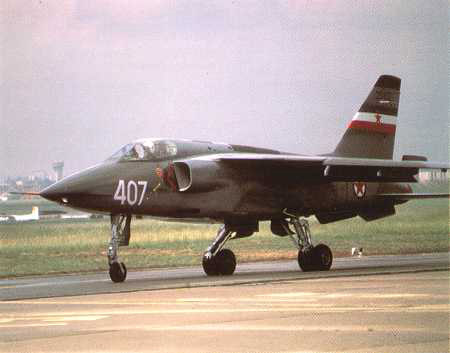
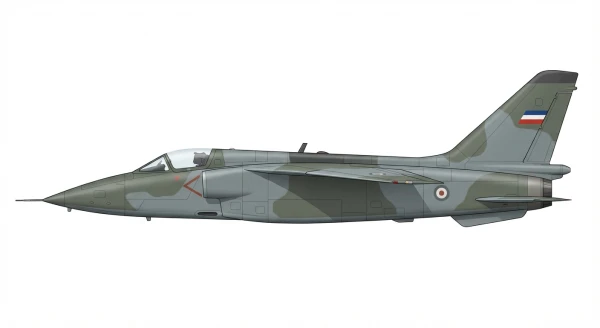
During 1970, Romania and Yugoslavia initiated discussions to jointly develop a new ground-attack fighter, leading to the YuRom venture in 1971. This collaboration, driven by the nations' desire to avoid overreliance on the Soviet Union, aimed to produce a lightweight, rugged aircraft using locally sourced equipment and avionics, capable of operating from austere airstrips. The resulting design was a conventional twin-engine monoplane with high-mounted, swept wings. Designated IAR-93 Vultur in Romania and J-22 Orao in Yugoslavia, the project initially sought a supersonic single-engine aircraft, but the UK's refusal to license the desired engine forced the selection of the less powerful Rolls-Royce Viper. Plans to incorporate an afterburner faced prolonged difficulties, leaving early models without it, until the 1980s, when both countries developed afterburning versions. The Yugoslav prototype first flew on 31 October 1974, deliberately timed to coincide with the IAR-93 Vultur's first flight. Serial production began at Mostar, but the facility was abandoned and heavily damaged during the Yugoslav Wars in 1992. In October 1983, the first afterburner-equipped J-22 Orao flew, and on 22 November 1984, an Orao exceeded Mach 1 in a shallow dive, becoming the first Yugoslav-designed aircraft to achieve this feat.
The J-22 Orao is a twin-engined combat jet aircraft designed for performing close air support, ground-attack, and tactical reconnaissance missions, with a limited air-defense capability. Its configuration features a shoulder-mounted wing and two 23 mm twin-barrel cannons within the lower forward fuselage, and it can be outfitted with bombs, rockets, and air-to-surface missiles. The cockpit is furnished with Martin-Baker-built zero/zero ejection seats, and the rear fuselage is detachable to ease engine access. Standard communication and navigation equipment are present, including a Honeywell SGP500 twin-gyroscope navigation system, a fire control and weapons management system with a Thomson-CSF VE-120T head-up display (HUD), a GEC-Marconi three-axis stability augmentation system, and a Rockwell Collins VIR-30 VHF omnidirectional range and instrument landing system. For defense, it includes an Iskra SO-1 radar warning receiver (RWR), chaff/flare dispensers, and a P10-65-13 passive jammer pod, with options for optical/infrared reconnaissance or optical reconnaissance/jammer pods.
The J-22 Orao features five hardpoints – four underwing and one centerline – capable of carrying a total external payload of 2,800 kg (6,200 lb). Each wing hardpoint can accommodate up to 500 kg (1,100 lb), while the fuselage station can handle 800 kg (1,800 lb). Standard armament includes two GSh-23L 23 mm twin-barrel cannons, mounted in the lower forward fuselage with 200 rounds per gun. For air-to-ground missions, the aircraft can carry a variety of ordnance, including 50/100/250/500 kg general-purpose bombs, BL755 cluster bombs, PLAB-350 napalm bombs, Matra Durandal anti-runway bombs, and AM-500 sea mines. It can also be equipped with BRZ-127 rockets, L-57-16MD (UB-16) rocket pods, L-128-04 rocket pods, AGM-65B Maverick TV-guided air-to-ground missiles, or Grom-1 AGMs (based on the Soviet Kh-23).
The J-22 Orao saw its initial operational deployment with the 351st reconnaissance aviation squadron of the 82nd Aviation Brigade within the Yugoslav Air Force. Prior to the Yugoslav Wars in 1991, only three squadrons were fully equipped with the J-22 and NJ-22 variants, including the 238th fighter-bomber aviation squadron of the 82nd Aviation Brigade, the 241st squadron of the 98th Aviation Brigade, and the 242nd squadron of the 127th Fighter-Bomber Regiment at Golubovci Airbase. At the onset of the conflict in Slovenia, J-22s performed show-of-force flights without engaging in combat. Later, during 1991, the Yugoslav People's Army (JNA) employed the J-22 in offensive ground-attack missions against targets in Croatia. As Yugoslavia dissolved, the majority of the airframes were relocated to Serbia and Montenegro, while some ended up in the control of other successor states. The Bosnian-Serb Republika Srpska Air Force inherited a squadron of nine Oraos which gradually degraded due to funding limitations and international embargoes; by 2003, seven remained. During 1999, the remaining Yugoslav J-22s engaged in limited combat against the Kosovo Liberation Army (KLA), flying 36 combat missions. One J-22 was lost, and eleven were destroyed on the ground during a NATO airstrike at Ponikve Air Base. As of 2019, the Serbian Air Force operated ten J-22 and NJ-22 Oraos, with additional airframes in storage, and continues to explore service life extension programs through overhauls and structural inspections.
Main Variants:
-
IJ-22 Orao 1: This was a dedicated reconnaissance variant, with 26 aircraft produced, including 15 pre-production models converted to the reconnaissance role.
-
INJ-22A Orao 1: This was an early series trainer aircraft, specifically purposed for training reconnaissance pilots.
-
J-22A Orao 1: This was the Yugoslav equivalent to the IAR-93A, equipped with non-afterburning turbojets.
-
J-22B Orao 2: This was the Yugoslav equivalent to the IAR-93B, featuring an afterburner and increased weapons load.
-
NJ-22 Orao: This was a dedicated two-seat training variant, equipped with afterburning engines and operated by the Yugoslav Air Force.