KC-10 Extender
American tanker and cargo aircraft, developed from the DC-10 airliner in the late 20th century, operated by the United States Air Force and the Royal Netherlands Air Force for aerial refueling and transport. Key figures: top speed 866 km/h, range 7,100 km, service ceiling 13,000 m, max takeoff weight 267,619 kg, unit price $96M, built 60.
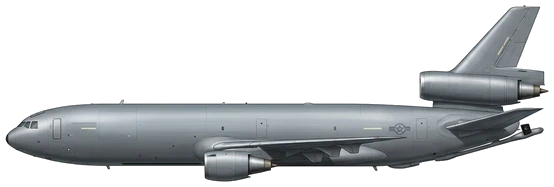
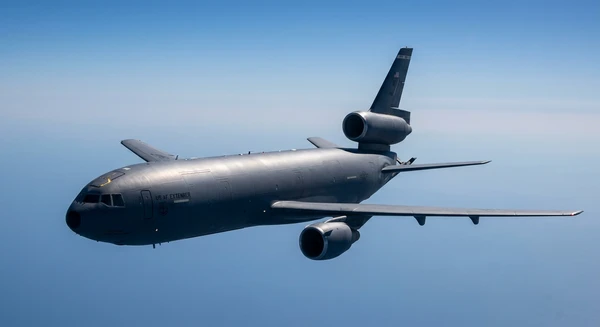
| Crew | 4 (aircraft commander, co-pilot, flight engineer, boom operator) |
| Length | 55.4 m (181.6 ft) |
| Wingspan | 50.4 m (165.4 ft) |
| Height | 17.7 m (58.1 ft) |
| Wing area | 367.7 m² (3957.9 sqft) |
| Empty weight | 109,328 kg (241,027 lbs) |
| Max. takeoff weight | 267,619 kg (589,998 lbs) |
| Powerplant | 3 × General Electric F103 (GE CF6-50C2) 234 kN each |
| Maximum speed | 866 km/h (538 mph) |
| Operational range | 7,100 km (4,412 mi) |
| Service ceiling | 13,000 m (42,651 ft) |
| Climb rate | 34.9 m/s (114.5 ft/s) |
Description
The McDonnell Douglas KC-10 Extender was developed under the Advanced Tanker Cargo Aircraft Program (ATCA) to supplement the Boeing KC-135 Stratotanker. Following the 1973 Yom Kippur War, the United States Air Force (USAF) sought a tanker with greater range and payload capabilities after Operation Nickel Grass demonstrated the limitations of existing assets when denied European landing rights. In December 1977, the USAF selected the McDonnell Douglas DC-10 over the Boeing 747 and Lockheed C-5, citing its performance on shorter runways. The KC-10 first flew in July 1980 and performed its first aerial refueling sortie in October 1980. McDonnell Douglas produced 60 aircraft for the USAF between 1981 and 1988.
Design
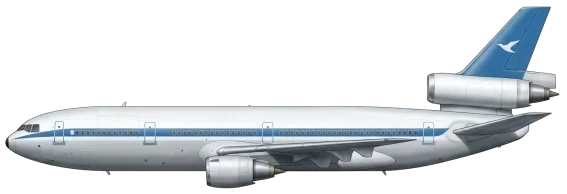
Based on the civilian DC-10-30CF, the KC-10 retains 88% commonality with the commercial airframe. Modifications for military service included the removal of most windows and lower cargo doors, the addition of military-specific avionics, and an improved cargo-handling system. The aircraft is powered by three General Electric F103 (CF6-50C2) turbofan engines, each providing 52,500 lbf of thrust. Fuel capacity was increased to 356,000 pounds (161,000 kg) through the installation of additional tanks in the baggage compartments below the main deck.
The refueling system features a digital fly-by-wire centerline boom and a hose-and-drogue system. The boom delivers fuel at a rate of 1,100 gallons per minute, while the drogue system operates at 470 gallons per minute. The boom operator is positioned in a rear cockpit with a wide window for visual monitoring. The final 20 aircraft produced also featured wing-mounted hose-and-drogue pods. In cargo configuration, the KC-10 carries up to 170,000 pounds (77,000 kg) of freight or a combination of 75 personnel and 146,000 pounds (66,000 kg) of cargo.
Operational History
The USAF operated the KC-10 from 1981 to 2024. During Operation El Dorado Canyon in 1986, the aircraft provided refueling for F-111s striking Libya. In the 1990–91 Gulf War, KC-10s and KC-135s conducted 51,700 refueling operations, delivering 125 million gallons of fuel. Subsequent deployments included Operation Allied Force in 1999, where the KC-10 flew 409 missions, and operations in Afghanistan and Iraq. In 2021, the fleet supported the evacuation of 124,000 people during Operation Allies Refuge. The Royal Netherlands Air Force (RNLAF) operated two converted KDC-10s from 1995 to 2021. Upon retirement, the Dutch aircraft were sold to Omega Aerial Refueling Services. The USAF retired its final KC-10 in September 2024.
Variants
- KC-10A: The initial military production tanker and cargo variant based on the DC-10-30CF.
- KDC-10: A conversion of civilian DC-10-30CF aircraft for tanker and transport roles, operated by the RNLAF and Omega Aerial Refueling Services.
- KC-10B: A proposed tanker and transport version of the MD-11CF with increased cargo and fuel capacity offered to international customers.
Frequently Asked Questions
What type of aircraft is the KC-10 Extender?
What is the maximum speed of the KC-10 Extender?
What is the range of the KC-10 Extender?
When did the KC-10 Extender first fly?
How many KC-10 Extender have been built?
Which countries operate the KC-10 Extender?
How much does a KC-10 Extender cost?
What is the service ceiling of the KC-10 Extender?
- MAY 102026 Created Page created: KC-10 Extender