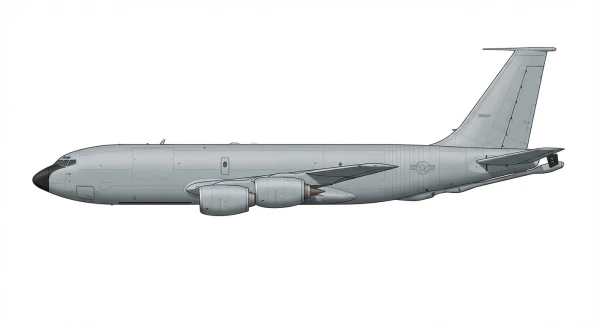
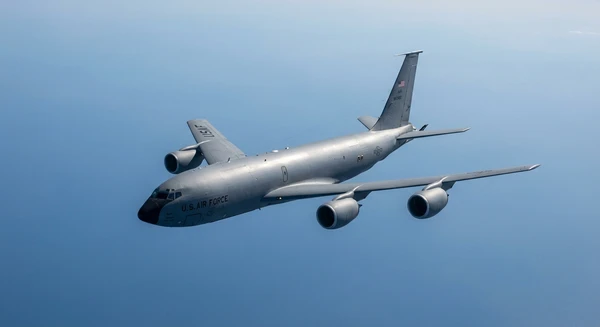
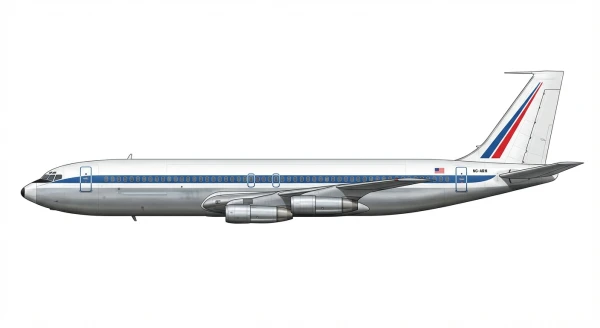
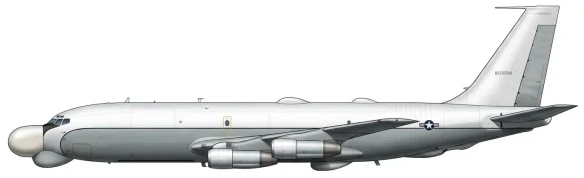
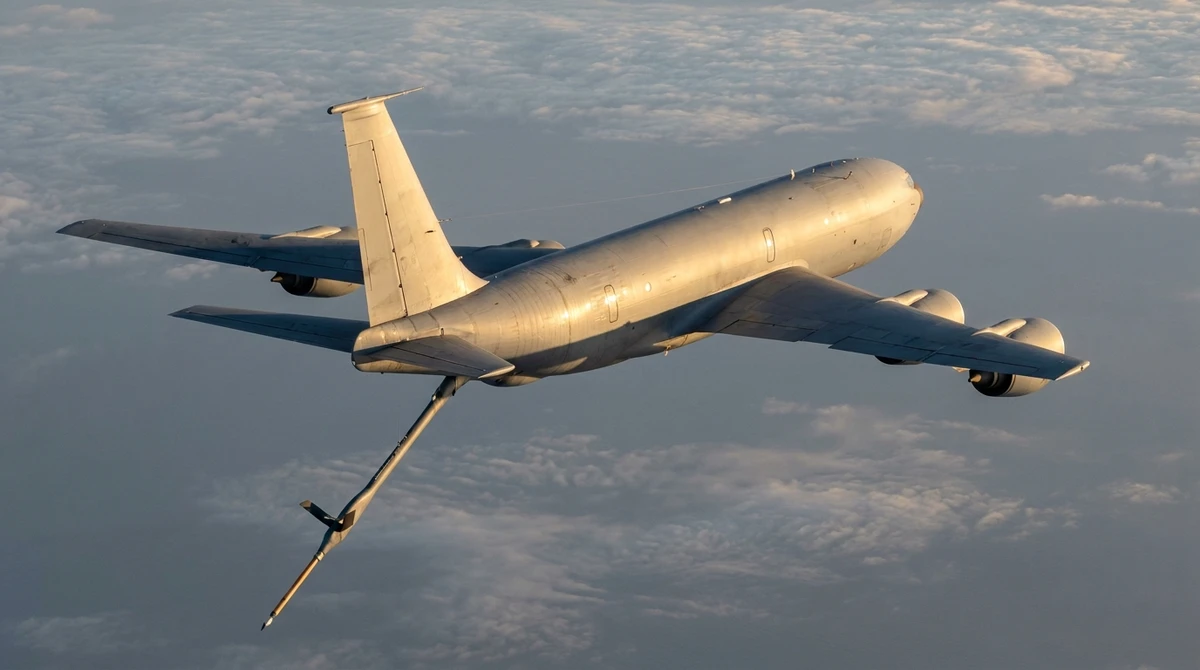
The Boeing KC-135 Stratotanker is an American military aerial refueling aircraft manufactured by Boeing. It entered service with the United States Air Force (USAF) in 1957 as the service's first jet-powered refueling tanker, replacing the piston-engined KC-97 Stratofreighter. The aircraft is known for providing continuous aerial refueling support for over 60 years, extending the range and endurance of strategic bombers and tactical fighters.
Development
Development began in the early 1950s using the Boeing 367-80 prototype demonstrator, parallel to the development of the commercial Boeing 707 airliner. Although Lockheed won the Strategic Air Command's 1954 jet tanker competition, the USAF ordered Boeing's design because the prototype was already flying and could be delivered two years earlier. The USAF placed an initial order for 29 KC-135As in 1954, and the type made its first flight in August 1956. Deliveries began in June 1957 and ended in 1965, with Boeing producing 820 total aircraft across the basic C-135 family.
Design
The KC-135 features 35° aft-swept wings, a narrow fuselage, and four underwing engine pods. Originally powered by Pratt & Whitney J57 turbojets using water injection, fleet retrofit programs replaced these with TF33 turbofans on the KC-135E and CFM International CFM56 (F108) turbofans on the KC-135R and KC-135T. Fuel is transferred primarily through a tail-mounted flying boom controlled by a prone operator, or via boom-attached drogues and wing-mounted Multi-point Refueling System pods. Avionics updates include the Pacer-CRAG modification—which eliminated the navigator position—and the Block 45 digital glass cockpit update. The upper deck can carry a payload of up to 83,000 pounds (38,000 kg) of cargo or 80 passengers.
Operational History
The KC-135 entered service supporting Strategic Air Command bombers before expanding its role to refuel tactical fighters during the Vietnam War, Operation Desert Storm, and Operation Epic Fury. Operational control transferred from Strategic Air Command to Air Mobility Command following a USAF reorganization in 1992. Export and international operators include France, Singapore, Turkey, Chile, and a commercial lessee in India, with France and Singapore later replacing their fleets with Airbus A330 MRTTs. Over its service life, 52 Stratotankers have been lost in accidents, resulting in 385 fatalities.
Variants
- KC-135A: Original production variant powered by four Pratt & Whitney J57 turbojet engines, with 732 built.
- KC-135E: Modified variant for Air National Guard and Air Force Reserve units retrofitted with Pratt & Whitney TF33 turbofans from retired 707 airliners.
- KC-135Q: Specialized variant fitted with separate fuel systems to transport JP-7 fuel for the Lockheed SR-71 Blackbird.
- KC-135R: Upgraded variant re-engined with CFM56 high-bypass turbofans, offering increased fuel offload capabilities and operational efficiency.
- C-135F: Dual-role tanker and cargo transport variant built new for the French Air Force.