KJ-2000 Mainring
Chinese second-generation airborne early warning and control (AEW&C) aircraft, developed in the early 2000s and operated by the People's Liberation Army Air Force for aerial surveillance and command. Key figures: top speed 850 km/h, range 5,500 km, max takeoff weight 175,000 kg, built 5. In service with 1 air force as of 2026 — China (4).
| Max. takeoff weight | 175,000 kg (385,808 lbs) |
| Powerplant | Soloviev D-30KP-2 |
| Maximum speed | 850 km/h (528 mph) |
| Operational range | 5,500 km (3,418 mi) |
| Endurance | 7 hours |

Description
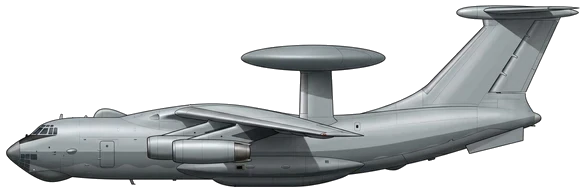
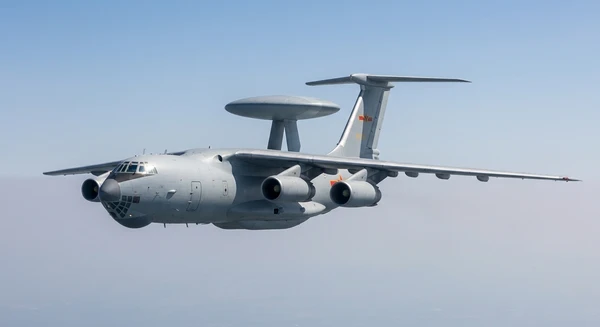
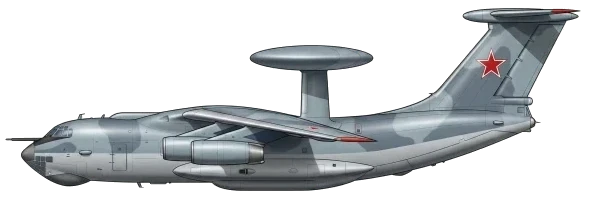
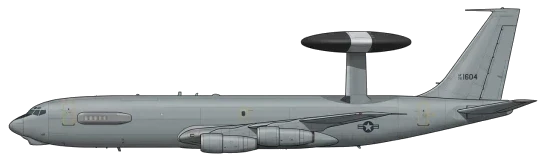
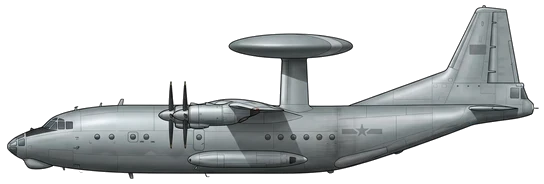
The Shaanxi KJ-2000 (Chinese: 空警-2000; NATO reporting name: Mainring) is a Chinese airborne early warning and control (AEW&C) aircraft developed by the Shaanxi Aircraft Corporation. Built on a modified Russian Ilyushin Il-76 airframe fitted with domestically designed avionics, it was the first AEW&C system to enter service with the People's Liberation Army Air Force (PLAAF). It is identified by its fixed radome housing three active electronically scanned array (AESA) radar modules, each covering a 120-degree sector, in place of the rotating radome used on the Boeing E-3 Sentry and Beriev A-50.
Development
The KJ-2000 is a second-generation Chinese AEW&C design, following the cancellation of the KJ-1 programme when military spending was cut during the reform and opening up period of the late 1970s. Interest in AEW&C capability increased after the Gulf War. The programme began after the A-50I contract with Russia and Israel collapsed in July 2000, when American pressure blocked the export of the Israeli EL/M-2075 Phalcon radar. China then developed a domestic system, and the first aircraft flew in 2003. Four aircraft have been identified, with further production constrained by the availability of Il-76 airframes; Rosoboronexport raised prices on Il-76 deliveries to China and India, and negotiations continued into early 2008. In March 2011, a Sino-Russian agreement moved Il-76 production to Chinese-owned companies, while Soloviev D-30KP-2 engine deliveries were unaffected. Supplier uncertainty led China to develop the KJ-200 on the smaller Shaanxi Y-8 airframe as a backup.
Design
The radome is 14 m (46 ft) in diameter and stationary, containing three phased-array modules arranged in an equilateral triangle, each covering a 120-degree sector for full 360-degree coverage. This contrasts with the 9 m (30 ft) rotating radomes of the E-3 Sentry and A-50. The radar is designated K/LLQF01, a multi-function three-dimensional pulse-Doppler AESA set developed by the Nanjing Research Institute of Electronics Technology (NRIET), a subsidiary of the China Electronics Technology Group Corporation. It operates between 1200 and 1400 MHz, detects fighter-sized targets at up to 470 km (290 mi) and ballistic missiles at up to 1,200 km (750 mi), and tracks 60–100 targets simultaneously. Maximum take-off weight is 175,000 kg (385,809 lb), maximum speed 850 km/h (530 mph), range 5,500 km (3,400 mi), and endurance 7 hours 40 minutes.
Operational History
The PLAAF established its first AWACS regiment in late 2004 at a remote airfield in southern China, selected for security reasons. The unit was commanded by Zhang Guangjian (张广建), a pilot with over 6,000 flight hours including time on the Il-76. The base was rebuilt to support the type, and the first KJ-2000 arrived in 2005, subsequently operating alongside KJ-200s in a mixed fleet. In 2013, three KJ-2000s conducted a 24-hour coverage exercise spanning northwest China, the East China Sea, and the South China Sea. Five aircraft were estimated in service as of 2008.
Variants
- KJ-2000: Il-76-based AEW&C aircraft with a fixed 14 m radome housing three AESA arrays.
- KJ-200: Simplified system on the Shaanxi Y-8 airframe, with a triple tail-fin layout and an Erieye-style "balance beam" lateral-scanning array.
- KJ-500: Third-generation AEW&C aircraft based on the enlarged Shaanxi Y-9.
- KJ-3000: Planned KJ-2000 replacement, reported in 2013 and confirmed in 2019 as based on the Xian Y-20 airframe.
Frequently Asked Questions
What type of aircraft is the KJ-2000 Mainring?
What is the maximum speed of the KJ-2000 Mainring?
What is the range of the KJ-2000 Mainring?
When did the KJ-2000 Mainring first fly?
How many KJ-2000 Mainring have been built?
Which countries operate the KJ-2000 Mainring?
- AUG 302026 Updated Description updated
- AUG 12026 Updated Manufacturer updated
- JUN 302026 Created Page created: KJ-2000 Mainring; then manufacturer updated