KJ-200 Moth
Chinese airborne early warning and control aircraft, developed in the early 21st century, deployed in military surveillance and command operations. Key figures: top speed 660 km/h, range 5,615 km, service ceiling 10,400 m, max takeoff weight 61,000 kg, built 11. In service with 1 air force as of 2026 — China (17).
| Length | 34.0 m (111.6 ft) |
| Wingspan | 38 m (124.7 ft) |
| Height | 11.2 m (36.6 ft) |
| Wing area | 121.9 m² (1312.1 sqft) |
| Empty weight | 35,490 kg (78,242 lbs) |
| Max. takeoff weight | 61,000 kg (134,482 lbs) |
| Powerplant | 4 × Zhuzhou WJ-6 turboprop 3,170 kW each |
| Maximum speed | 660 km/h (410 mph) |
| Operational range | 5,615 km (3,489 mi) |
| Service ceiling | 10,400 m (34,121 ft) |
| Climb rate | 10.0 m/s (32.8 ft/s) |

Description
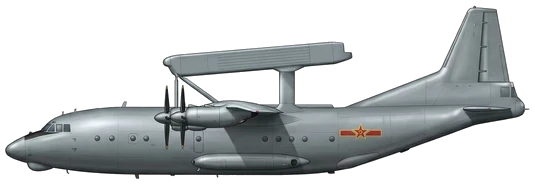
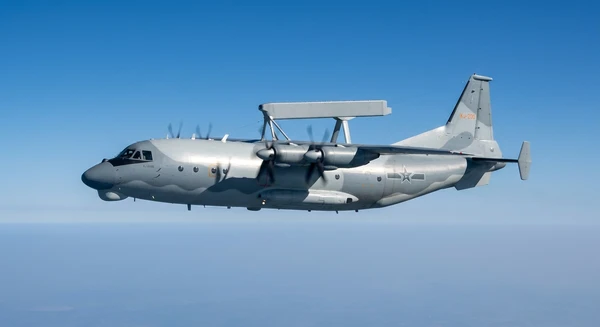
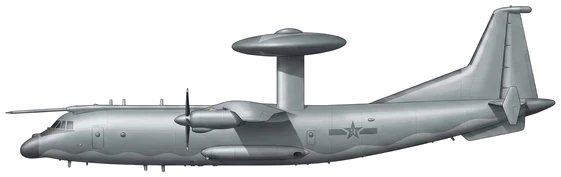
The KJ-200 (NATO reporting name: Moth), also designated Y-8W and known among observers as the GX-5, is an airborne early warning and control (AEW&C) aircraft developed by the Shaanxi Aircraft Corporation of China. Derived from the Shaanxi Y-8 military transport, it entered service with the People's Liberation Army in 2007 and is identified by the dorsal "plank" radar housing carrying an active electronically scanned array.
Development
Development began in 2002 after the United States blocked the sale of the Israeli EL/W-2090 Phalcon radar system to China. According to Science and Technology Daily, Shaanxi chief designer Ouyang Shaoxiu led the programme, which modified approximately 80 percent of the baseline Y-8 airframe. The first flight took place in January 2005. The second prototype crashed in 2006 as a result of wing icing, an accident that according to Chinese reporting almost derailed the programme. Ten aircraft are in Chinese service: four with the People's Liberation Army Air Force and six with the People's Liberation Army Naval Air Force.
Design
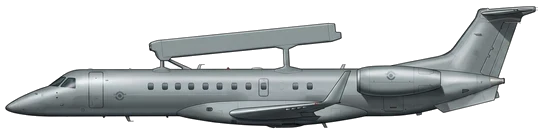
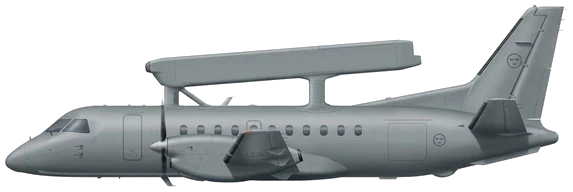
The airframe is based on the Y-8 four-engine turboprop transport, extensively reworked for the AEW&C role. The primary sensor is the JY-06 active electronically scanned array radar, mounted in a "plank" or balance-beam housing above the fuselage. This configuration is externally comparable to installations of the Ericsson Erieye radar, as used on the Embraer R-99 and Saab 340 AEW. Later production variants added satellite communications and revised mission electronics, and the KJ-200A introduced a redesigned nose section.
Operational History
The KJ-200 entered PLA service in 2007 and made its first official public appearance at the 2009 Chinese National Day Parade. Aircraft serve with both air force and naval aviation units, the latter operating over the South China Sea and adjacent waters. In February 2017, a KJ-200 and a US Navy Lockheed P-3 Orion inadvertently passed within 1,000 feet (300 metres) of each other over the South China Sea. No export customers have been recorded.
Variants
- KJ-200: Base production variant with JY-06 dorsal AESA radar.
- KJ-200A: Modified KJ-200 with revised nose section and new electronics, first observed in December 2016.
- KJ-200AG: Unofficial designation for a KJ-200A fitted with an inflight refuelling probe.
- KJ-200H: Variant modified for People's Liberation Army Naval Air Force service.
- KJ-200B: Adds satellite communications and new electronics; first observed in 2016 and in service from 2023.
Identified in 2 sorties in the official China-Taiwan Tensions activity reports between 2023 and 2023 — a floor, not a census: only sorties the source identified by type are counted, and how much it disclosed varies by year.
Frequently Asked Questions
What type of aircraft is the KJ-200 Moth?
What is the maximum speed of the KJ-200 Moth?
What is the range of the KJ-200 Moth?
When did the KJ-200 Moth first fly?
How many KJ-200 Moth have been built?
Which countries operate the KJ-200 Moth?
What is the service ceiling of the KJ-200 Moth?
- AUG 302026 Updated Description updated
- AUG 142026 Updated Air force inventory entries linked to this aircraft page
- JUL 232026 Updated Sources and cross-references refreshed
- JUN 302026 Created Page created: KJ-200 Moth