L-70 Vinka
Finnish-designed piston-powered military basic trainer aircraft, developed in the 1970s and used for pilot training and liaison roles. Key figures: top speed 240 km/h, range 860 km, service ceiling 5,000 m, max takeoff weight 1,250 kg, built 30.
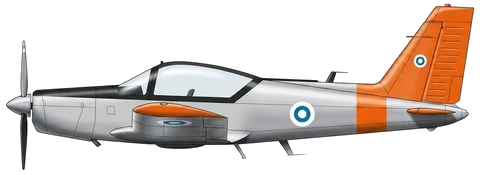
| Crew | 2 (student, instructor) |
| Length | 7.5 m (24.6 ft) |
| Wingspan | 9.9 m (32.3 ft) |
| Height | 3.3 m (10.9 ft) |
| Wing area | 14 m² (150.7 sqft) |
| Empty weight | 767 kg (1,691 lbs) |
| Max. takeoff weight | 1,250 kg (2,756 lbs) |
| Powerplant | 1 × Lycoming AEIO-360-A1B6 149 kW each |
| Maximum speed | 240 km/h (149 mph) |
| Operational range | 860 km (534 mi) |
| Service ceiling | 5,000 m (16,404 ft) |
| Climb rate | 5.7 m/s (18.7 ft/s) |
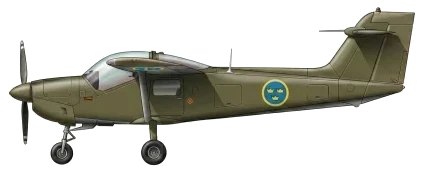
Description
The Valmet L-70 Vinka is a Finnish-designed, piston-powered military basic trainer aircraft developed by Valmet Oy. Design work commenced in September 1970 to replace the Saab Safir trainers then in use with the Finnish Air Force. Following a development order for the LEKO-70 in March 1973, the first prototype made its maiden flight on 1 July 1975 from Halli Airport. The Finnish Air Force ordered 30 aircraft under the designation Vinka on 28 January 1977, with production taking place at Valmet’s Kuorevesi plant.
Design
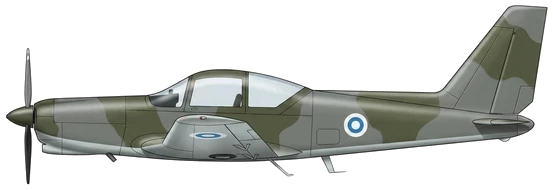
The L-70 is an all-metal, low-winged tractor monoplane configured with a fixed nosewheel undercarriage. It is powered by a 200 hp (149 kW) Lycoming AEIO-360-A1B6 flat-four piston engine driving a two-bladed variable-pitch propeller. In its primary training role, a pupil and instructor sit side-by-side under a large sliding canopy. For liaison missions, the cabin can accommodate either two additional seats or a stretcher and medical attendant. The aircraft features four underwing hardpoints with a maximum external capacity of 300 kg, supporting up to 150 kg each on the inner hardpoints and 100 kg each on the outer hardpoints.
Operational History
The Vinka entered service with the Finnish Air Force on 13 October 1980, and deliveries concluded in 1982. Trainees flew approximately 100 hours in the Vinka at the Air Academy before transitioning to the British Aerospace Hawk jet trainer. Valmet marketed the aircraft internationally as the L-70 Miltrainer, though no export sales were secured. The Finnish Air Force retired its Vinka fleet on 1 September 2022, replacing the type with 28 ex-RAF Grob G 115Es.
Variants
- L-70 Vinka: The initial piston-powered basic trainer production variant built for the Finnish Air Force.
- L-70 Miltrainer: The designation used for unsuccessful international export marketing.
- L-80 TP Turbotrainer: A turboprop-powered variant featuring a new wing, retractable undercarriage, and a 360 shp Allison 250 engine, which first flew on 12 February 1985.
- L-90 TP: A development prototype used to develop the subsequent L-90 Redigo trainer.
Frequently Asked Questions
What type of aircraft is the L-70 Vinka?
What is the maximum speed of the L-70 Vinka?
What is the range of the L-70 Vinka?
When did the L-70 Vinka first fly?
How many L-70 Vinka have been built?
Which countries operate the L-70 Vinka?
What is the service ceiling of the L-70 Vinka?
- JUL 12026 Created Page created: L-70 Vinka