O-2 Skymaster
American military forward air control and psychological operations aircraft, used between 1967 and 2010. Key figures: top speed 320 km/h, range 1,710 km, service ceiling 6,000 m, max takeoff weight 2,449 kg, built 532. In service with 2 air forces as of 2026 — Uruguay (3), Chile (2).
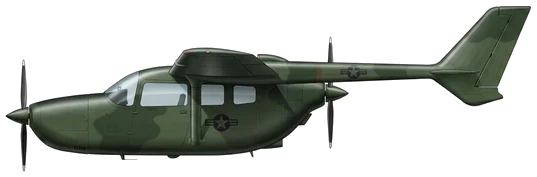
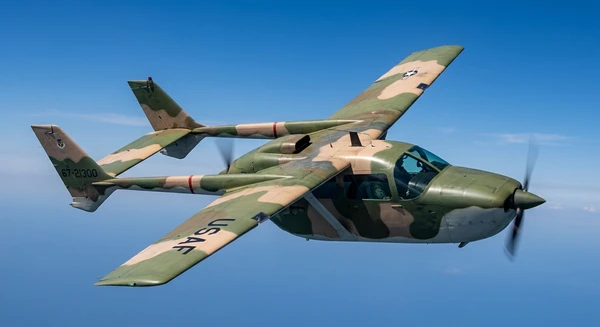
| Crew | 2 |
| Length | 9.1 m (29.8 ft) |
| Wingspan | 11.6 m (38.0 ft) |
| Height | 2.8 m (9.3 ft) |
| Wing area | 18.8 m² (202.5 sqft) |
| Empty weight | 1,292 kg (2,848 lbs) |
| Max. takeoff weight | 2,449 kg (5,399 lbs) |
| Powerplant | 2 × Continental IO-360C/D air-cooled flat-six 160 kW each |
| Maximum speed | 320 km/h (199 mph) |
| Operational range | 1,710 km (1,063 mi) |
| Service ceiling | 6,000 m (19,685 ft) |
| Climb rate | 6.0 m/s (19.7 ft/s) |


- Gun Pod SUU-11/A Minigun Pod
- Rocket Pod LAU-59/A Rocket Launcher
- Rocket Pod MA-2/A Rocket Launcher
- Cluster Bomb SUU-14/A Bomblet Dispenser
Description
In 1966, the United States Air Force (USAF) commissioned Cessna to build a military variant of the Model 337 Super Skymaster to supplement the Cessna O-1 Bird Dog in forward air control (FAC) operations. Designated the O-2 Skymaster, the aircraft first flew in January 1967, and production began in March 1967. By June 1970, Cessna had built 532 O-2s for the USAF.
Design
The O-2 is a twin-engine piston-powered aircraft featuring a high-wing design and a push-pull engine configuration. One engine is mounted in the nose and a second in the rear of the fuselage, providing centerline thrust. Power is provided by two 210 hp Continental IO-360C/D air-cooled flat-six engines. Military modifications to the civilian airframe included a gross weight increase to 5,400 lb, fore-and-aft seating for a pilot and observer, door view panels, military communication and navigation equipment, and flame-retardant foam in the wing-mounted fuel tanks, which reduced fuel capacity by 3%.
Armament
For armament, the O-2A is equipped with four underwing MAU-3A bomb racks. These hardpoints can carry SUU-11/A minigun pods, LAU-59/A or MA-2/A rocket launchers, and SUU-14/A bomblet dispensers. The O-2B variant is unarmed.
Operational History
During the Vietnam War, the USAF deployed the O-2A with the 20th Tactical Air Support Squadron for FAC duties, while the O-2B served in psychological operations (PSYOPS). A total of 178 USAF O-2s were lost during the conflict. The USAF and Air National Guard operated the aircraft into the late 1980s. The US Navy operated six former USAF O-2As for range control from 1983 until they were replaced by T-34C Turbo-Mentors. The US Army received O-2As in 1967, augmented by transfers from the Navy in 1990, and retired its final two aircraft in October 2010.
Export customers included the Republic of Vietnam Air Force, which received 35 aircraft. El Salvador acquired 23 O-2As and two O-2Bs starting in 1981, using them to observe rebel movements and direct air strikes; five were lost during the Salvadoran Civil War. Other military operators included Botswana, Costa Rica, the Dominican Republic, Ivory Coast, Haiti, Iran, Namibia, Nicaragua, the Solomon Islands, South Korea, Thailand, Uruguay, and Zimbabwe. In civilian service, the California Department of Forestry and Fire Protection (CAL FIRE) operated 20 reassembled O-2s for air attack missions from 1976 until their replacement by OV-10 Broncos.
Variants
- O-2A: A forward air control version equipped with four underwing ordnance hardpoints to hold rockets, gun pods, or flares, with 513 delivered.
- O-2B: An unarmed psychological warfare version equipped with loudspeakers and a leaflet dispenser, with 31 converted from civilian Model 337s.
Frequently Asked Questions
What type of aircraft is the O-2 Skymaster?
What is the maximum speed of the O-2 Skymaster?
What is the range of the O-2 Skymaster?
When did the O-2 Skymaster first fly?
How many O-2 Skymaster have been built?
Which countries operate the O-2 Skymaster?
What is the service ceiling of the O-2 Skymaster?
- JUL 232026 Updated Sources and cross-references refreshed
- JUN 302026 Created Page created: O-2 Skymaster