Uruguay Military Forces
Open-source order of battle for 2026: 21,000 active troops, 46 aircraft.

Armed Forces in 2026
| Domain | Strength | Composition |
|---|---|---|
| Air Force | 46 aircraft | 4 combat 15 helicopters 3 air bases +9 on order |
| Ground Forces | 31 tanks | |
| Personnel | 21,000 active | 1,400 paramilitary |
Global Military Index
Full ranking →| Pillar | Weight | Score | Basis |
|---|---|---|---|
| Manpower | 15% | 52.4 | Active, reserve & paramilitary personnel |
| Ground forces | 20% | 35.6 | Tanks, armor & artillery weighted by type |
| Naval power | 20% | 0.0 | Weighted by hull type: carrier tiers, nuclear vs conventional submarines |
| Air power | 25% | 22.1 | Weighted by aircraft type and fleet age |
| Nuclear deterrent | 10% | 0.0 | No declared nuclear capability |
| Defense budget | 10% | 37.5 | Annual spending, purchasing-power adjusted |
| Readiness | modifier | ×1.05 | Budget per soldier: proxy for training, maintenance & technology |
Country File
| Population | 3.4M (2024) |
| GDP | $81.0 billion (2024) |
| GDP per capita | $23,907 |
| Military budget | $1.7B (2024) |
| Share of GDP | 2.1% (2024) |
| Military spending per capita | $502 (2024) |
| Inflation rate | 4.85% (2024) |
| Capital | Montevideo |
| Region | America |
| Land area | 175,015 km² |
| Coastline | 660 km |
| Land borders | 1,564 km |
| Bordering countries | 2 |
| Currency | UYU |
Strategic Overview in 2026
Strategic Position
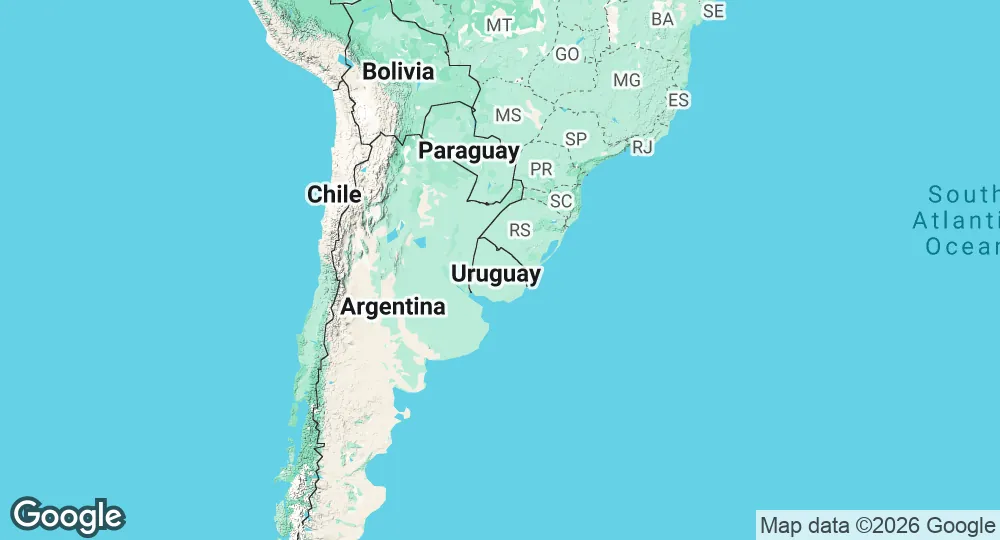
Uruguay occupies a position on the southeastern coast of South America, bordering Brazil to the north and Argentina to the west and south. Its defense posture is defined by its role as a buffer state between these two larger regional powers and its reliance on multilateralism. Primary security concerns include the protection of sovereign rights within its Exclusive Economic Zone (EEZ) in the South Atlantic, border security against transnational organized crime, and the maintenance of internal stability.
Uruguay is a signatory to the Inter-American Treaty of Reciprocal Assistance (Rio Treaty) and a member of the Organization of American States (OAS) and Mercosur. Defense doctrine emphasizes international law, territorial integrity, and non-intervention. A central pillar of the military’s strategic identity is its contribution to United Nations (UN) peacekeeping operations. In 2025, the armed forces maintain deployments in several theaters, including the Golan Heights (UNDOF) and the Democratic Republic of the Congo (MONUSCO).
Bilateral relations focus on cooperation with Brazil and Argentina on border security and riverine patrol. Under Law 19.677, the military conducts "Frontera Segura" (Secure Border) operations, which involve patrolling a 20-kilometer zone along the land borders to intercept narcotics, contraband, and illegal immigration.
Military Forces
The Armed Forces of Uruguay (Fuerzas Armadas del Uruguay) are organized into three branches: the National Army, the National Navy, and the Air Force. The President serves as the Commander-in-Chief, exercising authority through the Ministry of National Defense. Total active personnel number approximately 21,000.
National Army (Ejército Nacional) The Army is the largest branch and is organized into four territorial divisions. It operates a mix of armored platforms and motorized infantry.
- Armor: The inventory includes M-41 Walker Bulldog light tanks and Ti-67 (upgraded T-55) main battle tanks.
- Infantry and Reconnaissance: The force utilizes EE-9 Cascavel and EE-11 Urutu wheeled vehicles, alongside Mowag Piranha and Condor armored personnel carriers.
- Small Arms: Standard issue weapons include the FN FAL and Steyr AUG rifles.
- Special Operations: The Army maintains the 14th Airborne Infantry Battalion, which includes specialized counter-terrorism and commando units.
National Navy (Armada Nacional) The Navy is tasked with coastal defense, maritime search and rescue (SAR), and policing the EEZ. It includes the National Naval Prefecture, which functions as a coast guard.
- Vessels: The fleet consists of patrol craft, including Chamsuri-class and Marine Protector-class vessels. Older Portuguese João Belo-class frigates have largely been retired or downgraded in operational status.
- Naval Aviation: Operates Beechcraft King Air and Cessna aircraft for maritime surveillance.
- Marines: The Naval Infantry Command provides amphibious capabilities and port security.
Air Force (Fuerza Aérea Uruguaya) The Air Force focuses on airspace surveillance, transport, and search and rescue.
- Combat and Training: The force operates A-37B Dragonfly aircraft for light attack, though serviceability remains a constraint. In 2025, the transition toward Beechcraft T-6C Texan II aircraft for advanced training and light COIN (Counter-Insurgency) roles is a priority.
- Transport: Logistics are provided by C-130H Hercules and KC-130H aircraft, as well as EMB-110 and EMB-120 platforms.
- Rotary Wing: The helicopter fleet includes Bell 212 and UH-1H Iroquois models.
Defense Industry
Uruguay lacks a large-scale domestic arms manufacturing sector and relies almost exclusively on foreign imports for major weapon systems. Domestic capability is limited to the maintenance, repair, and overhaul (MRO) of existing equipment. The Navy operates the Diques y Astilleros Nacionales (SCRA), which provides shipbuilding and repair services for the fleet and commercial clients. Procurement typically involves the acquisition of surplus equipment through the U.S. Excess Defense Articles (EDA) program or direct purchases from international suppliers in Europe, Brazil, and Asia.
Strategic Trends
The primary modernization priority for 2025 and 2026 is the renewal of the naval fleet. The government has formalized contracts for the acquisition of new Offshore Patrol Vessels (OPVs) from Spanish shipbuilders to address capabilities gaps in maritime interdiction and fisheries protection. This program is the most significant naval procurement in several decades.
The Air Force is focused on replacing its aging light attack fleet, with ongoing efforts to secure funding for additional modern turboprop trainers with combat capabilities. The Army continues to prioritize its border security mission, which has shifted resources toward mobile surveillance and communication technology rather than heavy armored expansion.
Defense spending remains consistently below 2% of GDP. Budgetary constraints force the military to prioritize personnel costs and peacekeeping equipment over large-scale platform acquisitions. The force structure is characterized by a high ratio of officers to enlisted personnel, a factor that remains a subject of domestic legislative debate regarding potential downsizing or restructuring in 2026. General strategic orientation is shifting toward "Dual-Use" capabilities, where military assets are increasingly applied to civil protection, disaster relief, and internal security support.
Frequently Asked Questions
How large is Uruguay's military?
What is Uruguay's defense budget?
How does Uruguay rank militarily in the world?
Does Uruguay have nuclear weapons?
How many aircraft does Uruguay's air force have?
How many tanks does Uruguay have?
What percentage of GDP does Uruguay spend on defense?
What is Uruguay's military personnel per capita?
Does Uruguay have paramilitary forces?
Military Expenditure: CIA World Factbook. Last updated on 4 August 2026. Suggest a change
- AUG 42026 Updated Global Military Index updated in a site-wide editorial pass
- AUG 32026 Updated Global Military Index updated
- JUL 162026 Updated Global Military Index updated in a site-wide editorial pass
- JUN 162026 Updated Yearly statistics, military spending and 2 more fields updated
- JAN 172026 Updated Main battle tank count and Global Military Index updated
- JAN 132026 Updated Description added