OV-10 Bronco
American light attack and observation aircraft, notable for its use during the Vietnam War, especially in counter-insurgency operations. Key figures: top speed 452 km/h, range 2,222 km, service ceiling 8,780 m, max takeoff weight 6,552 kg, unit price $1M, built 360.
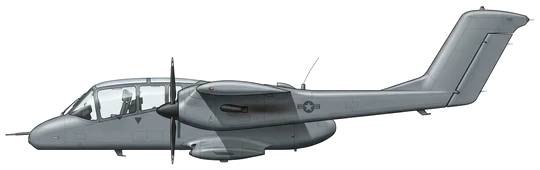
| Crew | 2 (pilot, observer) |
| Length | 12.7 m (41.7 ft) |
| Wingspan | 12.2 m (40.0 ft) |
| Height | 4.6 m (15.1 ft) |
| Wing area | 88.7 m² (954.7 sqft) |
| Empty weight | 3,261 kg (7,189 lbs) |
| Max. takeoff weight | 6,552 kg (14,445 lbs) |
| Powerplant | 2 × turboprops Garrett T76-G-412 776 kW each |
| Ejection seat | North American LW-3B |
| Maximum speed | 452 km/h (281 mph) |
| Operational range | 2,222 km (1,381 mi) |
| Service ceiling | 8,780 m (28,806 ft) |
| Climb rate | 15.3 m/s (50.2 ft/s) |
Description
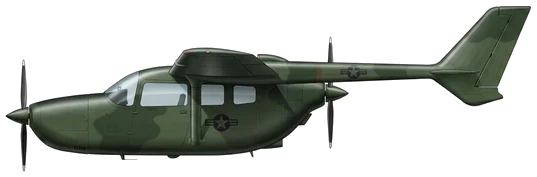
The North American Rockwell OV-10 Bronco is a twin-turboprop light attack and observation aircraft with short takeoff and landing capability, built in the United States for counter-insurgency and forward air control work. The first production OV-10A was delivered in June 1967 and the type entered service in October 1969 with the US Air Force, Marine Corps and Navy. It was the first aircraft designed specifically for the COIN and limited-war mission, and is identified by its twin-boom layout, sponsons and long loiter endurance.
Development
The concept was developed in the early 1960s by W.H. Beckett and K.P. Rice of the USMC, who proposed a simple turboprop aircraft able to operate from roads and unimproved strips close to ground units, replacing the Cessna O-1 Bird Dog. A tri-service Light Armed Reconnaissance Aircraft (LARA) specification was issued in 1963, calling for a two-seat twin-engine aircraft carrying 2,400 lb of cargo or six paratroopers, capable of 350 mph, an 800 ft takeoff, and carrier operation. Eleven proposals were submitted in March 1963, including the Convair Model 48 Charger and Grumman Model 134R; the North American NA-300 was selected in August 1964, with a contract for seven prototypes two months later. The prototype flew on 16 July 1965. Testing added a second crewman, crew and engine armour, 250 gallons of internal fuel and heavier armament, raising empty weight by 29 percent and forcing the wingspan to grow from 30 to 40 ft with engines uprated to 715 shp. At least 157 OV-10As were delivered to the USAF before production ended in April 1969; the USMC received 114.
Design
The OV-10 has a central fuselage attached to a shoulder wing carrying twin booms joined by the horizontal stabilizer, with a rear-facing hinged cargo door for airdropping. The cockpit sits forward of the engines for visibility, and crews used North American Rockwell ejection seats. Sponsons under the fuselage reduce drag and carry the guns and stores, angled downward on production aircraft to ensure clean jettison. Engines could run on high-octane automotive fuel with slight power loss, repairs required only ordinary tools, and no ground equipment was needed for starting. The OV-10D added a turret-mounted forward-looking infrared sensor in an extended nose, chaff dispensers on the booms and infrared-suppressive exhausts; Pave Nail OV-10As of the 23d TASS received a Pave Spot laser designator pod, night periscope and LORAN.
Armament
Four 7.62 mm M60C machine guns were normally carried in the sponsons, with the YOV-10D fitting a turreted 20 mm M197 cannon slaved to the FLIR. Five fuselage and two underwing hardpoints carried up to 3,200 lb of stores, typically seven-shot 2.75 in rocket pods with white phosphorus or high-explosive rounds, four-shot 5 in Zuni pods, bombs up to 500 lb, ADSIDS seismic sensors and Mk-6 illumination flares. AIM-9 Sidewinders could be carried on the wing stations.
Operational History
The USMC took the Bronco into combat in Vietnam in 1968 as a FAC, radio relay, artillery spotter, escort and attack aircraft. USAF OV-10As arrived on 31 July 1968 for Operation Combat Bronco with the 19th TASS at Bien Hoa, later serving with the 20th TASS at Da Nang and the 23d TASS at Nakhon Phanom on Igloo White and Prairie Fire missions. The Navy's VAL-4 "Black Ponies" operated the type from April 1969 to April 1972 supporting SEALs and riverine forces. Vietnam losses totalled 81 aircraft: 64 USAF, 10 USMC and 7 USN. Twenty-six RAAF and RNZAF pilots flew FAC sorties with USAF squadrons between 1968 and 1971. The USAF retired the type on 1 September 1991; USMC OV-10s flew their last combat deployment in Desert Storm, where two were shot down, and were withdrawn in 1995. Exports went to Germany (18 OV-10B target tugs), Thailand (32 OV-10C), Venezuela (16 OV-10E), Indonesia (16 OV-10F), Morocco (six ex-USMC OV-10A), Colombia (12 in 1991) and the Philippines. Indonesian OV-10Fs flew in East Timor, West Papua and the 2003–2004 Aceh offensive; Moroccan aircraft flew against Polisario forces, losing one in 1985. Philippine Air Force OV-10s struck Moro Islamic Liberation Front and Abu Sayyaf targets and bombed Maute positions on 1 June 2017 at Marawi, retiring on 28 December 2024. Two OV-10Gs flew 120 combat sorties over Iraq and Syria for Operation Inherent Resolve from May 2015. Surplus airframes went to NASA, the Department of State, the Bureau of Land Management and CAL FIRE.
Variants
- YOV-10A: Seven prototypes with 600 shp T76-G-6/8 engines, the last flown with YT74-P-1 powerplants.
- OV-10A: Initial production version with 40 ft wing and 715 shp T76-G-10/12 engines, 271 built for the USMC and USAF.
- OV-10B: German target tug with towing pod and glazed rear dome, 18 built, designated OV-10B(Z) with an added J85-GE-4 turbojet above the fuselage.
- OV-10D: Night Observation Gunship System development with FLIR turret, larger engines, fiberglass propellers and chaff dispensers, 17 converted from OV-10As.
- OV-10M: Philippine Air Force four-bladed conversion with strengthened wings and GBU-12 and GBU-49 capability integrated in 2012.
Frequently Asked Questions
What type of aircraft is the OV-10 Bronco?
What is the maximum speed of the OV-10 Bronco?
What is the range of the OV-10 Bronco?
When did the OV-10 Bronco first fly?
How many OV-10 Bronco have been built?
Which countries operate the OV-10 Bronco?
How much does a OV-10 Bronco cost?
What is the service ceiling of the OV-10 Bronco?
- AUG 302026 Updated Description updated
- AUG 122026 Updated Range corrected to the ferry range with auxiliary fuel
- AUG 52026 Updated Climb rate added; thrust updated
- APR 72026 Updated Sources and cross-references refreshed
- JAN 242026 Updated Thrust updated
- JAN 122026 Updated Range updated in a site-wide editorial pass