OH-6 Cayuse
American light observation helicopter, introduced in the mid-1960s, designed for personnel transport, escort, and observation missions. Key figures: top speed 240 km/h, range 610 km, service ceiling 4,800 m, max takeoff weight 1,225 kg, built 1,422.
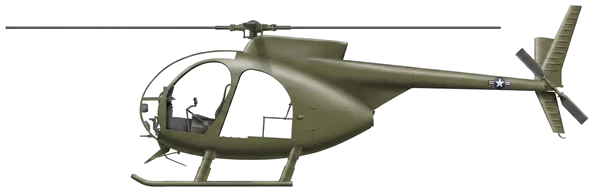
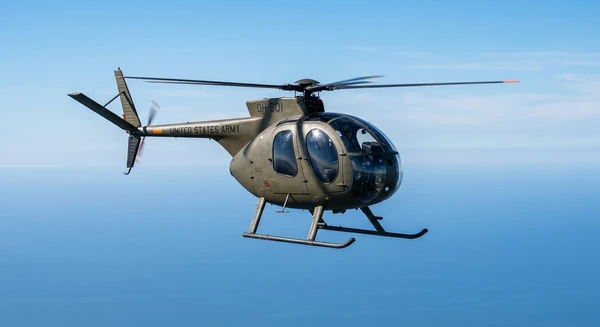
| Crew | 2 |
| Length | 9.2 m (30.3 ft) |
| Wingspan | 8.0 m (26.3 ft) |
| Height | 2.5 m (8.1 ft) |
| Wing area | 50.6 m² (544.6 sqft) |
| Empty weight | 557 kg (1,228 lbs) |
| Max. takeoff weight | 1,225 kg (2,701 lbs) |
| Powerplant | 1 × Allison T63-A-5A 236 kW each |
| Maximum speed | 240 km/h (149 mph) |
| Operational range | 610 km (379 mi) |
| Service ceiling | 4,800 m (15,748 ft) |
| Climb rate | 10.5 m/s (34.4 ft/s) |
- Gun Pod XM-27 7.62 mm machine-gun
- Gun Pod XM-75 grenade launcher
Description
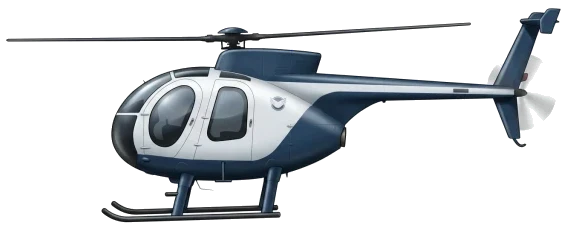
The Hughes OH-6 Cayuse is a single-engine light helicopter designed to meet United States Army Technical Specification 153, issued in 1960 to replace the Bell H-13 Sioux. Hughes submitted the Model 369, which competed against Bell and Fairchild-Hiller. The first prototype flew on February 27, 1963, and the U.S. Army awarded Hughes a production contract in May 1965. Hughes produced 1,422 OH-6As for the U.S. Army, and Kawasaki Heavy Industries license-produced 387 OH-6/Hughes 369s in Japan.
Design
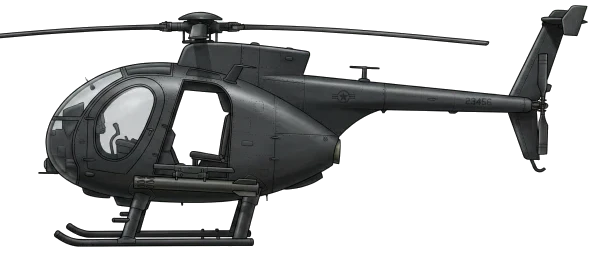
The aircraft has a teardrop-shaped fuselage designed with internal bulkheads and self-sealing fuel tanks for crashworthiness. It features a four-bladed fully-articulated main rotor, a large plexiglass windscreen, and a light aluminum skin that crumples to absorb impact energy. Powered by an Allison T63-A-5A turboshaft engine, the OH-6A has a maximum takeoff weight of 2,700 lb and a maximum cruise speed of 130 knots. It is operated by a pilot and observer, carrying up to five passengers or 1,000 lb of internal cargo. Weapon systems are provisioned on the port side, accommodating either an XM-27 7.62 mm machine-gun with 2,000 to 4,000 rounds of ammunition, or an XM-75 grenade launcher.
Operational History
Entering U.S. Army service in 1966, the OH-6 set 23 world helicopter records, including a 2,213.04-mile non-stop flight. In the Vietnam War, where first units arrived in December 1967, the helicopter operated in "hunter-killer" teams with Bell AH-1 Cobra attack helicopters, drawing ground fire and marking targets with smoke grenades. Ground fire claimed 964 of the 1,422 Army OH-6As in the conflict. In December 1972, the CIA used two acoustically modified OH-6As (designated 500P) for a covert wiretapping mission near Vinh, North Vietnam. Following the failure of Operation Eagle Claw, the U.S. Army selected the OH-6A for its specialized tactical units, which became the MH-6 light assault and AH-6 light attack platforms of the 160th Special Operations Aviation Regiment. Former international operators include Spain, Denmark, Japan, Malta, Nicaragua, and Taiwan.
Variants
- YOH-6A: Prototype aircraft powered by a single Allison T63-A-5A turboshaft engine.
- OH-6A: Initial production model powered by a 263 kW (317 shp) Allison T63-A5A turboshaft engine.
- OH-6B: Upgraded variant fitted with a 313.32 kW (420 shp) Allison T63-A-720 turboshaft engine.
- OH-6D: JGSDF variant based on the Hughes Model 500D and built under license by Kawasaki.
- AH-6C: Modified OH-6A armed transport configured for light attack operations with the 160th SOAR(A).
Frequently Asked Questions
What type of aircraft is the OH-6 Cayuse?
What is the maximum speed of the OH-6 Cayuse?
What is the range of the OH-6 Cayuse?
When did the OH-6 Cayuse first fly?
How many OH-6 Cayuse have been built?
Which countries operate the OH-6 Cayuse?
What is the service ceiling of the OH-6 Cayuse?
- AUG 12026 Updated Manufacturer updated
- JUL 232026 Updated Sources and cross-references refreshed
- JUN 302026 Created Page created: OH-6 Cayuse