AH-6 Little Bird
American light attack helicopter, best recognized for deployment in special operations during conflicts like the Iraq War. Key figures: top speed 282 km/h, range 430 km, service ceiling 4,877 m, max takeoff weight 1,610 kg, unit price $7.5M, built 1,420. In service with 2 air forces as of 2026 — United States (39), Thailand (8).
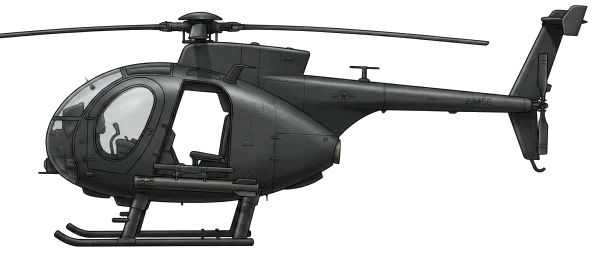
| Crew | 2 |
| Length | 9.2 m (30.1 ft) |
| Wingspan | 8.4 m (27.4 ft) |
| Height | 2.6 m (8.6 ft) |
| Empty weight | 896 kg (1,975 lbs) |
| Max. takeoff weight | 1,610 kg (3,549 lbs) |
| Powerplant | 1 × turboshaft Allison T63-A5-A 239 kW each |
| Maximum speed | 282 km/h (175 mph) |
| Operational range | 430 km (267 mi) |
| Service ceiling | 4,877 m (16,001 ft) |
| Climb rate | 10.5 m/s (34.4 ft/s) |


Recent Events — AH-6 Little Bird
1 event →
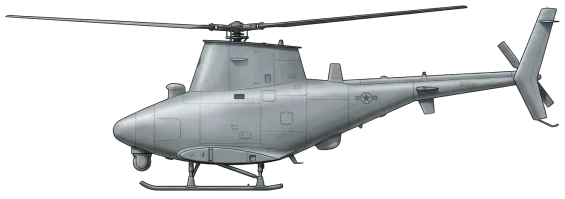
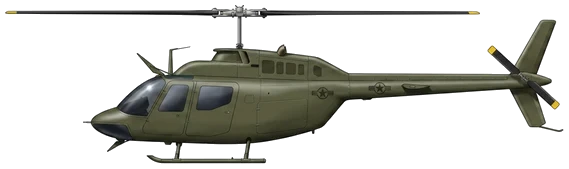
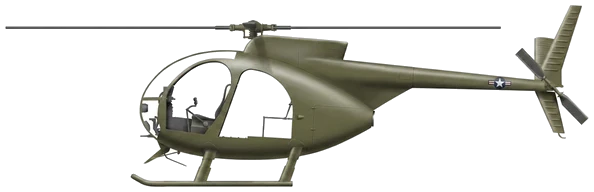
Description
The AH-6 Little Bird is the light attack helicopter of the US Army's 160th Special Operations Aviation Regiment (Airborne), the armed counterpart of the MH-6 assault variant, both derived from the Hughes OH-6A Cayuse and the MD 500 series. Armed OH-6As developed at Fort Rucker in 1980 became the AH-6 of the unit's Light Attack Company in 1981, and the family has since been rebuilt through the AH/MH-6J on the MD 530MG to the current AH/MH-6M Mission Enhanced Little Bird on the MD 530F airframe. Boeing's AH-6i, first flown in September 2009, is an export derivative ordered by Saudi Arabia and Thailand.
Development
The OH-6 originated in the US Army's 1960 Technical Specification 153 for a Light Observation Helicopter. Hughes Tool Company's Model 369 first flew on 27 February 1963 as the YOH-6A with a 252 shp (188 kW) Allison T63-A-5A, beat Bell and Fairchild-Hiller designs at Fort Rucker and won a production contract in May 1965 for 714 aircraft, later raised to 1,300.
After the failure of Operation Eagle Claw in April 1980 exposed the Army's lack of crews trained for special operations, the task force formed for a second Iran rescue attempt, Operation Credible Sport, chose the OH-6A for its ability to land in the most restrictive sites and travel inside Air Force airlifters; beside the task force's UH-60As and CH-47Cs it became the Little Bird. When the hostages were released on 20 January 1981 the Army kept the unit: Task Force 158 was made permanent as what became the 160th Special Operations Aviation Regiment, with the transport OH-6As as the MH-6 of its Light Assault Company and the armed ones as the AH-6 of its Light Attack Company. The airframes were rebuilt in steps, from the AH-6C on the OH-6A through the AH-6F and AH-6G to the AH/MH-6J on the MD 530MG, with an improved engine, FLIR and GPS/inertial navigation, and then to the current AH/MH-6M standard.
Boeing Rotorcraft Systems built the Unmanned Little Bird (ULB) demonstrator from a civil MD 530F; it first flew on 8 September 2004, flew autonomously with a safety pilot on 16 October 2004 and made its first uncrewed flight on 30 June 2006 at Yuma Proving Ground. The A/MH-6X Mission Enhanced Little Bird, an optionally crewed A/MH-6M with the ULB systems and a prototype glass cockpit, first flew at Mesa, Arizona, on 20 September 2006. The AH-6S proposed for the Army's Armed Aerial Scout competition, which ended in late 2013, was to be stretched 380 mm (15 in) to carry recovered crews and fitted with a Rolls-Royce 250-CE30; its export counterpart, the AH-6i, first flew on 16 September 2009.
Design
The MH-6M uses the MD 530F airframe with a six-blade main rotor of 8.35 m (27 ft 5 in) diameter and a four-blade tail rotor, replacing the five-blade rotor of the earlier MD 500E-based versions. The fuselage is 7.50 m (24 ft 7 in) long, 9.94 m (32 ft 7 in) with rotors, 1.40 m (4 ft 7 in) wide and 2.67 m (8 ft 9 in) high. Empty weight is 722 kg (1,591 lb) and maximum take-off weight 1,406 kg (3,100 lb). The single Allison 250-C30 turboshaft is derated to 425 shp (317 kW) for take-off and 375 shp (280 kW) maximum continuous. Maximum speed is 282 km/h (175 mph), cruise 250 km/h (155 mph), range 430 km (267 mi) at 1,524 m (5,000 ft), and service ceiling 5,700 m (18,700 ft).
Two pilots fly the aircraft; the unarmed MH-6 carries up to six operators, or 684 kg (1,509 lb), on outboard benches fitted for three on each side for rooftop and street insertions where the MH-60 cannot land. The ULB payload is 1,090 kg (2,400 lb) and the A/MH-6X adds 450 kg (1,000 lb); an Unmanned Little Bird flew fully autonomously, avoiding obstacles with LIDAR, in June 2010, and the H-6U demonstrated tablet-directed autonomous landings for the Office of Naval Research's AACUS programme at Quantico in April 2014.
Armament
The AH-6's weapon options are two 12.7 mm GAU-19 Gatling guns or two 7.62 mm M134 Miniguns, two seven-tube LAU-68D/A pods for 2.75 in (70 mm) Hydra 70 or laser-guided APKWS rockets, two or four AGM-114 Hellfire anti-tank missiles, or two or four FIM-92 Stinger missiles for self-defence. In the Persian Gulf in 1987 the AH-6s flew with 7.62 mm Miniguns and 2.75 in rockets, and the MH-6 was fitted with a Minigun of its own by October of that year.
Operational History
The 160th's Little Birds first fought openly in Grenada on 25 October 1983, when six MH-6s and two AH-6s flew in from Pope Air Force Base inside four C-130s; the two AH-6s abandoned an attack on Fort Rupert in the face of the air defences around St George's. After the tanker Bridgeton struck a mine on 24 July 1987, two MH-6s and four AH-6s deployed to the Persian Gulf as Detachment 160 under Operation Prime Chance, flying from Navy ships and leased barges as "SEABAT" teams, the FLIR-equipped MH-6 finding targets for the gunships. On 21 September 1987 a team from USS Jarrett caught the Iranian landing ship Iran Ajr laying mines and fired on it until its crew abandoned ship, after which it was boarded and captured; on 8 October a team from USS Ford sank a Boghammar and two Boston Whalers.
For Operation Just Cause, C-5s delivered nine MH-6s and 11 AH-6G/Js to Howard Air Force Base on 17 December 1989. In the opening hours of the invasion four AH-6s struck the Panamanian Defense Forces headquarters, La Comandancia, one crash-landing inside the compound after being hit, and an MH-6 lost power and crashed in the street during the rooftop prisoner rescue at Cárcel Modelo. An AH-6 shot down during a raid near Colón cost the regiment its first soldiers killed in combat. In Mogadishu on 3–4 October 1993, MH-6s inserted Delta Force operators onto rooftops near the Olympic Hotel; after the MH-60L "Super Six-One" was shot down, the MH-6 "Star Four-One" landed beside the wreck under fire and extracted two wounded soldiers while AH-6Js gave fire support through the night. In Iraq, both types supported the 75th Ranger Regiment at the Haditha Dam in April 2003, and an MH-6 was shot down over Yusufiyah on 14 May 2006, killing both crew. AH-6s took part in the seizure of the Russian-flagged tanker Marinera in the North Atlantic on 7 January 2026, and on 5 April 2026 US forces reportedly destroyed four MH-6s and two MC-130Js at a makeshift airstrip in Iran during a combat search-and-rescue mission for a downed F-15E weapon systems officer, to deny them to Iran.
Saudi Arabia requested 36 AH-6i through Foreign Military Sales in October 2010 and the type entered service with the Saudi Arabian National Guard; Jordan expressed interest in May 2010. Thailand's order for eight, worth US$103.8 million through Korean Air on behalf of Boeing, was confirmed on 5 January 2024.
Variants
- AH-6C: First special-operations gunship, an OH-6A modified at Fort Rucker to carry weapons for the 160th SOAR.
- AH/MH-6J: Attack and assault versions on the MD 530MG with an improved engine, FLIR and GPS/inertial navigation.
- AH/MH-6M Mission Enhanced Little Bird: Current fleet standard on the MD 530 airframe with six-blade main rotor and four-blade tail rotor.
- A/MH-6X: Optionally crewed MELB demonstrator carrying the Unmanned Little Bird autonomy suite and a prototype glass cockpit, first flown 20 September 2006.
- AH-6i: Boeing's export gunship on the AH-6S design, first flown 16 September 2009, bought by Saudi Arabia and Thailand.
- AH-6S: Stretched proposal for the Armed Aerial Scout programme with AH-64D Block III-based cockpit and composite blades and a Rolls-Royce 250-CE30 engine; the Army ended the programme in late 2013.
Frequently Asked Questions
What type of aircraft is the AH-6 Little Bird?
What is the maximum speed of the AH-6 Little Bird?
What is the range of the AH-6 Little Bird?
When did the AH-6 Little Bird first fly?
How many AH-6 Little Bird have been built?
Which countries operate the AH-6 Little Bird?
How much does a AH-6 Little Bird cost?
What is the service ceiling of the AH-6 Little Bird?
- OCT 32026 Updated Description expanded with 160th SOAR history, MH-6M and AH-6i variants and combat use from Grenada to 2026
- AUG 52026 Updated Powerplant updated in a site-wide editorial pass
- APR 72026 Updated Sources and cross-references refreshed
- FEB 72026 Updated Wingspan added
- JAN 122026 Updated Range updated in a site-wide editorial pass