A-5 Vigilante
American supersonic bomber, renowned for Cold War nuclear deterrent role, later adapted for reconnaissance missions. Key figures: top speed 2,123 km/h, range 1,804 km, service ceiling 15,880 m, max takeoff weight 28,615 kg, unit price $10M, built 167.
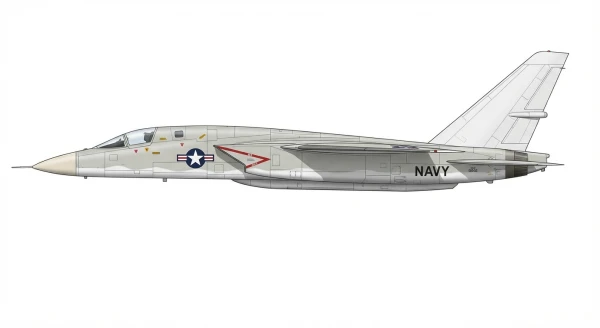
| Crew | 2 (pilot, bombardier/navigator) |
| Length | 23.3 m (76.5 ft) |
| Wingspan | 16.2 m (53.0 ft) |
| Height | 5.9 m (19.4 ft) |
| Wing area | 65.1 m² (700.7 sqft) |
| Empty weight | 14,870 kg (32,783 lbs) |
| Max. takeoff weight | 28,615 kg (63,085 lbs) |
| Powerplant | 2 × turbojets General Electric J79-GE-8 9,786 kgf each |
| Ejection seat | North American HS-1A |
| Maximum speed | 2123 km/h (Mach 2.0) |
| Operational range | 1,804 km (1,121 mi) |
| Service ceiling | 15,880 m (52,100 ft) |
| Climb rate | 40.6 m/s (133.2 ft/s) |
Description
The North American A-5 Vigilante was a carrier-based supersonic bomber and reconnaissance aircraft built by North American Aviation for the United States Navy. Designated A3J before the 1962 Tri-Service designation change, it entered service in June 1961 with Heavy Attack Squadron Three (VAH-3) at NAS Sanford, Florida, replacing the Douglas A-3 Skywarrior in the nuclear strike role. It was the first bomber fitted with a digital computer, and the RA-5C reconnaissance variant flew post-strike missions throughout the Vietnam War.
Development
North American began a private study in early 1954 for a carrier-based, all-weather supersonic strike bomber to succeed the abortive XA2J Super Savage, with work led by preliminary design chief Frank G. Compton at the Columbus division. The design, designated the North American General Purpose Attack Weapon (NAGPAW), had to combine Mach 2 speed with launch at maximum weight without wind-over-the-deck. An initial design and mockup contract followed in July 1955, full development and production authorisation on 29 August 1956, and a prototype contract in September 1956. The first flight took place at Columbus, Ohio, on 31 August 1958. Production ended in 1963 when the Navy shifted to submarine-launched ballistic missiles; 59 A-5As and six A-5Bs were completed, followed by 69 new-build RA-5Cs, including 36 attrition replacements built 1968–1970. The Royal Australian Air Force evaluated the RA-5C as a Canberra replacement and an officer team proposed 36 aircraft as an interim type pending F-111C delivery; the Australian government rejected the proposal.
Design
The Vigilante had a high-mounted swept wing with boundary-layer control blown flaps and no ailerons, roll control coming from spoilers and differential all-moving tailplanes, with a single all-moving vertical fin. Wing skins used aluminium-lithium alloy, critical structures titanium, and gold coating reflected heat around the bomb bay; wings, fin and nose radome folded for carrier stowage. Two General Electric J79-GE-8 turbojets of 17,000 lbf with afterburner were fed by variable-ramp slanted side intakes, later J79-10 engines on RA-5Cs giving 17,900 lbf. Avionics included the AN/ASB-12 nav/attack system, a Pilot's Projected Display Indicator head-up display, REINS inertial navigation and the Autonetics VERDAN digital computer, with an early fly-by-wire system backed by mechanical/hydraulic controls. The RA-5C added a ventral canoe fairing housing AN/APD-7 SLAR, AN/AAS-21 infrared line scanner and camera packs, plus AN/ALQ-61 ELINT and AN/APR-25/APR-27 warning receivers. Crew was two in tandem on North American HS-1A ejection seats.
Armament
The primary weapon was carried in a linear bomb bay between the engines, ejecting a "stores train" of a Mk 28, B27, B28 or B43 nuclear bomb attached to two expendable fuel tanks rearward at about 50 ft/s. The system proved unreliable and no live weapon was ever carried in it; on three occasions catapult shock ejected the fuel cans onto the deck, causing one aircraft loss. Two wing pylons, increased to four on the A-5B, could carry B43, Mark 83 or Mark 84 bombs but were used mainly for drop tanks.
Operational History
Ten RVAH squadrons were established under Reconnaissance Attack Wing One, deploying aboard Forrestal, Saratoga, Ranger, Independence, Kitty Hawk, Constellation, Enterprise, America, John F. Kennedy and Nimitz. Eight squadrons served in Vietnam from August 1964; 18 RA-5Cs were lost in combat — 14 to anti-aircraft fire, three to SAMs and one to a MiG-21 during Linebacker II — with nine more lost in operational accidents. On 13 December 1960, Commander Leroy A. Heath and Lieutenant Larry Monroe set a 91,450.8 ft altitude record with a 2,200 lb payload, held for 13 years. Disestablishment began in 1974; RVAH-7 completed the last deployment aboard USS Ranger in late 1979, and the final RA-5C flight took place on 20 November 1979 from NAS Key West.
Variants
- A3J-1 / A-5A: Initial nuclear strike version, 58 built with six cancelled, 42 later converted to RA-5C.
- A3J-2 / A-5B: Enlarged-fuel "humpback" version with four hardpoints and blown leading-edge flaps, 18 built and all converted to RA-5C.
- XA3J-3P / YA-5C: Five A3J-2s completed without reconnaissance systems for pilot familiarisation, later converted to RA-5C.
- RA-5C: Reconnaissance version with ventral sensor canoe and enlarged wing, 69 built plus 20 redesignated and 61 converted.
- NR-349: Proposed USAF Improved Manned Interceptor with three J79 engines and six AIM-54 Phoenix missiles.
Frequently Asked Questions
What type of aircraft is the A-5 Vigilante?
What is the maximum speed of the A-5 Vigilante?
What is the range of the A-5 Vigilante?
When did the A-5 Vigilante first fly?
How many A-5 Vigilante have been built?
Which countries operate the A-5 Vigilante?
How much does a A-5 Vigilante cost?
What is the service ceiling of the A-5 Vigilante?
- AUG 302026 Updated Description updated
- JUL 292026 Updated Sources and cross-references refreshed
- JUL 232026 Updated Sources and cross-references refreshed
- JUN 262026 Updated Bombs updated
- APR 72026 Updated Sources and cross-references refreshed
- JAN 242026 Updated A-5 Vigilante: thrust updated; A-5 Vigilante: price updated
- JAN 122026 Updated Range updated in a site-wide editorial pass