P.166
Italian twin-engined pusher utility aircraft first flown in 1957, flown by the Italian Air Force as a transport and photo-survey aircraft and by South Africa and Italy for coastal patrol. Key figures: top speed 400 km/h, range 2,084 km, service ceiling 8,535 m, max takeoff weight 4,300 kg, built 154.
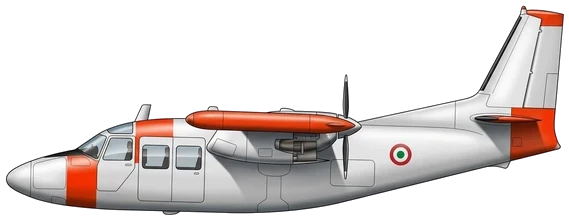
| Crew | 2 |
| Length | 11.9 m (39.0 ft) |
| Wingspan | 13.5 m (44.3 ft) |
| Height | 5 m (16.4 ft) |
| Wing area | 26.6 m² (285.9 sqft) |
| Empty weight | 2,650 kg (5,842 lbs) |
| Max. takeoff weight | 4,300 kg (9,480 lbs) |
| Powerplant | 2 × turboprops Lycoming LTP 101-700 448 kW each |
| Maximum speed | 400 km/h (249 mph) |
| Operational range | 2,084 km (1,295 mi) |
| Service ceiling | 8,535 m (28,002 ft) |
| Climb rate | 11.2 m/s (36.7 ft/s) |
Description
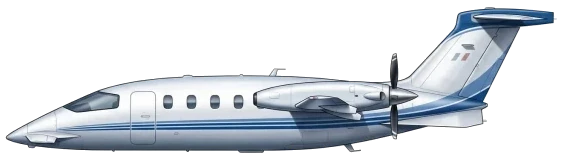
The Piaggio P.166 is an Italian twin-engine utility aircraft with pusher propellers, developed by Piaggio Aero. It was marketed as the Portofino and served in the South African Air Force as the Albatross. Military deliveries began in 1960, when the Italian Air Force received the first of 49 P.166M aircraft. The type has been used as an executive transport, feederliner, photo survey platform and maritime patrol aircraft.
Development
The P.166 was developed from the P.136 amphibian and first flew on 26 November 1957. It kept the P.136's wing and engines but had a new fuselage and tail unit. Early civil buyers used it as an executive transport and as a feeder and air taxi aircraft. A prototype of the more powerful P.166B, seating up to ten, flew on 27 March 1962. The 12-seat P.166C, with improved undercarriage, followed on 2 October 1964. The turboprop P.166D, powered by Lycoming LTP101 engines, first flew on 3 July 1976.
Design
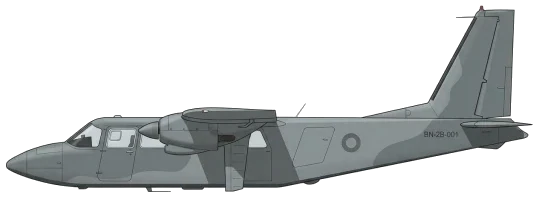
The P.166 is a high-wing monoplane with its engines mounted for pusher propellers. The turboprop P.166-DL3 has the following characteristics:
- Crew and cabin: two crew, with eight passengers or mission crew.
- Dimensions: length 11.88 m. Wingspan 13.51 m, or 14.69 m with tip tanks. Wing area 26.56 m², aspect ratio 7.3, NACA 230 series airfoil.
- Engines: two Lycoming LTP 101-700 turboprops rated at 447.5 kW (600 shp) each. They drive three-bladed Hartzell constant-speed, fully feathering metal pusher propellers 2.36 m in diameter.
- Fuel: standard fuel is held in outer wing tanks, tip tanks and a fuselage collector tank. An optional fuselage tank and under-wing drop tanks can be added.
- Weights: maximum takeoff weight 4,300 kg, maximum payload 1,073 kg.
- Performance: maximum speed 400 km/h at 3,050 m and cruise speed 300 km/h. Range is 1,390 km with maximum payload or 2,084 km with maximum standard fuel. Service ceiling is 8,535 m.
Operational History
The Italian Air Force received 49 P.166M aircraft between 1960 and 1968. It also took two P.166BL2/APH and six P.166-DL3/APH photo survey aircraft.
The Italian Coast Guard received 12 P.166-DL3/SEM aircraft between 1988 and 1990 and retired them in July 2017. The Guardia di Finanza took two ex-Alitalia P.166-DL3s as trainers and utility aircraft in 1990. It then received ten new-built P.166-DL3/SEMs between 1991 and 1995. Eight of its aircraft were converted to P.166DP1 standard, and the fleet was planned to remain in service until 2020.
Somalia's Aeronautical Corps bought two P.166-DL3 utility aircraft and two P.166-DL3/MAR maritime patrol aircraft in 1980. The South African Air Force operated the P.166S Albatross with 27 Squadron.
Civil operators included Alitalia, the Italian Ministry of Merchant Marine and many Australian carriers. Among these were Ansett-ANA, MacRobertson Miller Airlines and Papuan Air Transport.
Variants
- P.166AL1: first production version, carrying two pilots and six to eight passengers and powered by 340 hp Lycoming GSO-480-B1C6 engines, with 29 built.
- P.166M: military version of the P.166A, with 49 built for the Italian Air Force.
- P.166S Albatross: coastal patrol and search and rescue version for the South African Air Force, with the longer P.166B nose and larger tip tanks, with 20 built.
- P.166DL3: light utility transport powered by two Lycoming LTP101-600 turboprops, with 14 built including sub-variants.
- P.166DL3/SEM: maritime and ecological surveillance version, with 12 built for the Italian Coast Guard and ten for the Guardia di Finanza.
Frequently Asked Questions
What type of aircraft is the P.166?
What is the maximum speed of the P.166?
What is the range of the P.166?
When did the P.166 first fly?
How many P.166 have been built?
Which countries operate the P.166?
What is the service ceiling of the P.166?
- OCT 12026 Created Page created: P.166