GAF Nomad
Australian utility aircraft, renowned for its versatile, multi-purpose usage in civilian and military applications. Key figures: top speed 311 km/h, range 1,350 km, service ceiling 6,400 m, max takeoff weight 3,855 kg, built 172. In service with 1 air force as of 2026 — Philippines (3).
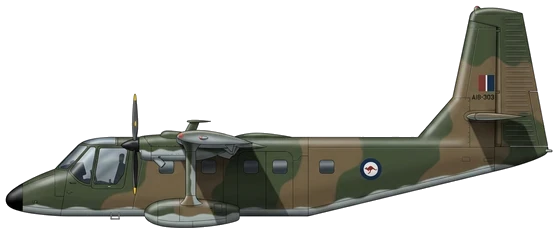
| Length | 12.6 m (41.2 ft) |
| Wingspan | 16.5 m (54.2 ft) |
| Height | 5.5 m (18.1 ft) |
| Wing area | 31.1 m² (334.8 sqft) |
| Empty weight | 2,150 kg (4,740 lbs) |
| Max. takeoff weight | 3,855 kg (8,499 lbs) |
| Powerplant | 2 × turboprops Allison 250-B17C 313 kW each |
| Maximum speed | 311 km/h (193 mph) |
| Operational range | 1,350 km (839 mi) |
| Service ceiling | 6,400 m (20,997 ft) |
| Climb rate | 7.4 m/s (24.3 ft/s) |

Description
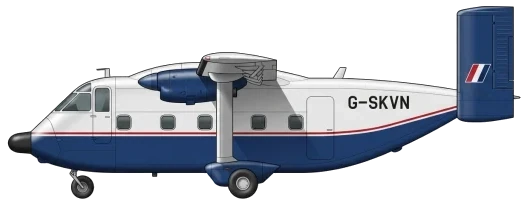
The GAF Nomad is a twin-turboprop STOL utility aircraft built by the Government Aircraft Factories in Melbourne, Australia. A high-wing design with retractable undercarriage, it was produced in the short N22 and stretched N24 forms for civil commuter, freight, military transport and maritime patrol roles. It first flew on 23 July 1971 and entered Australian Army service from 1975. Production ended in 1985 after 172 airframes, well short of the 200-unit break-even point, and the type was withdrawn from Australian military use in the 1990s following airworthiness concerns.
Development
Design work began at GAF in 1965 around a single-engined turboprop intended to replace the Cessna 180 and Pilatus PC-6. Australian Army feedback drawn from Vietnam experience, and civil operator responses, led GAF to redesign the aircraft as a twin, initially designated Project N. In January 1970 the Australian government funded two flying prototypes and one static airframe for A$3.2 million. VH-SUP flew on 23 July 1971, the second prototype on 5 December 1971; fin and rudder area were increased by 30 per cent to improve directional stability. Production was authorised in May 1972 at A$13 million, with 11 of the first 20 aircraft allocated to the Army. Unit cost in 1981 was A$991,000. GAF was absorbed into Aerospace Technologies of Australia in 1986. GippsAero acquired the type certificate in June 2008 and proposed the re-engined 18-seat GA18, but the project was abandoned by 2021.
Design
The Nomad is powered by two Allison 250B17B/C turboprops of 400 hp (300 kW) each, the first fixed-wing application of that engine. The N24A is 5 ft 10 in (1.77 m) longer than the N22B, with a larger nose compartment and separate baggage access aft of the cabin. The cabin has a constant rectangular cross-section, a large freight door and a flat floor with tie-down rails stressed to 150 lb/sq ft (730 kg/m²). The nose bay can house radar, cameras or laser ranging equipment. The retractable landing gear permits large low-pressure tyres for rough-field work, and the tailplane is all-moving. Militarised aircraft could carry Stanley Aviation zero-zero ejection seats, boron-carbide armour around the seats, forward bulkhead and side panels, and bullet-resistant windscreen glass. An amphibian version was offered.
Armament
Two hardpoints could be fitted to the flat fuselage underside for minigun pods and other stores, with four further hardpoints under the wings. The Royal Thai Armed Forces operated a dedicated attack version of the N22B under the designation B.JL.9.
Operational History
The Australian Army operated 12 N22B from 1975, adding eight N22B and four N24A in 1993; all were withdrawn in 1995 after a report recommended removal from military duties. The RAAF acquired an N22B in 1977, a Coastwatch Searchmaster and three N24As in 1989, and retired most by 1993. The Indonesian Navy received 12 Searchmaster B and six Searchmaster L between 1975 and 1977, then two N24As in 1993 and 18 ex-Army aircraft in 1995. The Philippine Air Force took 20 Nomads, with three active in 2024. Hughes Aircraft Company distributed the type in the United States, taking 20 by early 1981. Other users included the Royal Flying Doctor Service, the Australian Customs Service and the Royal Thai Armed Forces. As of May 2007 the type had suffered 32 hull losses and 76 fatalities.
Variants
- N.22B: Baseline 13-passenger production version, also the principal Australian Army model.
- N.22C: Cargo variant with maximum take-off weight raised to 4,050 kg (8,930 lb).
- N.22F Floatmaster: Floatplane version fitted with Wipline floats.
- N.24A: Stretched 17-passenger commercial version, 40 built.
- Nomad Searchmaster: Maritime patrol variants, including the Searchmaster B (seven built), Searchmaster L (11 built) and the radar-equipped LI and LII.
Frequently Asked Questions
What type of aircraft is the GAF Nomad?
What is the maximum speed of the GAF Nomad?
What is the range of the GAF Nomad?
When did the GAF Nomad first fly?
How many GAF Nomad have been built?
Which countries operate the GAF Nomad?
What is the service ceiling of the GAF Nomad?
- AUG 302026 Updated Description updated
- JUL 272026 Updated Name updated
- JUL 232026 Updated Sources and cross-references refreshed
- APR 72026 Updated Picture credits updated in a site-wide editorial pass
- JAN 122026 Updated Range updated in a site-wide editorial pass