PZL-130 Orlik
Polish turboprop trainer aircraft, renowned for its operational role in the Polish Air Force since the late 1980s. Key figures: top speed 550 km/h, range 2,200 km, service ceiling 10,000 m, max takeoff weight 2,950 kg, built 59. In service with 1 air force as of 2026 — Poland (28).
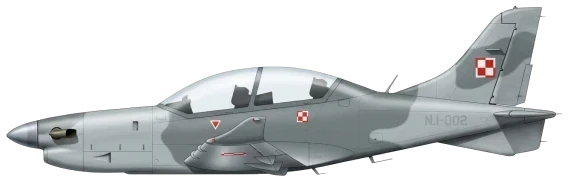
| Length | 9.3 m (30.5 ft) |
| Wingspan | 10 m (32.8 ft) |
| Height | 3.5 m (11.6 ft) |
| Wing area | 14.6 m² (156.7 sqft) |
| Empty weight | 1,825 kg (4,023 lbs) |
| Max. takeoff weight | 2,950 kg (6,504 lbs) |
| Powerplant | 1 × turboprop Pratt & Whitney Canada PT6A-25C 559 kW each |
| Ejection seat | Martin-Baker Mk 11 |
| Maximum speed | 550 km/h (342 mph) |
| Operational range | 2,200 km (1,367 mi) |
| Service ceiling | 10,000 m (32,808 ft) |
| Climb rate | 14.4 m/s (47.2 ft/s) |

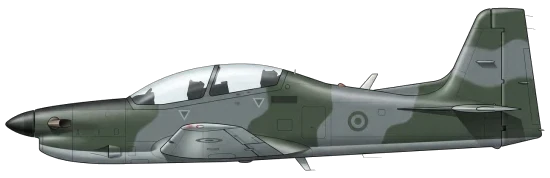
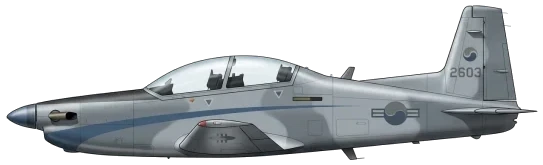
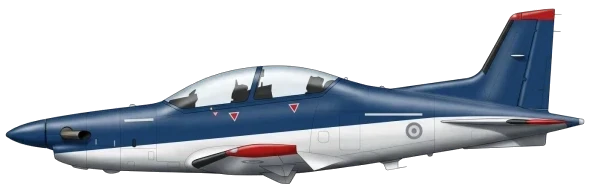
Description
The PZL-130 Orlik was designed by PZL Warszawa-Okecie to serve as a trainer for the Polish Air Force, intended to replace the PZL-110 Koliber and comply with the US FAR 23 standard. The project leadership was under Andrzej Frydrychewicz, head engineer at PZL Warszawa-Okecie. The design incorporated a low-aspect ratio wing, aimed at simulating the handling characteristics of jet fighters. The initial design considered a Soviet Vedeneyev M14Pm radial engine, although production models were intended to utilize a modified Polish Ivchenko AI-14 engine. The first prototype conducted its maiden flight on 12 October 1984, with subsequent prototypes flying in December 1984 and January 1985. While the focus remained on piston-engined versions for the Polish Air Force, a turboprop variant, the PZL-130T Turbo Orlik, was concurrently planned for export. The third prototype was modified in July 1986 to test a Pratt & Whitney PT6A-25P turboprop, but was lost in a crash in January 1987. Two additional turboprop prototypes were developed, one powered by a Czech Walter M-601E flying in 1989 designated PZL-130TB, and another with a PT6A-25 flying in 1990 designated PZL-130TP. Development of the piston-engined Orlik ceased in 1990 due to the insufficient power output of available Polish radial engines, leading to the selection of the M-601 powered PZL-130TB as the primary production variant.
Armament
The PZL-130 Orlik is equipped with six hardpoints capable of carrying a total external payload of up to 700 kg (1,500 lb).
Operational History
Deliveries of the PZL-130TB variant to the Polish Air Force commenced in 1994, with these aircraft entering service at the Military Pilot Academy in Dęblin and the 60th Training Air Regiment in Radom. All Polish PZL-130TBs were subsequently upgraded to the PZL-130TC I standard, which included the incorporation of Martin-Baker Mk.11 zero-zero ejection seats and modernized avionics. Further developments resulted in the PZL-130TC II variant, powered by a Pratt & Whitney Canada PT6A-25C turboprop, featuring winglets and modern Garmin avionics. The PZL-130TC II (GC) is an evolution of this standard, integrating a glass cockpit and a head-up display, also known as the Orlik MPT (Multi Purpose Trainer). The Polish Navy previously operated the Orlik.
Variants
Main Variants:
-
PZL-130 Orlik: Original version equipped with a Vedeneyev M14Pm piston engine on early prototypes.
-
PZL-130T Turbo Orlik: Prototype variant featuring a Pratt & Whitney Canada PT6A-25P turboprop engine.
-
PZL-130TB Orlik: Production variant powered by a Walter M601T turboprop engine.
-
PZL-130TC I Orlik: Variant incorporating Martin-Baker Mk.11 zero-zero class ejection seats and modernized avionics.
-
PZL-130TC II Orlik (Garmin): Variant equipped with a Pratt & Whitney Canada PT6A-25C turboprop, featuring winglets, modernized Garmin avionics, and a revised instructor's seat position.
Frequently Asked Questions
What type of aircraft is the PZL-130 Orlik?
What is the maximum speed of the PZL-130 Orlik?
What is the range of the PZL-130 Orlik?
When did the PZL-130 Orlik first fly?
How many PZL-130 Orlik have been built?
Which countries operate the PZL-130 Orlik?
What is the service ceiling of the PZL-130 Orlik?
- AUG 52026 Updated Climb rate added
- APR 72026 Updated Sources and cross-references refreshed
- JAN 122026 Updated Range updated in a site-wide editorial pass