Pilatus PC-9
Swiss trainer aircraft, renowned for its use in aerobatics, globally employed for military flight training since the 1980s. Key figures: top speed 593 km/h, range 1,537 km, service ceiling 11,600 m, max takeoff weight 3,200 kg, built 265. In service with 9 air forces as of 2026 — Croatia (14), Oman (12), Myanmar (10) and 6 others.
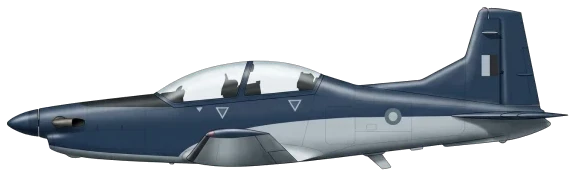
| Length | 10.2 m (33.4 ft) |
| Wingspan | 10.2 m (33.4 ft) |
| Height | 3.3 m (10.7 ft) |
| Wing area | 16.3 m² (175.2 sqft) |
| Empty weight | 1,781 kg (3,926 lbs) |
| Max. takeoff weight | 3,200 kg (7,055 lbs) |
| Powerplant | 1 × turboprop Pratt & Whitney Canada PT6A-62 708 kW each |
| Ejection seat | Martin-Baker Mk 11 |
| Maximum speed | 593 km/h (368 mph) |
| Operational range | 1,537 km (955 mi) |
| Service ceiling | 11,600 m (38,058 ft) |
| Climb rate | 19.7 m/s (64.6 ft/s) |
| Takeoff distance | 396 m (1,299 ft) |


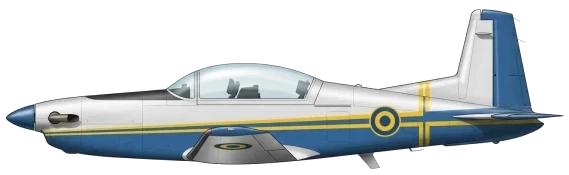
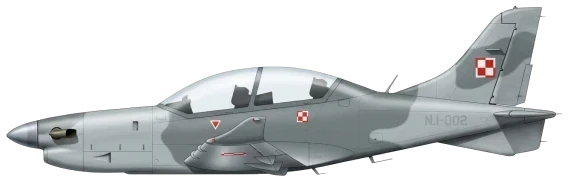
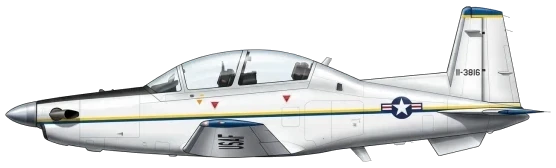
Description
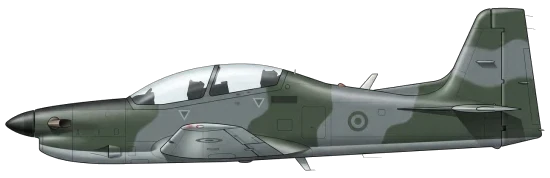
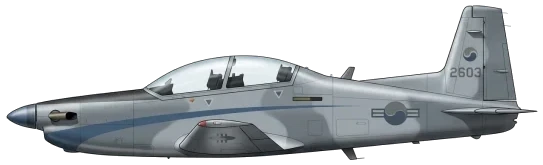
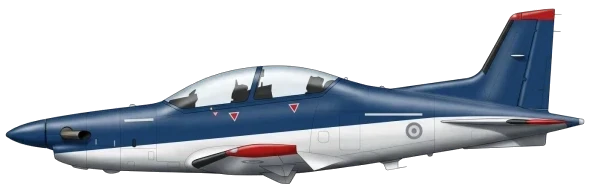
The Pilatus PC-9 is a single-engine, low-wing, tandem-seat turboprop training aircraft, designed and built by Pilatus Aircraft in Switzerland. A more powerful development of the PC-7, it has a lengthened cockpit, stepped ejection seats and a ventral airbrake, and shares little structural commonality with its predecessor. Certified in September 1985, it has been delivered to a dozen air forces and around 276 examples have been produced.
Development
The programme was launched in 1982 in response to changing training syllabuses, with customers seeking to reduce the number of stages and aircraft types used. The PC-9 was designed from the outset to cover basic and advanced training without an intermediate stage, including aerobatic and weapons training. Aerodynamic features were trialled on a PC-7 in 1982 and 1983; the first prototype flew on 7 May 1984, followed by a second on 20 July, close to production standard. Nearly 300 kg heavier than the PC-7, the aircraft received a lengthened nose and a longer canopy; a HUD and an on-board oxygen generation system were optional. In 1984, Pilatus teamed up with British Aerospace for the competition to replace the RAF's BAC Jet Provosts, lost to the Short Tucano; these commercial ties contributed to the first order, 30 aircraft for the Royal Saudi Air Force. Production of a first batch of ten aircraft began in 1985, followed in December by an order for 67 PC-9/As for the Royal Australian Air Force, assembled under licence by Hawker de Havilland until 1992. In the early 1990s, Pilatus and Beechcraft developed the Beech Pilatus PC-9 Mk. II for the American JPATS programme, selected in June 1995 and renamed Beechcraft T-6A Texan II. PC-9 production had ended by around 2010.
Design
The PC-9M is powered by a Pratt & Whitney Canada PT6A-62 of 857 kW flat-rated to 708 kW, for a maximum speed of 593 km/h and a ceiling of 11,580 m. Empty weight is 1,725 kg and maximum take-off weight 3,200 kg, with load factors of +7.0 to −3.5 g. The PC-9M adds an enlarged dorsal fin, modified wing-root fairings, stall strips on the leading edges and new engine and propeller controls.
Armament
The aircraft has seven hardpoints, three under each wing, the two inboard rated at 250 kg and the outboard at 110 kg.
Operational History
On 22 March 1991, over Iraq during Operation Provide Comfort, an Iraqi PC-9 intercepted by American F-15Cs was abandoned by its pilot, who ejected before any shot was fired. The US Army operated three PC-9s as test and chase aircraft between 1991 and 1996, sold on to Slovenia in 1995. The PC-9M was ordered by Croatia (17 in 1997), Slovenia (9 in December 1997), Oman (12 in January 1999), Ireland (8 in 2003), Bulgaria (12 in 2004) and Mexico. The last delivery, an Irish replacement aircraft, took place in 2017. Around 15 examples were sold to civil operators, including ten PC-9B target tugs operated by Condor; Qinetiq Germany acquired nine second-hand in early 2023. The type has served with the RAAF's Roulettes and the Royal Thai Air Force's Blue Phoenix team, formed in 2012. Chad's use of the PC-9 against opponents in 2008 raised controversy over Swiss export controls. The RAAF trained its last course on the PC-9 on 6 December 2019, the aircraft being replaced by the PC-21.
Variants
- PC-9: Basic two-seat training version.
- PC-9/A: 67 aircraft for the RAAF, two of them delivered complete by Pilatus, 17 assembled from kits and 48 built under licence by Hawker de Havilland.
- PC-9B: Target tug for the Luftwaffe, with increased fuel capacity (3 h 20 min endurance) and two underwing Southwest RM-24 winches deploying a target up to 3.5 km behind.
- PC-9M: Production standard introduced in 1997, with enlarged dorsal fin and aerodynamic modifications.
- Beech Pilatus PC-9 Mk. II: Heavily modified version developed with Beechcraft for JPATS, which became the Beechcraft T-6A Texan II.
Frequently Asked Questions
What type of aircraft is the Pilatus PC-9?
What is the maximum speed of the Pilatus PC-9?
What is the range of the Pilatus PC-9?
When did the Pilatus PC-9 first fly?
How many Pilatus PC-9 have been built?
Which countries operate the Pilatus PC-9?
What is the service ceiling of the Pilatus PC-9?
- AUG 302026 Updated Description updated
- AUG 62026 Updated Powerplant updated
- JUL 272026 Updated Name updated
- APR 72026 Updated Sources and cross-references refreshed
- JAN 122026 Updated Range updated in a site-wide editorial pass