Su-34 Fullback
Summary
| Category | Combat Aircraft |
| Origin country | 🇷🇺 Russia |
| Manufacturer | Sukhoi |
| First flight | 13 April 1990 |
| Year introduced | 1997 |
| Number produced | 155 units |
| Average unit price | $36 million |
Technical specifications
| Version: Su-34 Fullback | |
|---|---|
| Crew | 1 pilot + 1 WSO |
| Operational range | 4,000 km (2,485 mi) |
| Maximum speed | 2120 km/h (1317 mph) |
| Wing area | 52.0 m² (560.2 sqft) |
| Wingspan | 14.7 m (48.2 ft) |
| Height | 6.4 m (20.9 ft) |
| Length | 23.3 m (76.6 ft) |
| Service ceiling | 15,000 m (49,213 ft) |
| Empty weight | 20,000 kg (44,092 lbs) |
| Max. takeoff weight | 45,000 kg (99,208 lbs) |
| Takeoff distance | 1,260 m (4,134 ft) |
| Powerplant | 2 x turbofans Al-31F Srs 3 delivering 25000 kgf each |
| Ejection seat | Zvezda K-36DM |


28 recent events involving the Su-34 Fullback
| Date | Air Force | Aircraft | Active Δ | Ordered Δ |
|---|---|---|---|---|
| 20 Feb 2026 | 🇷🇺 Russian Air Force | Su-34 | -1 | — |
| Su-34 shot down by Ukrainian Patriot missile over Zaporizhzhia Oblast while launching KAB glide-bombs; crew likely killed. Details → | ||||
| 28 Jan 2026 | 🇷🇺 Russian Air Force | Su-34 | -1 | — |
| Su-34 fighter-bomber reportedly shot down over Black Sea near Odesa; crew's fate unknown. Details → | ||||
| 25 Sep 2025 | 🇷🇺 Russian Air Force | Su-34 | -1 | — |
| Su-34 shot down after a bombing mission on Stepnogorsk, likely by a Ukrainian MIM-104 Patriot in Vasilyevka, Zaporizhzhia. One crew member died. Details → | ||||
| 22 Mar 2025 | 🇷🇺 Russian Air Force | Su-34 | -1 | — |
| Damaged after an emergency gear-up landing at Lipetsk Air Base. Details → | ||||
| 22 Aug 2024 | 🇷🇺 Russian Air Force | Su-34 | -3 | — |
| Destroyed on the ground during a Ukrainian drone attack on Marinovka air base. Details → | ||||
| 2 Aug 2024 | 🇷🇺 Russian Air Force | Su-34 | -1 | — |
| Destroyed on the ground by a Ukrainian drone attack on Morozovsk air base. Details → | ||||
| 27 Jul 2024 | 🇷🇺 Russian Air Force | Su-34 | -1 | — |
| Crashed in Volgograd Oblast during training; both crew ejected. Details → | ||||
| 19 May 2024 | 🇷🇺 Russian Air Force | Su-34 | -1 | — |
| Damaged in a Ukrainian UAV attack on Kushchevskaya Air Base. Details → | ||||
| 6 May 2024 | 🇷🇺 Russian Air Force | Su-34 | -1 | — |
| Reportedly lost along with its crew. Details → | ||||
| 3 Jan 2024 | 🇷🇺 Russian Air Force | Su-34 | -1 | — |
| Damaged in a sabotage attempt involving arson at Chelyabinsk Shagol airfield. Details → | ||||
Armament
Missiles payload:
- Hypersonic Air-to-Surface Kh-47M2 Kinzhal (AS-24 Killjoy)
- Air-to-Surface Raduga Kh-59M Ovod-M (AS-18 Kazoo)
- Air-to-Surface Vympel Kh-25 (AS-10 Karen)
- Air-to-Surface Vympel Kh-29 (AS-14 Kedge)
- Anti-Radiation Vympel Kh-31 Taifun (AS-17 Krypton)
- Air-to-Air Long-Range Vympel R-27 / K-27 (AA-10 Alamo)
- Air-to-Air Short-Range Vympel R-73 (AA-11 Archer)
- Air-to-Air Medium-Range Vympel R-77 RVV-AE (AA-12 Adder)
- Air-to-Surface Zvezda Kh-35 Uran (AS-20 Kayak)
Bombs payload:
- Low-Drag FAB-100
- Low-Drag FAB-250
- Low-Drag JSC NPO Basalt FAB-500
- Guided KAB-500
- Guided KAB-1500
- Pods Cluster KMGU-2
Description
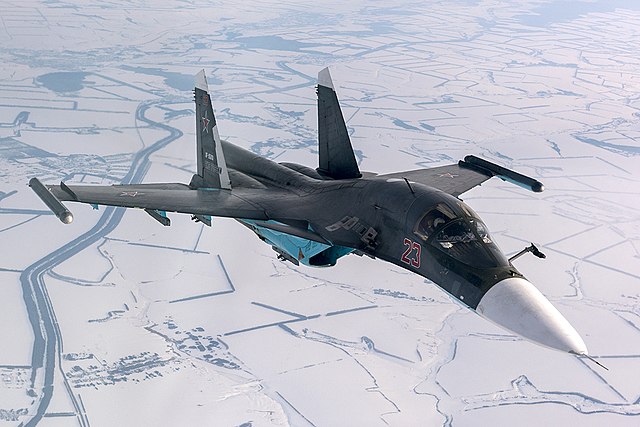
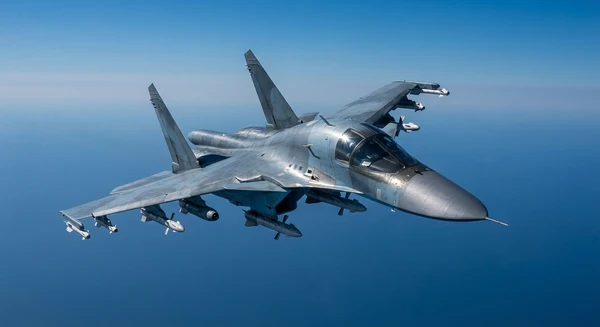
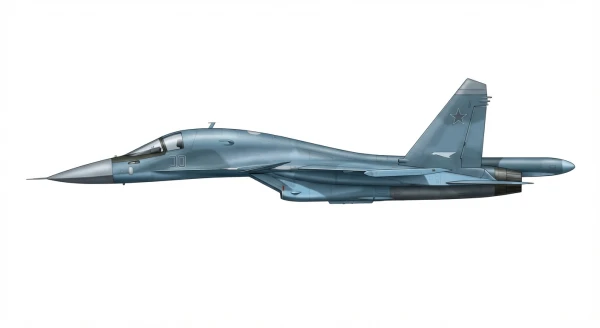
The Su-34 Fullback is a Russian twin-engine, twin-seat, all-weather supersonic medium-range fighter-bomber/strike aircraft. It is a derivative of the Su-27 Flanker, developed by the Sukhoi Design Bureau. The Su-34 is designed primarily for tactical deployment against ground and naval targets (tactical bombing/attack/interdiction roles), but it also has secondary air-to-air capability. The aircraft was first introduced into Russian service in 2014, although its development began much earlier, in the 1980s, during the last years of the Soviet Union. It was intended to replace older Soviet-era attack aircraft like the Su-24 Fencer.
The development of the Su-34 Fullback was a long and protracted process that began in the 1980s. The aircraft was conceived as a successor to the Su-24 Fencer, aiming to offer improved range, payload, and avionics. Originally designated as the "Su-27IB" (IB stands for Istrebitel-Bombardirovshchik, which means "fighter-bomber"), it inherited the basic design and aerodynamic features from the Su-27 Flanker, including its twin-engine configuration. However, the Su-34 was reconfigured to accommodate a side-by-side seating arrangement for its two crew members, offering better ergonomics and collaboration, which is particularly useful for long-duration missions.
One of the notable design features is its duckbill-shaped nose, which houses advanced radar and other electronic systems for targeting and reconnaissance. The aircraft also boasts sophisticated avionics including multifunctional displays, fly-by-wire systems, and an air refueling system, allowing it to extend its operational range.
The Su-34 was engineered to be highly versatile, capable of carrying a large array of weaponry, ranging from precision-guided munitions to anti-ship and air-to-air missiles. This makes it apt for multirole functions, from tactical bombing to air interdiction and anti-ship roles. The aircraft’s structural design was strengthened to withstand the rigors of low-level flying and ground attack missions, with added features like armor protection for the cockpit and key systems, increasing its survivability in combat.
Its development faced multiple delays due to the collapse of the Soviet Union and subsequent budget constraints. It wasn't until the mid-2000s that the aircraft was subjected to a series of tests and modifications, leading to its eventual introduction into the Russian Air Force in 2014.
Armament
The Su-34 Fullback comes with a built-in 30mm GSh-30-1 cannon and has 12 hardpoints that can carry up to 8,000 kg (17,600 lbs) of munitions. The aircraft can be armed with a wide variety of weaponry, which allows it to perform roles ranging from tactical bombing to air-to-air combat and anti-ship missions.
In terms of air-to-ground munitions, the Su-34 can deploy precision-guided bombs such as the KAB-500 and KAB-1500, unguided bombs, and rockets. It can also carry anti-radiation missiles for SEAD (Suppression of Enemy Air Defenses) missions, such as the Kh-25MP and Kh-58. For anti-ship missions, it can be equipped with missiles like the Kh-31A or the heavier Kh-35 and P-800 Oniks.
The aircraft also has air-to-air capabilities, being able to carry short-range R-73 and medium-range R-77 missiles for self-defense against enemy aircraft. This makes it versatile enough to hold its own in aerial combat, even though its primary role is focused on ground attack and interdiction.
Additionally, the Su-34 has the ability to carry external fuel tanks to extend its operational range, and it is also capable of in-flight refueling for long-duration missions.
Operational history
The Su-34 Fullback's operational history began with its introduction into the Russian Air Force in 2014, although it had been in limited service and testing phases for years prior. The aircraft has been involved in various military exercises and training missions, but its most notable operational deployment has been in the Syrian Civil War. Starting in late 2015, the Su-34 was deployed to Syria as part of Russia's intervention in support of the Bashar al-Assad government. There, it has been used primarily for bombing missions against a variety of targets, including enemy fortifications, weapon depots, and moving vehicles.
Its performance in Syria has served as a real-world test of its capabilities and has been generally considered successful in terms of its strike accuracy and mission versatility. The aircraft's deployment has also provided the Russian military with an opportunity to showcase the Su-34 to potential foreign buyers, although the aircraft's export success has been limited so far.
The Su-34 has also been a part of larger-scale military exercises conducted by Russia in different regions, including the Arctic and Eastern Europe, but it is the Syrian conflict that remains its most significant operational engagement to date.
Variants
- Su-34 (Su-27IB): The base model of the Su-34 Fullback, featuring all the standard capabilities such as advanced avionics, a large payload capacity, and multirole versatility.
- Su-34M: A modernized version with enhanced avionics, additional weapon options, and improved radar systems. This variant is aimed at increasing the aircraft's overall effectiveness and is expected to gradually replace the base model in Russian service.
- Su-32: Designation for export, almost identical to the Su-34 but marketed to other countries for roles ranging from deep-strike missions to maritime attack and reconnaissance.
- Su-32FN: Export version aimed at naval operations, designed primarily for anti-ship missions and maritime patrol. It features specialized avionics and weaponry suitable for naval engagements.