Su-24 Fencer
Soviet strike/bomber, distinctively recognized in Afghanistan conflicts during the Cold War, extensively served in post-Soviet states and naval aviation. Key figures: top speed 1,654 km/h, range 2,775 km, service ceiling 11,000 m, max takeoff weight 43,755 kg, unit price $25M, built 1,400. In service with 6 air forces as of 2026 — Russia (294), Algeria (42), Iran (18) and 3 others.
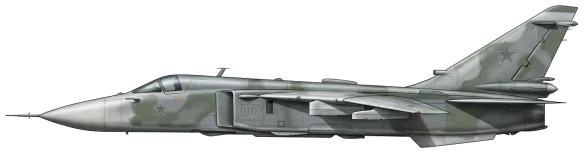

| Crew | 2 (pilot, WSO) |
| Length | 24.5 m (80.5 ft) |
| Wingspan | 17.6 m (57.9 ft) |
| Height | 6.2 m (20.3 ft) |
| Wing area | 46.4 m² (499.4 sqft) |
| Empty weight | 22,320 kg (49,207 lbs) |
| Max. takeoff weight | 43,755 kg (96,463 lbs) |
| Powerplant | 2 × turbojets Saturn AL-21F-3 11,196 kgf each |
| Ejection seat | Zvezda K-36DM |
| Maximum speed | 1654 km/h (Mach 1.6) |
| Operational range | 2,775 km (1,724 mi) |
| Service ceiling | 11,000 m (36,089 ft) |
| Climb rate | 150.0 m/s (492.1 ft/s) |
| Takeoff distance | 850 m (2,789 ft) |






- Anti-Radiation Raduga Kh-58 (AS-11 Kilter)
- Air-to-Surface Raduga Kh-59 Ovod (AS-13 Kingbolt)
- Air-to-Surface Raduga Kh-59M Ovod-M (AS-18 Kazoo)
- Air-to-Surface Vympel Kh-25 (AS-10 Karen)
- Air-to-Surface Vympel Kh-29 (AS-14 Kedge)
- Anti-Radiation Vympel Kh-31 Taifun (AS-17 Krypton)
- Air-to-Air Short-Range Vympel R-60 / K-60 (AA-8 Aphid)
Recent Events — Su-24 Fencer
36 events →-
AUG 222026
 Russia
Destroyed by Ukrainian drones at Saky AB alongside four pieces of airfield equipment and drone control points.
Destroyed
-
JUL 42026
Russia
Su-24 of Russia's Africa Corps struck by Tuareg ground fire during airstrikes near Anefif; crashed on attempted emergency landing near Gao; both pilots killed.
Shot down
-
JUN 162026
 Ukraine
Su-24M of the 7th Tactical Aviation Brigade crashed in Khmelnytskyi Oblast during a mission; both crew killed.
Crash
-
MAR 52026
 Iran
Destroyed on ground at Ahvaz International Airport by US precision strike; CENTCOM released footage.
Destroyed
-
MAR 22026
Iran
×2
Two Su-24 Fencer intercepted and shot down by Qatari F-15QA fighters minutes from Al Udeid Air Base; first air-to-air kills for the F-15QA.
Shot down
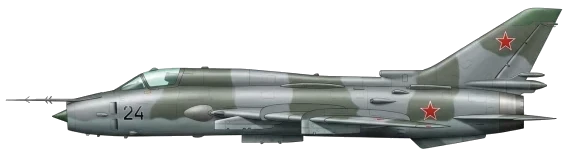
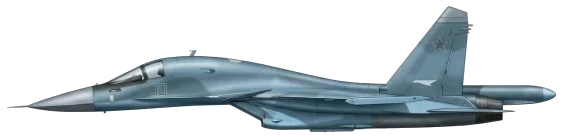
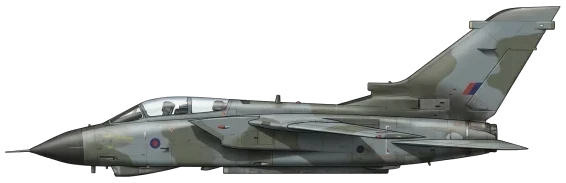
Description
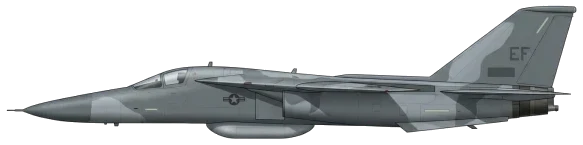
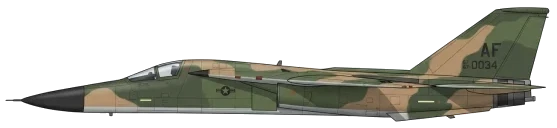
The Sukhoi Su-24 (NATO reporting name Fencer) is a twin-engined, variable-sweep tactical bomber developed in the Soviet Union as the counterpart to the American F-111. The first Soviet tactical aircraft with an integrated digital navigation and attack system, it gave front-line aviation a true all-weather, low-level strike capability when it entered service in 1974; about 1,400 were built before production ended in 1993. Half a century on, it remains in Russian service in large numbers and is one of Ukraine's cruise-missile carriers, and has fought near-continuously since 2011, from Libya and Syria to Ukraine, Mali and the 2026 Iran war.
Development
The requirement dates from 1961, when acceptance of the Su-7B was tied to an all-weather precision-strike derivative. The Su-7 airframe proved too small for the avionics, so a new aircraft was built around the Puma navigation and attack system, whose twin Orion radar antennas forced the wide nose and side-by-side cockpit. A revised specification for a low-level supersonic penetrator with short-field performance led to the T-6, sanctioned on 24 August 1965 with two Tumansky R-27 turbojets plus four RD-36-35 lift jets, which first flew on 2 July 1967. The lift engines bought short-field performance at the cost of fuel, hardpoints and stability, and with the F-111 proving the swing wing in service the OKB was ordered in August 1968 to adopt variable geometry; the T-6-2I flew on 17 January 1970. State trials ran until 1974 because of the complexity of the Puma suite — two Orion-A radars, a Relyef terrain-clearance radar for automatic very-low-level flight and an Orbita-10-58 computer. The first production aircraft flew on 31 December 1971 and the Su-24 was formally accepted on 4 February 1975, after reaching units in 1974; development cost thirteen test pilots in ten fatal accidents.
Design
The Su-24 pairs a shoulder-mounted swing wing with a small fixed glove swept at 69 degrees, with sweep settings of 16 degrees for take-off and landing, 35 and 45 for cruise and 69 for the low-level dash. Spread, the wing gives a landing speed of 230 km/h (140 mph); swept, the high wing loading gives a stable ride at low altitude. Maximum take-off weight is 43,755 kg (96,460 lb).
Two Saturn/Lyulka AL-21F-3A afterburning turbojets each deliver 11,200 kgf (109.8 kN, 24,700 lbf) in reheat. The earliest Fencer-A aircraft had variable intake ramps and reached Mach 2.18 at altitude; since the type operated almost entirely at low altitude, the ramp actuators were deleted, cutting the ceiling to 11,000 m (36,000 ft) and top speed to about Mach 1.6. Later aircraft gained radar- and missile-warning receivers, active jamming and chaff and flare dispensers in large wing-glove fences (Fencer-C).
Upgrades
The Su-24M introduced a 0.76 m (30 in) forward fuselage plug with a retractable refuelling probe, the PNS-24M inertial navigation system and the Kaira-24 laser and TV designator in a ventral bulge, broadly equivalent to the American Pave Tack. From 1999 the Gefest programme and from 2000 Sukhoi's own M2 package added the SVP-24 navigation and sighting system, a head-up display, GLONASS and multi-function displays; the last Su-24M2 batch was delivered in 2009. Ukraine's Mykolaiv Aircraft Repair Plant announced its own Su-24M and Su-24MR overhaul line in 2019.
Armament
Fixed armament is one GSh-6-23 23 mm rotary cannon with 500 rounds; the Su-24MR deletes it. Nine hardpoints carry up to 8,000 kg (17,600 lb). The original Su-24 was limited to Kh-23 and Kh-28 missiles and unguided weapons; the Su-24M added the Kh-25 and Kh-29, the anti-radar Kh-58, the Kh-59 stand-off missile and the KAB-500 and KAB-1500 guided bombs, and the M2 standard brought the Kh-31A/P, Kh-59MK and satellite-guided KAB-500S. R-60 or, on modernised aircraft, R-73 missiles are carried for self-defence. Ukrainian aircraft have been adapted to the 2,900 lb (1,300 kg) Anglo-French Storm Shadow/SCALP-EG cruise missile.
Operational History
Soviet and post-Soviet service
The Soviet Union committed Su-24s to Afghanistan in two short bombing campaigns, in 1984 and during the 1988 withdrawal, without loss. The break-up of the USSR left fleets in Russia, Ukraine, Belarus, Kazakhstan, Uzbekistan and Azerbaijan; Uzbek Su-24s flew against the Tajik opposition and the Taliban, losing one aircraft in each campaign. Russian Fencers flew in both Chechen wars, losing up to four in the second, and independent estimates put Russian Su-24 losses in the August 2008 Georgia war at two.
Middle East and Africa
During Desert Storm Iraq flew most of its Su-24MK fleet to Iran, where the aircraft stayed. Libyan rebels shot down a Su-24MK on 5 March 2011 and NATO destroyed the rest of the small fleet on the ground. Syrian Su-24MK2s entered the civil war in November 2012, losing one to an Igla missile that month, one to an Israeli Patriot over the Golan on 23 September 2014 and one to rebels in March 2018.
Russia's intervention in Syria from September 2015 relied on the Su-24M far more than on its newer types: Fencers flew over 80 percent of strikes from Khmeimim. On 24 November 2015 a Turkish F-16 shot down a Su-24M on the border and the pilot was killed by rebels on the ground after ejecting; Russia responded with S-400 batteries, fighter escorts and air-to-air missiles on its Su-24s. Syrian service ended in two steps: Turkish F-16s shot down two Syrian Su-24MK2s over Idlib on 1 March 2020, and after the fall of the Assad government in December 2024 Israel said its strikes had destroyed most of the remaining aircraft, and no Syrian Su-24 is credited as operational today.
Ukraine, 2014-2026
Ukraine's 7th Tactical Aviation Brigade at Starokostiantyniv inherited its Su-24M and MR aircraft from the Soviet Union and lost one to Russian proxy forces in Luhansk on 20 August 2014. It began the 2022 invasion with 10 to 20 operational aircraft and no stand-off weapons, so crews had to fly inside Russian air-defence envelopes, and the brigade lost many aircraft in the first months. British Storm Shadow transformed its role from May 2023: Su-24s fitted with pylons from retired RAF Tornado GR4s became Ukraine's cruise-missile launchers, hitting the Sevastopol dry docks holding the submarine Rostov-na-Donu and landing ship Minsk on 13 September 2023, the Black Sea Fleet headquarters on 22 September, the corvette Askold at Kerch on 4 November and the landing ship Novocherkassk on 26 December. Attrition continued: Russian strikes on Starokostiantyniv destroyed five aircraft on 28 May 2023 and another in August 2024, and a Su-24M crashed on a combat mission in Khmelnytskyi Oblast on 16 June 2026, killing both crew.
Many Russian losses have come on the ground: the August 2022 explosions at Saky Air Base in Crimea wrote off several Naval Aviation Su-24s, and drone strikes have since hit aircraft there and at bases inside Russia, most recently at Saky on 22 August 2026. The Su-34 is the designated replacement, but the Su-24M stays in the front-line order of battle.
Mali and the 2026 Iran war
Su-24Ms of Russia's Africa Corps appeared at Bamako in June 2025 in support of the Malian army against Tuareg rebels; one force-landed in the Niger River near Gao on 14 June 2025, and a second was brought down by ground fire near Anefif on 4 July 2026, killing its crew. On 2 March 2026, during the US-Israeli campaign against Iran, two Iranian Su-24s flying at about 80 ft (24 m) over the Gulf towards Al Udeid Air Base were shot down by Qatari F-15QAs, according to Qatar, the first air-to-air kills for the F-15EX family; a third was destroyed on the ground at Ahvaz by a US strike on 5 March.
Operators
Russia is by far the largest user, with some 260 Su-24M/M2/MR in the Aerospace Forces and several dozen more in Naval Aviation as of 2026. Algeria flies some 40 Su-24MK and MR, Iran had 21 Su-24MK before its March 2026 losses, and Ukraine a dozen or so Su-24M and MR as of 2026. Sudan keeps a handful of ex-Belarusian aircraft and two Su-24Ms fly for the Libyan National Army. Belarus, Kazakhstan (retired by 2023), Azerbaijan, Iraq and Syria no longer operate the type.
Variants
- Su-24 (Fencer-A/B/C): First production version, about 500 built 1971-1983; Kh-23 and Kh-28 missiles and unguided weapons.
- Su-24M (Fencer-D): Definitive strike version, in service 1983, about 770 built 1981-1993; refuelling probe, Kaira-24 designator, guided weapons.
- Su-24M2: Russian modernisation from 1999-2000 with SVP-24, GLONASS and new cockpit.
- Su-24MK (Fencer-D): Export Su-24M with downgraded avionics, built 1988-1992 for Algeria, Iraq, Libya and Syria.
- Su-24MR (Fencer-E): Reconnaissance version, 130 built 1983-1993; attack radar, designator and cannon replaced by cameras, side-looking radar and an infrared sensor.
- Su-24MP (Fencer-F): Electronic intelligence and jamming version; only 10 built.
Frequently Asked Questions
What type of aircraft is the Su-24 Fencer?
What is the maximum speed of the Su-24 Fencer?
What is the range of the Su-24 Fencer?
When did the Su-24 Fencer first fly?
How many Su-24 Fencer have been built?
Which countries operate the Su-24 Fencer?
How much does a Su-24 Fencer cost?
What is the service ceiling of the Su-24 Fencer?
- OCT 52026 Updated Alternative name T-6 added (the prototype designation, shared with the T-6 Texan II)
- OCT 52026 Updated Description overhauled: Storm Shadow carrier in Ukraine, end of Syrian service, Mali and 2026 losses over the Gulf
- OCT 52026 Updated Maximum takeoff weight and service ceiling corrected
- AUG 132026 Updated Service entry corrected to the 1974 adoption
- AUG 122026 Updated Range corrected to the ferry range
- AUG 52026 Updated Climb rate added; powerplant and thrust updated
- JUL 232026 Updated Sources and cross-references refreshed