Tsaigumi
Nigerian medium-altitude long-endurance unmanned aerial vehicle, introduced in the late 2010s, used for surveillance, reconnaissance and counter-insurgency support. Key figures: service ceiling 4,600 m, max takeoff weight 95 kg, unit price $0.257M.
| Wingspan | 6.8 m (22.3 ft) |
| Max. takeoff weight | 95 kg (209 lbs) |
| Powerplant | 1 × piston engine |
| Endurance | 10 hours |
| Service ceiling | 4,600 m (15,092 ft) |
Description
The Tsaigumi (Hausa: "surveillance") is an unmanned aerial vehicle developed by the Air Force Institute of Technology (AFIT) for the Nigerian Air Force, with technical support from the Portuguese firm UAVision. Inducted into service on 15 February 2018, it is an unarmed intelligence, surveillance and reconnaissance platform and is described by the Nigerian Air Force as the country's first locally built military UAV.
Development
In September 2015 the Nigerian Air Force announced plans to build a new UAV, and in 2016 signed a Memorandum of Understanding with UAVision. The design was credited to Nkemdilim Anulika Ofodile, an aerospace engineer serving with the Nigerian Air Force. The airframe was built by the 431 Engineering Group of the Nigerian Air Force, while avionics and telemetry equipment were supplied by UAVision. Following the induction, former President Goodluck Jonathan stated that the Tsaigumi was the same aircraft as the GULMA, a UAV developed in Nigeria in 2013, disputing its status as the first domestic type. Air Vice Marshal Olatokunbo Adesanya responded that the GULMA "was not operational" and that the Tsaigumi was therefore the first completed Nigerian UAV; the GULMA is likely to have served as a prototype for the later design. In November 2023 the Nigerian Air Force moved to acquire six additional aircraft, along with ground control stations and spares, under a $1.54 million government allocation.
Design
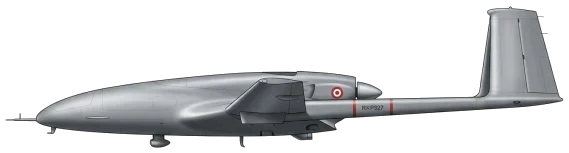
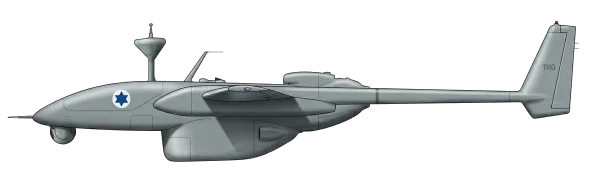
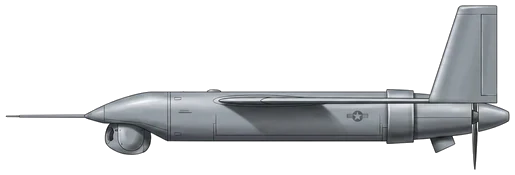
The Tsaigumi is a twin-boom, high-wing monoplane with an H-type tail and a pusher propeller driven by a single piston engine. Maximum take-off weight is 95 kg and wingspan 6.8 m. Tricycle landing gear comprises two main wheels and a steerable nose wheel. Mission radius is 100 km, endurance exceeds 10 hours, and the service ceiling is 15,000 ft (4,600 m), with a normal operating altitude of 5,000 ft (1,500 m). The payload is carried in a gyro-stabilised multi-sensor gimbal beneath the fuselage housing a day/night electro-optical/infrared FLIR camera system for high-definition imagery, video surveillance, target tracking and night operations. Navigation uses GPS and an inertial navigation system. The aircraft carries no armament. It is flown from a ground control station by a crew of three: mission commander, pilot and navigator.
Operational History
The type was formally inducted on 15 February 2018 at Nigerian Air Force Base Kaduna, commissioned by President Muhammadu Buhari, who stated that it would "create employment and possibly generate revenue as Nigeria's first military export product." According to Air Vice Marshal Olatokunbo Adesanya, the Tsaigumi is employed for disaster monitoring, law enforcement, weather forecasting, wildlife protection, monitoring of Nigeria's exclusive economic zone, naval search and rescue, maritime patrol, convoy protection and pipeline and power-line infrastructure monitoring. These tasks support Nigerian counter-terrorism and counter-insurgency operations in the north-east and operations against armed banditry elsewhere in the country. No export customers have been recorded, though mass production and export remain stated objectives of the programme.
Frequently Asked Questions
What type of aircraft is the Tsaigumi?
Which countries operate the Tsaigumi?
How much does a Tsaigumi cost?
What is the service ceiling of the Tsaigumi?
- AUG 202026 Updated Blog-only figures incompatible with the 95 kg MTOW nulled (8.6 m length, 128 kW, 250 km/h, 1,000 km); NAF-stated figures kept.
- AUG 202026 Created Tsaigumi (NAF/UAVision) UAV page created: specs, description, origin/operator (Nigeria), 5 related aircraft