Tu-141 Strizh
Soviet medium-range reconnaissance drone, developed in the late 1970s, used for aerial reconnaissance and later repurposed as a long-range loitering munition. Key figures: top speed 1,100 km/h, range 1,000 km, service ceiling 6,000 m, max takeoff weight 6,215 kg.
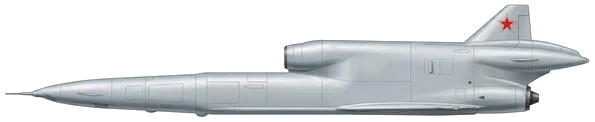
| Length | 14.3 m (47.0 ft) |
| Wingspan | 3.9 m (12.7 ft) |
| Height | 2.4 m (8.0 ft) |
| Wing area | 10 m² (107.6 sqft) |
| Max. takeoff weight | 6,215 kg (13,702 lbs) |
| Powerplant | 1 × Tumansky KR-17A 19 kN each |
| Maximum speed | 1100 km/h (684 mph) |
| Operational range | 1,000 km (621 mi) |
| Service ceiling | 6,000 m (19,685 ft) |


Description
The Tupolev Tu-141 Strizh is a Soviet medium-range reconnaissance drone designed as a follow-on to the Tupolev Tu-123. Designed for reconnaissance missions within a 1,000-kilometer radius, the drone operates at transonic speeds.
Design
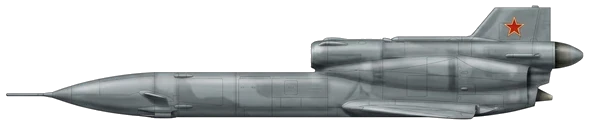
The Tu-141 features a dart-like, rear-mounted delta wing and forward-mounted canards. Power is provided by a single Tumansky KR-17A turbojet engine, which produces 19.6 kN (4,409 lbf) of thrust and is mounted above the tail. The drone is launched from a trailer using a solid-propellant booster and recovers using a tail-mounted parachute. It has a length of 14.33 meters, a wingspan of 3.88 meters, a height of 2.44 meters, and a gross weight of 6,215 kg. Performance specifications include a maximum speed of 1,100 km/h, a cruise speed of 1,000 km/h, and a service ceiling of 6,000 meters. For reconnaissance operations, the Tu-141 carries payloads consisting of film cameras, infrared imagers, EO imagers, or imaging radar.
Armament
While designed as a reconnaissance platform, the Tu-141 was repurposed by Ukraine as a long-range loitering munition during the 2022 Russian invasion. In this role, the aircraft was modified to carry a bomb payload.
Operational History
The Tu-141 initially served with the Soviet Army from 1979 to 1989, deployed primarily along the western borders of the Soviet Union. Following the dissolution of the Soviet Union, Russia retired the type. In 2014, the Ukrainian Air Force's 383rd UAV Brigade reactivated its Tu-141 fleet for operations in the war in Donbas.
During the 2022 Russian invasion of Ukraine, the Tu-141 was used in several recorded incidents. On 10 March 2022, a Ukrainian Tu-141 carrying a bomb flew over Romania and Hungary before running out of fuel and crashing in Zagreb, Croatia. On 3 July 2022, Russian air defenses shot down two Ukrainian Tu-141 drones in the Kursk region. On 5 December 2022, Ukraine targeted Russian airbases at Engels-2 and Dyagilevo using Soviet-made jet drones, damaging two Tu-95s, one Tu-22M3, and destroying a fuel truck. On 26 December 2022, a modified Tu-141 was used in a subsequent attack on the Engels-2 airbase, resulting in three fatalities. On 26 March 2023, Russian forces downed a Tu-141 near Kireyevsk using a Polye-21 electronic jamming system.
Frequently Asked Questions
What type of aircraft is the Tu-141 Strizh?
What is the maximum speed of the Tu-141 Strizh?
What is the range of the Tu-141 Strizh?
Which countries operate the Tu-141 Strizh?
What is the service ceiling of the Tu-141 Strizh?
- JUL 62026 Created Page created: Tu-141 Strizh