Tu-214
Russian medium-range narrow-body airliner, best known as the airframe behind Russia's command post, communications relay and intelligence-gathering aircraft. Key figures: top speed 900 km/h, range 6,500 km, service ceiling 12,100 m, max takeoff weight 110,750 kg, unit price $65M, built 89. In service with 1 air force as of 2026 — Russia (6).
| Crew | 3 |
| Length | 46.1 m (151.4 ft) |
| Wingspan | 41.8 m (137.1 ft) |
| Height | 13.9 m (45.6 ft) |
| Wing area | 184.2 m² (1982.7 sqft) |
| Empty weight | 59,000 kg (130,073 lbs) |
| Max. takeoff weight | 110,750 kg (244,162 lbs) |
| Powerplant | 2 × turbofans Aviadvigatel PS-90A 16,000 kgf each |
| Maximum speed | 900 km/h (559 mph) |
| Operational range | 6,500 km (4,039 mi) |
| Service ceiling | 12,100 m (39,698 ft) |

Description
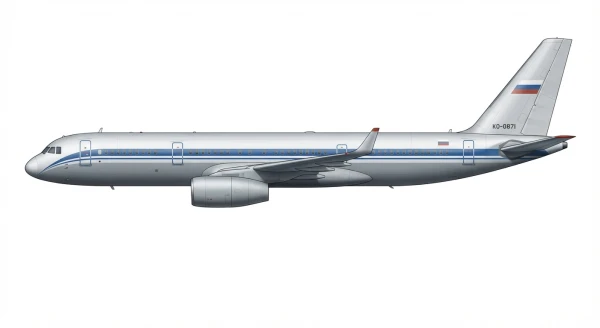
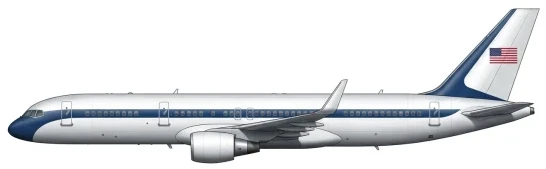
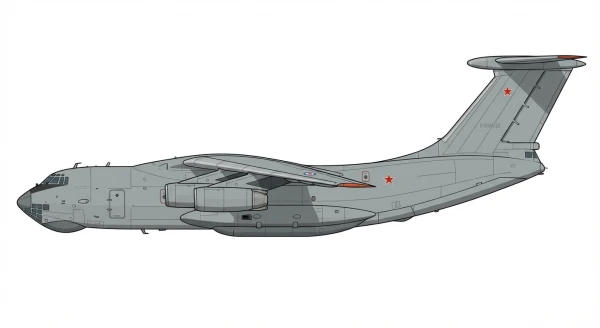
The Tupolev Tu-214 is the Kazan-built member of the Tu-204 family of twin-engined, medium-range narrow-body airliners, and the airframe on which most of Russia's modern special-mission and government aircraft are based. Technically a Tu-204-200, it differs from the Ulyanovsk-built Tu-204 chiefly in where it is assembled: Tu-204s come from Aviastar-SP at Ulyanovsk, Tu-214s from the Kazan Aircraft Production Association, and each plant has some control over the design of its own variant. First flown on 21 March 1996, the Tu-214 has been developed into airborne command posts, communications relays, Open Skies observation aircraft and a dedicated intelligence-gathering platform.
Development
The Tu-204 was designed for Aeroflot in the 1980s as a replacement for the Tu-154 trijet, broadly equivalent to the Boeing 757 with slightly lower range and payload. It first flew on 2 January 1989 and entered airline service in the mid-1990s. The Kazan-built Tu-214 followed on 21 March 1996 with a higher maximum take-off weight — 110.75 tonnes against 105 tonnes for the Tu-204-100 — plus greater payload and fuel capacity, which is precisely what made it attractive as a mission platform.
Civil sales were modest and the type's centre of gravity shifted towards state customers. Under Western sanctions after 2022 the Tu-214 acquired fresh importance as an airliner that could be built without imported components: United Aircraft Corporation announced plans to raise output to ten or twelve aircraft a year and to build 70 by 2030, a prototype with fully Russian content flew in November 2024, and the changes were certified by Rosaviatsiya in December 2025. Aeroflot nonetheless signalled in 2024 that it preferred to concentrate its orders on the newer MC-21, citing among other things the Tu-214's three-person cockpit.
Design
The Tu-214 is a conventional low-wing airliner with two Aviadvigatel PS-90A turbofans of 16,000 kgf each on underwing pylons, a 41.8 m wingspan and a 46.14 m fuselage. Range is around 6,500 km, enough for the long unrefuelled transits that command-post and reconnaissance work demands, and the airframe offers cabin volume, electrical power and endurance that a converted fighter or a smaller transport cannot match. It retains a three-person flight crew, which counts against it commercially but matters little in military service.
Military and Government Variants
- Tu-214R — the most capable of the family, developed under the codename Project 141 to replace the Il-20 as an electronic intelligence platform. It carries the MRC-411 multi-intelligence payload, combining ELINT sensors, a side-looking synthetic aperture radar, further signals intelligence equipment and multi-spectral electro-optical systems. Two were flying with the Russian Air Force by January 2015; one deployed to Latakia in Syria in February 2016, others have flown surveillance orbits close to the Latvian, Estonian and Finnish borders, and the type has been employed against Ukraine since 2022.
- Tu-214ON — an Open Skies observation aircraft fitted with an A-84ON panoramic camera, an AK-111 topographic camera, two AK-112 digital aerial cameras, a Raduga infrared imager and a Ronsard side-looking radar. Two were delivered in 2013 and 2014 to replace the Tu-154 and An-30 in the role; after Russia withdrew from the Treaty on Open Skies in 2021 they were reassigned to military observation flights over Crimea.
- Tu-214PU and Tu-214PU-SBUS — airborne command posts, six of them operated for the Russian President, the SBUS variant built entirely from Russian components under a 2015 order.
- Tu-214SR and Tu-214SUS — communications relay aircraft, five flown by the Rossiya Special Flight Unit for the government and two more for the presidential fleet.
- Tu-214LMK — a flying laboratory carrying the LMK-214 mission complex, testing radar and avionics for the modernised Tu-160M2 and the future PAK DA bomber since December 2018.
Operational History
The Tu-214 fleet is small but carries a disproportionate share of the Russian state's airborne command, communications and intelligence capability. Individual Tu-214R sorties are tracked closely by NATO air forces, and deployments of the type — to Syria in 2016, along the Baltic approaches in the years that followed, and over Ukraine since 2022 — are treated as indicators of Russian reconnaissance priorities rather than routine transport movements.
Frequently Asked Questions
What type of aircraft is the Tu-214?
What is the maximum speed of the Tu-214?
What is the range of the Tu-214?
When did the Tu-214 first fly?
How many Tu-214 have been built?
Which countries operate the Tu-214?
How much does a Tu-214 cost?
What is the service ceiling of the Tu-214?
- AUG 52026 Updated Crew, height and 7 more fields added; name, description and 3 more fields updated
- APR 82026 Updated Empty weight added
- APR 72026 Updated Picture credits updated in a site-wide editorial pass
- FEB 72026 Updated Tu-214 Mogul: top speed added; Tu-214 Mogul: ceiling added; Tu-214 Mogul: range added; Tu-214 Mogul: wingspan added