Tu-154 Careless
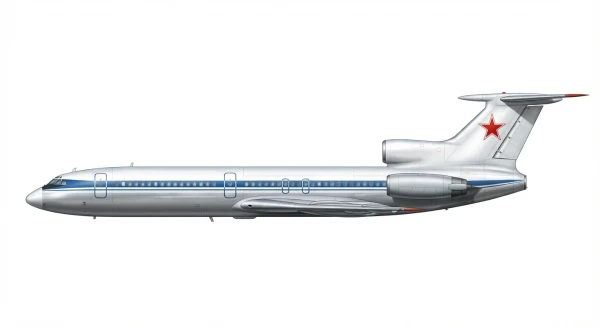
Soviet trijet airliner, prominent during the Cold War era, extensively deployed in civilian and military operations globally. Key figures: top speed 913 km/h, range 6,600 km, service ceiling 12,100 m, max takeoff weight 104,000 kg, unit price $45M, built 1,026. In service with 2 air forces as of 2026 — China (12), Russia (4).
| Crew | 3 |
| Length | 48 m (157.5 ft) |
| Wingspan | 37.6 m (123.2 ft) |
| Height | 11.4 m (37.4 ft) |
| Wing area | 202 m² (2174.3 sqft) |
| Empty weight | 55,300 kg (121,915 lbs) |
| Max. takeoff weight | 104,000 kg (229,280 lbs) |
| Powerplant | 3 × turbofans Soloviev D-30KU-154 10,503 kgf each |
| Maximum speed | 913 km/h (567 mph) |
| Operational range | 6,600 km (4,101 mi) |
| Service ceiling | 12,100 m (39,698 ft) |


Description
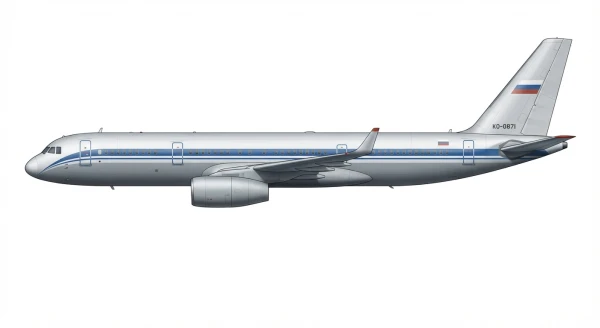
The Tupolev Tu-154 (NATO reporting name "Careless") is a three-engined, medium-range narrow-body airliner designed by the Tupolev design bureau in the Soviet Union. Deliveries to Aeroflot began in 1970, with mail services from May 1971 and passenger services from February 1972. It became the standard Soviet and Russian domestic-route airliner, carrying 137.5 million passengers a year (243.8 billion passenger-km) for Aeroflot and its subsidiaries in 1990, and was able to work from unpaved and gravel strips in the Arctic regions of northern and eastern Russia.
Development
The Tu-154 was specified to replace the Tu-104 jet and the An-10 and Il-18 turboprops. Aeroflot required either a 16–18 t payload over 2,850–4,000 km at 900 km/h, or a 5.8 t payload over 5,800–7,000 km at 850 km/h, with a 2,600 m take-off run at maximum weight. The Ministry of Aircraft Industry selected the Tupolev proposal over the competing long-range Ilyushin Il-62. Sergey Yeger was the first project chief, succeeded by Dmitryi S. Markov in 1964 and Aleksandr S. Shengardt in 1975. First flight was on 4 October 1968; 1,025 airframes were completed, with 214 still in service on 14 December 2009. The final aircraft went to the Russian Defence Ministry on 19 February 2013 from the Aviakor factory.
Design
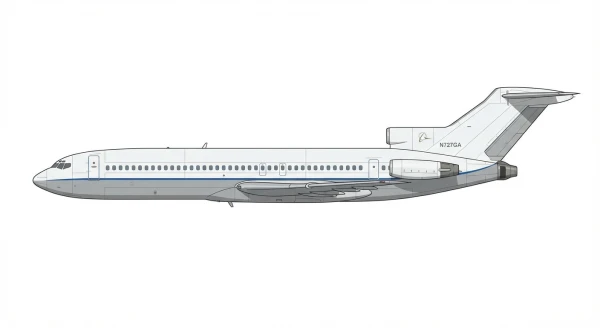
Three rear-mounted low-bypass turbofans are arranged as on the Boeing 727, the centre engine fed by an S-duct. Early aircraft used Kuznetsov NK-8-2 engines; the Tu-154M substituted Soloviev D-30KU-154s. The wing is swept 35° at quarter-chord and has anhedral, reducing lateral stability but improving Dutch roll resistance. Oversized landing gear comprises two six-wheel main bogies with low-pressure tyres retracting into trailing-edge pods, a two-wheel nose unit, and soft oleo struts for rough-field work. The six-abreast cabin seats 128 in two classes, 164 single-class and up to 180 high-density. Flight controls are hydraulic with dual yokes; the intended three-man crew was augmented by a navigator station. The Tu-154M-100 introduced an NVU-B3 Doppler system, triple autopilot with ICAO Category II ILS approach, autothrottle and the Kurs-MP radio navigation suite. Tu-154M D-30 engines accept hush kits for Stage III noise compliance; earlier variants cannot be modified.
Operational History
The type was exported to 17 non-Russian airlines and used as head-of-state transport by several air forces. Germany converted an ex-East German airframe to Tu-154M-ON standard for Open Skies flights in 1996; it was lost in a mid-air collision in 1997 after 24 missions. Aeroflot withdrew the type on 31 December 2009 with Flight 736 from Yekaterinburg to Moscow; Uzbekistan Airways followed in December 2010 and Iran grounded its fleet in February 2011. The Russian Defence Ministry grounded all Tu-154s on 27 December 2016 after the 25 December Sochi crash that killed 92, including 64 members of the Alexandrov Ensemble. ALROSA retired the last Russian passenger example in October 2020. Between 1970 and December 2016 there were 110 serious incidents, 73 hull losses and 2,911 fatalities. About 25 remained in government or military service in up to five countries as of August 2025.
Variants
- Tu-154: Initial NK-8-2-powered production model seating 164, about 42 built.
- Tu-154A: 1974 version with centre-section fuel tanks, extra emergency exits and NK-8-2U engines, 94,000 kg maximum take-off weight.
- Tu-154B: Strengthened wing introduced in 1975 after cracking on earlier airframes, with added fuselage tank and Category II autopilot; 111 built, plus 64 B-1 and around 311 B-2.
- Tu-154S: All-cargo conversion with strengthened floor and forward port cargo door for nine PAV-3 pallets, 20,000 kg payload; nine converted.
- Tu-154M: D-30KU-154-engined variant first flown in 1982 with double-slotted flaps and relocated APU, about 320 built.
Frequently Asked Questions
What type of aircraft is the Tu-154 Careless?
What is the maximum speed of the Tu-154 Careless?
What is the range of the Tu-154 Careless?
When did the Tu-154 Careless first fly?
How many Tu-154 Careless have been built?
Which countries operate the Tu-154 Careless?
How much does a Tu-154 Careless cost?
What is the service ceiling of the Tu-154 Careless?
- AUG 302026 Updated Description updated
- AUG 52026 Updated Crew, height and 3 more fields added; description, version and 6 more fields updated
- JUL 232026 Updated Sources and cross-references refreshed
- APR 82026 Updated Empty weight added
- APR 72026 Updated Picture credits updated in a site-wide editorial pass
- FEB 72026 Updated Wingspan added
- JAN 122026 Updated Range updated in a site-wide editorial pass