Tu-142
Soviet/Russian maritime reconnaissance and anti-submarine warfare aircraft, introduced in the late 20th century, operated by the Russian and Indian navies. Key figures: top speed 925 km/h, range 12,550 km, service ceiling 12,000 m, max takeoff weight 185,000 kg, built 100. In service with 1 air force as of 2026 — Russia (32).
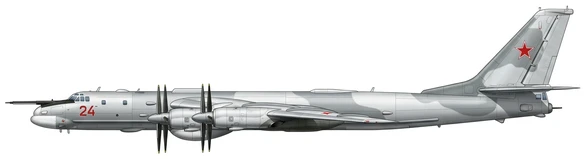
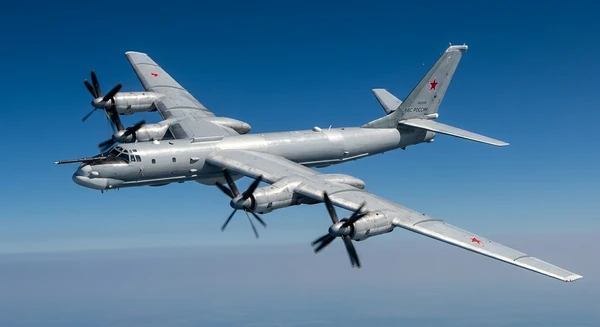
| Crew | 11–13 |
| Length | 53.1 m (174.1 ft) |
| Wingspan | 50 m (164.0 ft) |
| Height | 12.1 m (39.8 ft) |
| Wing area | 311.1 m² (3348.6 sqft) |
| Empty weight | 90,000 kg (198,416 lbs) |
| Max. takeoff weight | 185,000 kg (407,855 lbs) |
| Powerplant | 4 × Kuznetsov NK-12MP 11,033 kW each |
| Maximum speed | 925 km/h (575 mph) |
| Operational range | 12,550 km (7,798 mi) |
| Service ceiling | 12,000 m (39,370 ft) |

- Anti-Submarine 450 mm anti-submarine torpedoes
- Anti-Ship 533 mm anti-ship torpedoes
- Anti-Submarine depth charges
- Naval mines
- Sonobuoys
Description
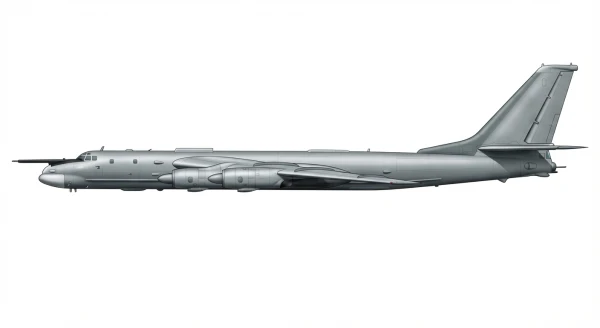
The Tupolev Tu-142 (NATO reporting name: Bear F/J) is a Soviet/Russian maritime reconnaissance and anti-submarine warfare (ASW) aircraft. Developed in response to the US Polaris submarine-launched ballistic missile programme, it was derived from the Tu-95 strategic bomber. Designed by Tupolev, the aircraft was manufactured by the Kuibyshev Aviation and Taganrog Machinery Plants from 1968 to 1994, with 100 units produced. The first prototype completed its maiden flight on 18 June 1968, and the aircraft achieved initial operational capability in December 1972.
Design
The Tu-142 features a stretched fuselage, metal fuel tanks, an expanded wing area of 295 square meters, and a tail turret with twin 23-mm AM-23 cannons as its defensive armament. It is powered by four Kuznetsov turboprop engines (NK-12MV or NK-12MP) driving eight-bladed contra-rotating propellers. Early aircraft utilized 12-wheel main undercarriage bogies, later replaced by four-wheel or two-axle bogies to reduce empty weight by 4,000 kg. Early avionics centered on the Berkut 360-degree radar search-and-targeting system. Subsequent versions integrated the Korshun target acquisition radar, the MMS-106 Ladoga magnetic anomaly detector (MAD), and Nashatyr-Nefrit ASW avionics with the Zarechye sonar system, compatible with RGB-16 and RGB-26 sonobuoys. The Tu-142MR communications variant uses a long trailing wire radio aerial to relay messages to submerged submarines.
Operational History
The Soviet Navy deployed the Tu-142 to the Northern and Pacific Fleets, primarily to track nuclear-powered submarines. Notable operations included tracking a US submarine in the Philippine Sea in October 1977 for over 4 hours. Soviet aircraft also operated from bases in Angola, Cuba, Ethiopia, Vietnam, and South Yemen. Following the dissolution of the Soviet Union, the remaining fleet was transferred to the Russian Navy; Ukrainian-held units were dismantled under the START I treaty. The Indian Navy operated eight export-designated Tu-142MK-E aircraft from 1988 until their retirement in March 2017, participating in search efforts during Operation Cactus in July 1988. In May 2026, a Ukrainian drone strike on Taganrog airfield reportedly destroyed two Russian Tu-142s.
Variants
-
Tu-142: The initial production variant featuring ASW systems and either 12-wheel or four-wheel main undercarriage bogies.
-
Tu-142M: A Taganrog-built version featuring a 30-centimeter front fuselage stretch, a redesigned cockpit, and two-axle main undercarriage bogies.
-
Tu-142MK: An upgraded variant equipped with the Korshun radar, updated avionics, and an MMS-106 Ladoga magnetic anomaly detector.
-
Tu-142M3: The final production "Bear F" variant, equipped with NK-12MP engines, Korshun-KN-N search-and-targeting system, and distinctive chin fairings.
-
Tu-142MR: A submarine communications relay variant featuring a long trailing wire radio aerial and simplified avionics.
Frequently Asked Questions
What type of aircraft is the Tu-142?
What is the maximum speed of the Tu-142?
What is the range of the Tu-142?
When did the Tu-142 first fly?
How many Tu-142 have been built?
Which countries operate the Tu-142?
What is the service ceiling of the Tu-142?
- AUG 102026 Updated Bombs added; range updated
- JUL 242026 Created Page created: Tu-142