UTVA-75
Yugoslav light utility and basic trainer aircraft, introduced in the late 1970s and used primarily for military pilot training and light utility roles. Key figures: top speed 215 km/h, range 800 km, service ceiling 4,000 m, max takeoff weight 960 kg, built 136.
| Crew | 2 |
| Length | 7.1 m (23.3 ft) |
| Wingspan | 9.7 m (31.9 ft) |
| Height | 3.2 m (10.3 ft) |
| Wing area | 14.6 m² (157.5 sqft) |
| Empty weight | 685 kg (1,510 lbs) |
| Max. takeoff weight | 960 kg (2,116 lbs) |
| Powerplant | 1 × Lycoming IO-360-B1F 134 kW each |
| Maximum speed | 215 km/h (134 mph) |
| Operational range | 800 km (497 mi) |
| Service ceiling | 4,000 m (13,123 ft) |
| Climb rate | 4.5 m/s (14.8 ft/s) |
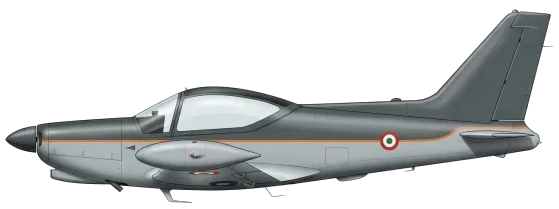
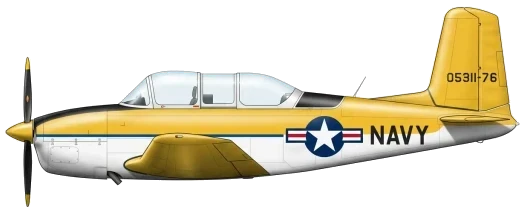
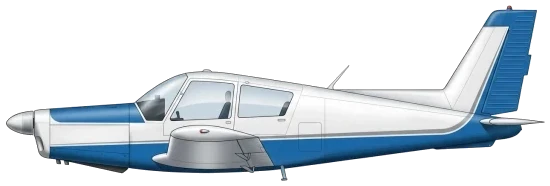
Description
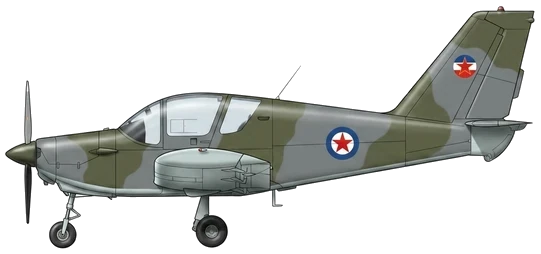
The UTVA-75 is a single-engine light utility and basic training aircraft produced by the Serbian (formerly Yugoslav) manufacturer Utva. Introduced in the late 1970s, it was used for primary flight training, reconnaissance, liaison and light transport, and served with the Yugoslav Air Force and the air arms of the successor states. It is recognisable by its upward-opening gull-wing cockpit doors and the row of air scoops in the central front frame of the cockpit.
Development
The aircraft was designed in the early 1970s to replace the UTVA Aero 3 as the Yugoslav Air Force's primary basic trainer. The first flight took place in 1976, and 136 aircraft were built for the Yugoslav Air Force between 1978 and 1985. A four-seat derivative with revised avionics, the UTVA-75A41, first flew in 1986. Later modifications included reinforced landing gear for rough-field operations, additional fuel tanks and mission equipment such as cameras and crop-dusting apparatus.
Design
The UTVA-75 is a low-wing monoplane with an all-metal, semi-monocoque airframe built primarily from aluminium alloys, and fixed tricycle landing gear suitable for paved runways and unprepared strips. The two occupants sit side by side with dual controls. Wing area is 14.63 m² with a span of 9.73 m and length of 7.11 m; empty weight is 685 kg and maximum takeoff weight 960 kg. Power comes from a single Lycoming IO-360-B1F four-cylinder air-cooled horizontally opposed piston engine of 134 kW (180 hp) driving a two-blade Hartzell HC-C2YK-1BF/F7666A variable-pitch metal propeller. Maximum speed is 215 km/h, cruise 165 km/h, never-exceed speed 270 km/h, service ceiling 4,000 m and rate of climb 4.5 m/s. Standard fuel capacity is 160 litres, or 360 litres with drop tanks, giving a range of 800 km and a ferry range of 2,000 km. G limits are +4.4/-2.2. Baseline avionics comprise a King KR85 ADF and King KY 195B; optional fits include King KR87 ADF, KNS81 RNAV, KN 53 VOR/LOC, KI 525A HSI, KI 229 RMI, KN 62A DME and KT 79 transponder.
Armament
Two underwing hardpoints are provided, each rated at 150 kg. Options include two RL 128-02 128 mm rocket launchers (HVAR-5) or two 57 mm launchers with 12 rockets, two 120 kg bombs or four 50 kg bombs, two MAC-AA-52 7.62 mm gun pods, two 100 kg cargo containers, or two drop tanks.
Operational History
Following the breakup of Yugoslavia, surviving aircraft passed to Serbia, Slovenia, Croatia, Montenegro, North Macedonia and Republika Srpska, whose examples were transferred to Bosnia and Herzegovina in 2006. Slovenia handed its fleet over to aeroclubs, and Letalski center Maribor operated the type civilly from 1989 to 2022. Export operators include the Sudanese Air Force and the Somaliland Armed Forces, which acquired four for civil and military use.
Variants
- UTVA-75A11: Single-seat agricultural aircraft using largely the same airframe.
- UTVA-75A21: Two-seater with dual controls and provisions for blind instrument flying.
- UTVA-75A41: Four-seat version with expanded avionics, first flown in 1986.
- SAFAT 03: Sudanese development by the SAFAT Aviation Complex at Khartoum with modified fuselage and tail fin, one example displayed at the 2011 Dubai Air Show.
Frequently Asked Questions
What type of aircraft is the UTVA-75?
What is the maximum speed of the UTVA-75?
What is the range of the UTVA-75?
When did the UTVA-75 first fly?
How many UTVA-75 have been built?
Which countries operate the UTVA-75?
What is the service ceiling of the UTVA-75?
- AUG 302026 Updated Description updated
- JUL 12026 Created Page created: UTVA-75