Valiant
British high-altitude jet bomber, designed to carry nuclear weapons and operated during the 1950s and 1960s as part of the strategic deterrent force. Key figures: top speed 912 km/h, range 7,200 km, service ceiling 16,000 m, max takeoff weight 63,503 kg, built 108.
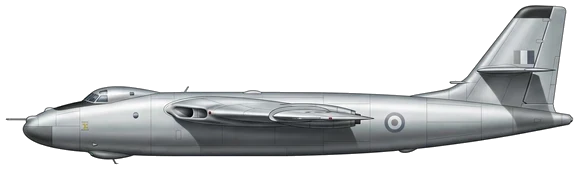
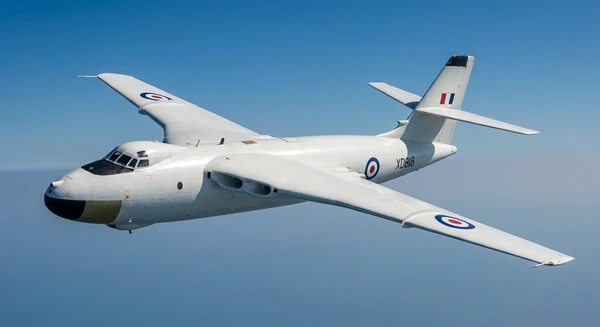
| Crew | 5 (2 pilots, 2 navigators, air electronics officer) |
| Length | 33.0 m (108.2 ft) |
| Wingspan | 34.9 m (114.3 ft) |
| Height | 9.8 m (32.2 ft) |
| Wing area | 219.4 m² (2361.6 sqft) |
| Empty weight | 34,419 kg (75,881 lbs) |
| Max. takeoff weight | 63,503 kg (140,000 lbs) |
| Powerplant | 4 × Rolls-Royce Avon RA28 Mk 204 44 kN each |
| Maximum speed | 912 km/h (567 mph) |
| Operational range | 7,200 km (4,474 mi) |
| Service ceiling | 16,000 m (52,493 ft) |
| Climb rate | 20.0 m/s (65.6 ft/s) |
- Cruise Blue Steel
- Nuclear Blue Danube
- Nuclear Yellow Sun
- Nuclear Short Granite
- Unguided Bomb 1,000 lb bomb
Description
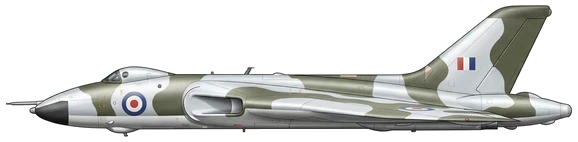
The Vickers Valiant was a British four-engine jet bomber developed by Vickers-Armstrongs to meet Air Ministry Specification B.35/46. It was the first of the "V bombers" to enter operational service as part of the Royal Air Force strategic deterrent force. Designed by a team led by George Edwards, the aircraft used a less aerodynamically complex configuration than the competing Avro Vulcan and Handley Page Victor to ensure rapid delivery. The first prototype flew on 18 May 1951, and the first production aircraft was delivered to the RAF on 8 February 1955. Vickers produced a total of 108 aircraft, including prototypes, with production ending in August 1957.
Design
The aircraft featured a shoulder-mounted wing using a compound sweep of 37 degrees on the inboard section and 21 degrees on the outer section. Power was provided by four Rolls-Royce Avon turbojet engines buried in pairs within the wing roots. The crew of five—consisting of two pilots, two navigators, and an air electronics officer—occupied a pressurized compartment in the forward fuselage. Only the pilot and co-pilot were provided with Martin-Baker Mk.3 ejector seats. Most aircraft systems, including the flaps and landing gear, were electrically driven, while the primary flight controls used electro-hydraulic power units with manual backup. Avionics included H2S radar, Green Satin doppler radar, and Orange Putter tail warning radar.
Armament
The internal bomb bay was designed to carry a single 10,000 lb nuclear weapon, such as the Blue Danube or Yellow Sun, or up to 21 1,000 lb conventional bombs. Specialized variants could carry a camera crate in the bomb bay for photographic reconnaissance or a Hose Drum Unit (HDU) for aerial refueling. For tanker operations, the aircraft typically used 1,650-gallon underwing fuel tanks and a nose-mounted refueling probe.
Operational History
The Valiant entered service with 138 Squadron and eventually equipped 10 RAF squadrons. During the 1956 Suez Crisis, Valiants operating from Malta conducted conventional bombing missions against Egyptian airfields and communications hubs. The type was the only V bomber to drop live nuclear weapons during testing, performing the first British atomic bomb drop in 1956 and the first hydrogen bomb drop in 1957. In 1962, the fleet transitioned from high-altitude to low-level flight profiles to evade Soviet surface-to-air missiles. This change in operation led to the discovery of fatigue and crystalline corrosion in the wing rear spar attachment forgings in 1964. Due to the cost of repairs, the Ministry of Defence retired the fleet in early 1965.
Variants
- Valiant B.1: The primary bomber variant, powered by Avon RA.14 or RA.28 engines.
- Type 710 Valiant B(PR).1: A specialized reconnaissance version equipped with a removable camera crate in the bomb bay.
- Type 733 Valiant B(PR)K.1: A multi-role variant capable of bombing, photographic reconnaissance, and aerial refueling missions.
- Type 758 Valiant B(K).1: A bomber and tanker variant fitted with a removable hose-and-drogue system.
- Valiant B.2: A low-level pathfinder prototype with a strengthened airframe, lengthened fuselage, and rear-retracting main landing gear.
Frequently Asked Questions
What type of aircraft is the Valiant?
What is the maximum speed of the Valiant?
What is the range of the Valiant?
When did the Valiant first fly?
How many Valiant have been built?
Which countries operate the Valiant?
What is the service ceiling of the Valiant?
- MAY 102026 Created Page created: Valiant