ATR-72 vs CN-235
ATR-72 vs CN-235 at a glance — top speed 565 vs 450 km/h, range 1,404 vs 4,355 km, max takeoff weight 22,500 vs 16,500 kg, built 1,000 vs 354 units.
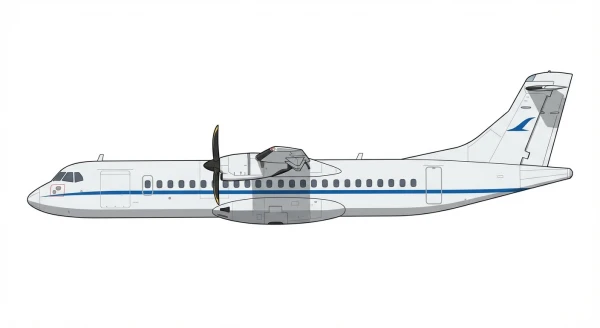
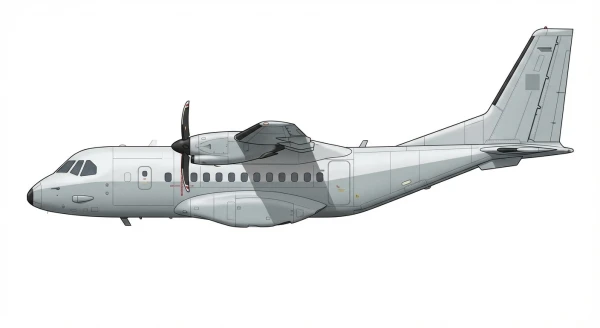
| ATR-72 | CN-235 | |
|---|---|---|
| Origin country | 🇫🇷 France🇮🇹 Italy | 🇪🇸 Spain🇮🇩 Indonesia |
| Category | Military Transport Aircraft | Military Transport Aircraft |
| Manufacturer | ATR | CASA |
| First flight | 27 October 1988 | 11 November 1983 |
| Year introduced | 1989 | 1988 |
| Number produced | 1000 units | 354 units |
| Average unit price | $26 million | $25 million |
| Wing area | 61.0 m² | 59.1 m² |
| Wingspan | 27.1 m | 25.8 m |
| Height | 7.7 m | 8.2 m |
| Length | 27.2 m | 21.4 m |
| Maximum speed | 565 km/h | 450 km/h |
| Operational range | 1,404 km | 4,355 km |
| Service ceiling | 7,620 m | 9,144 m |
| Max. takeoff weight | 22,500 kg | 16,500 kg |
| Empty weight | 12,950 kg | 8,800 kg |
| Total thrust | 2 x 2,051 kW | 2 x 1,305 kW |
Detailed Comparison
The ATR-72 and CN-235 represent two distinct approaches to the medium-lift turboprop market, with the former being a militarized regional airliner and the latter a purpose-built tactical transport. The ATR-72, a product of a Franco-Italian joint venture, offers a larger airframe with higher speed, while the CN-235, a Spanish-Indonesian collaboration, provides superior tactical flexibility through its design features.
Development and Design
The ATR-72's design originates from the civilian sector as a stretched variant of the ATR-42 airliner. Its development prioritized passenger capacity and fuel efficiency, resulting in a design that features a conventional side cargo door and lacks an integrated rear ramp, limiting its ability to handle oversized cargo or conduct vehicle airdrops. The airframe makes extensive use of carbon fiber in the wing construction to reduce weight. A notable feature is the "Hotel Mode," which allows the right-side engine's turbine to run for on-ground power without spinning the propeller, compensating for the lack of a standard APU.
In contrast, the CN-235 was designed from the outset as a military transport. Its most critical design feature is the rear-fuselage loading ramp, which allows for easy loading of palletized cargo, small vehicles, and the deployment of paratroopers. Its relatively wide fuselage for its class and emphasis on short-field capabilities underscore its tactical focus. The international workshare between Spain's CASA and Indonesia's IPTN was a key aspect of its production, intended to keep the aircraft competitively priced.
Specifications and Performances
While both aircraft are twin-turboprops, their performance metrics reflect their different design philosophies. The ATR-72 is significantly larger, with a Max Takeoff Weight of 22,500 kg compared to the CN-235’s 16,500 kg, and it is faster by over 100 km/h. However, the CN-235 offers a substantially greater range of 5,060 km, a critical advantage for long-endurance maritime patrol or strategic transit. It also boasts a higher service ceiling (9,144 m vs. 7,620 m), which is beneficial for surveillance missions and avoiding certain weather or threat envelopes. Despite the ATR-72's more powerful engines (2,051 kW each vs. the CN-235's 1,305 kW), their takeoff distances are nearly identical, highlighting the CN-235's effective STOL design.
Deployment and usage
The operational roles of each aircraft diverge significantly. The ATR-72's military application is almost exclusively as a sophisticated special-mission platform. Nations like Italy (P-72A) and Turkey (TMPA) employ heavily modified variants for maritime patrol (MPA), anti-submarine warfare (ASW), and C4ISR missions. These versions are equipped with advanced systems like Leonardo's ATOS mission system, AESA radars, and can be armed with lightweight torpedoes.
The CN-235 serves as a more traditional military workhorse. Its rear ramp makes it a capable tactical airlifter for cargo and troop transport, a role the standard ATR-72 cannot fulfill. It is also a proven MPA platform, operated by Turkey and South Korea, with six hardpoints enabling it to carry anti-ship missiles like the Exocet and Mk.46 torpedoes. Furthermore, its adaptability is demonstrated by the AC-235 light gunship variant developed for Jordan, armed with Hellfire missiles and a 30mm cannon.
Conclusion
The choice between these aircraft is dictated entirely by mission priorities. The ATR-72 provides an efficient, modern, and fast airframe that serves as an excellent foundation for high-endurance, sensor-heavy special missions like MPA and electronic intelligence, where cargo versatility is secondary. The CN-235 is the more versatile tactical asset. Its purpose-built military design, centered on a rear cargo ramp, superior range, and demonstrated weapons integration, makes it suitable for a far broader spectrum of roles, from frontline logistics and humanitarian aid to armed maritime patrol and close air support.