Yak-18 Max
Soviet tandem two-seat primary trainer aircraft, introduced in the late 1940s, widely used by communist bloc nations for pilot training and light night bombing roles. Key figures: top speed 300 km/h, range 700 km, service ceiling 5,060 m, max takeoff weight 1,320 kg.
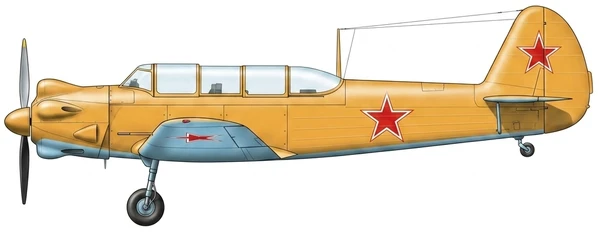
| Crew | 2 |
| Length | 8.4 m (27.4 ft) |
| Wingspan | 10.6 m (34.8 ft) |
| Height | 3.4 m (11.0 ft) |
| Wing area | 17.8 m² (191.6 sqft) |
| Empty weight | 1,025 kg (2,260 lbs) |
| Max. takeoff weight | 1,320 kg (2,910 lbs) |
| Powerplant | 1 × radial piston engine Ivchenko AI-14RF 224 kW each |
| Maximum speed | 300 km/h (186 mph) |
| Operational range | 700 km (435 mi) |
| Service ceiling | 5,060 m (16,601 ft) |
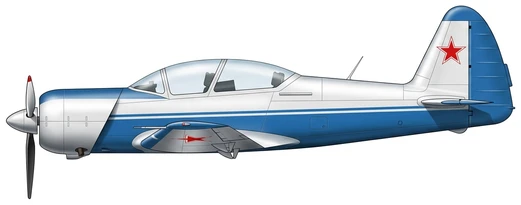
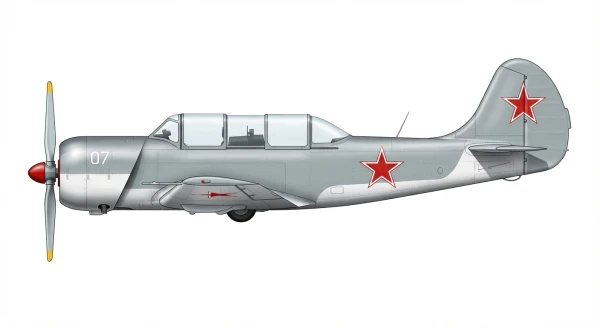
Description
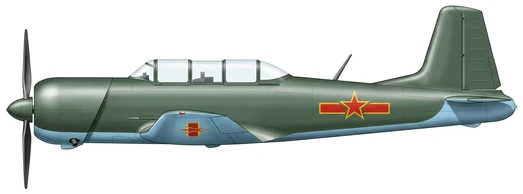
The Yakovlev Yak-18 (NATO reporting name Max) is a Soviet tandem two-seat military primary trainer aircraft. Powered initially by a 119 kW (160 hp) Shvetsov M-11FR-1 radial engine, the aircraft entered service in 1946 and became the standard primary trainer for the Soviet Air Force and DOSAAF aero clubs. The type was exported widely, produced under license in China as the Nanchang CJ-5, set an international class speed record in 1951, and served as a night harassment bomber during the Korean War.
Development
Alexander Sergeyevich Yakovlev initiated the design of the Yak-18 in May 1945 to replace the UT-2 and Yak-5 trainers. Following testing of an advanced UT-2 derivative in 1944, the new aircraft made its first flight in 1946 and entered service later that year, remaining in production with Yakovlev until 1956. Kit exports to China began in 1950, leading to licensed production of the Nanchang CJ-5 in 1954, which produced 379 aircraft through 1958. Yakovlev later redesigned the aircraft as the Yak-18A, adding tricycle landing gear and an Ivchenko AI-14RF radial engine.
Design
The aircraft is a tandem two-seat design with pneumatically operated retractable main landing gear and a fixed tailwheel in its initial configuration. Baseline power was supplied by a 119 kW (160 hp) Shvetsov M-11 five-cylinder radial engine, whereas the Yak-18A variant incorporated a 224 kW (300 hp) Ivchenko AI-14RF nine-cylinder radial engine driving a two-bladed variable-pitch propeller. Specifications for the Yak-18A include a length of 8.35 m, a wingspan of 10.6 m, an empty weight of 1,025 kg, and a maximum takeoff weight of 1,320 kg. The Yak-18A achieves a maximum speed of 300 km/h, a range of 700 km, and a service ceiling of 5,060 m.
Armament
For combat missions during the Korean War, North Korean Yak-18s were modified with bomb racks mounted on the wing center section. These fittings enabled the trainer aircraft to carry and drop bombs during night harassment sorties against United Nations positions.
Operational History
The Yak-18 served as the standard trainer for Soviet military flight schools, while also providing initial flight instruction to cosmonaut Yuri Gagarin and defector Ken Rowe (No Kum-Sok). The North Korean Air Force used modified Yak-18s as night bombers during the Korean War, where UN troops nicknamed them "Washing Machine Charlie" and "Bed Check Charlie." In June 1953, four or five North Korean Yak-18s destroyed an Inchon fuel dump containing nearly 5.5 million US gallons of fuel. The type was operated by over 20 nations, with evidence indicating North Korea maintained CJ-5 or Yak-18 airframes in a bombing role as late as 2014.
Variants
- Yak-18: Original production primary trainer with retractable main gear and a fixed tailwheel.
- Yak-18U: Low-volume production variant featuring retractable tricycle landing gear.
- Yak-18A: Mass-production variant powered by a 224 kW (300 hp) Ivchenko AI-14RF engine and fitted with retractable tricycle landing gear.
- Yak-18P: Single-seat aerobatic variant developed for Soviet flying clubs.
- Nanchang CJ-5: Chinese license-built version of the Yak-18, with 379 units produced between 1954 and 1958.
Frequently Asked Questions
What type of aircraft is the Yak-18 Max?
What is the maximum speed of the Yak-18 Max?
What is the range of the Yak-18 Max?
When did the Yak-18 Max first fly?
What is the service ceiling of the Yak-18 Max?
- AUG 62026 Created Page created: Yak-18 Max