Bayraktar Akıncı vs TAI Aksungur
Bayraktar Akıncı vs TAI Aksungur at a glance — top speed 361 vs 250 km/h, range 7,500 vs 6,500 km, max takeoff weight 5,500 vs 3,300 kg, built 110 vs 12 units.
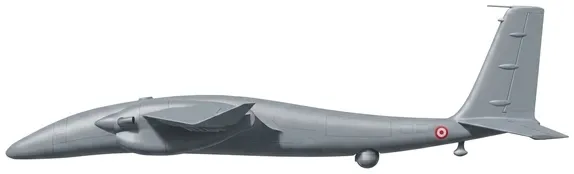
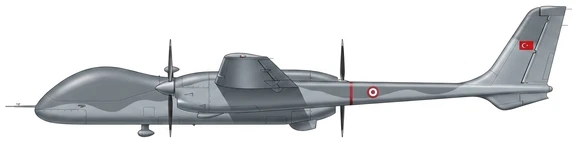
| Bayraktar Akıncı | TAI Aksungur | |
|---|---|---|
| Origin country | 🇹🇷 Turkey | 🇹🇷 Turkey |
| Category | Military Drones | Military Drones |
| Manufacturer | Baykar | TAI |
| First flight | 6 December 2019 | 20 March 2019 |
| Year introduced | 2021 | 2021 |
| Number produced | 110 units | 12 units |
| Average unit price | $30 million | $17.5 million |
| Wingspan | 20.0 m | 24.2 m |
| Height | 4.1 m | 3.1 m |
| Length | 12.2 m | 12.5 m |
| Maximum speed | 361 km/h | 250 km/h |
| Operational range | 7,500 km | 6,500 km |
| Service ceiling | 13,716 m | 12,192 m |
| Max. takeoff weight | 5,500 kg | 3,300 kg |
| Empty weight | 4,501 kg | 1,800 kg |
| Total thrust | 2 x 340 kW | 2 x 160 kW |
Detailed Comparison
The Bayraktar Akıncı and TAI Aksungur are twin-engine Turkish UAVs that entered service in 2021, yet they fulfill divergent tactical requirements within a layered air defense doctrine. While the Akıncı functions as a strategic HALE (High-Altitude Long-Endurance) combat platform capable of launching cruise missiles, the Aksungur utilizes a high-efficiency airframe designed for extreme endurance and maritime surveillance. Both platforms illustrate Turkey's rapid expansion in indigenous unmanned aviation, leveraging shared munitions but distinct operational envelopes.
Development and Design
The Akıncı features a robust, gull-wing design powered by turboprop engines (Ivchenko-Progress or Pratt & Whitney), emphasizing power output to support heavy payloads and high-altitude operations. Its avionics suite, including an AESA radar, signals a design intent focused on sophisticated air-to-air and strategic strike capabilities. Conversely, the Aksungur, developed in just 18 months, evolves from the TAI Anka lineage. It employs a twin-boom configuration and utilizes TEI-PD170 dual-turbocharged diesel engines. This design prioritizes fuel efficiency and aerodynamic stability, tailoring the platform for prolonged intelligence, surveillance, and reconnaissance (ISR) rather than high-speed engagement.
Specifications and Performances
Performance metrics highlight the trade-off between kinetic power and persistence. The Akıncı offers a substantially higher Maximum Takeoff Weight (MTOW) of 5,500 kg and a combat load of 1,350 kg, nearly double the Aksungur's 750 kg capacity. This allows the Akıncı to carry heavy ordnance like SOM cruise missiles and NEB-84 bunker busters, which are beyond the Aksungur's weight limits. However, the Aksungur dominates in station-keeping, boasting an endurance of 60 hours compared to the Akıncı's 25 hours. While the Akıncı achieves higher speeds (361 km/h) and altitudes (45,000 ft), the Aksungur's efficient cruising profile (250 km/h) is optimized for long-duration signals intelligence and maritime patrol.
Deployment and usage
Operationally, the Akıncı serves as a frontline combatant, extensively used in Pençe-Kilit Operations in Northern Iraq for precision strikes and electronic warfare tasks. Its utility extends to complex non-combat roles, such as the high-altitude search mission that located the Iranian president’s crash site in 2024. The Aksungur has carved a niche in the maritime domain, utilizing its hardpoints to deploy sonobuoys for anti-submarine warfare in the Aegean Sea. Both platforms face risks in contested airspace; the Akıncı has suffered losses in multiple theaters, while the Aksungur was recently intercepted by air defense systems in Iraq, underscoring the vulnerability of large, slow-moving drones against conventional air defenses.
Conclusion
These platforms act as complementary assets rather than direct competitors. The Bayraktar Akıncı provides a strategic strike capability previously reserved for manned aviation, delivering heavy munitions at standoff ranges. The TAI Aksungur offers a cost-effective solution for persistent surveillance, particularly in naval environments where loiter time is critical. Together, they provide a comprehensive unmanned capability, balancing heavy firepower with extreme endurance.